A 36V pack with 720Wh in a brick smaller than a shoebox sounds like an easy yes for a budget build. The listing for this one promises it works with motors from 100W to 2000W, carries a 30A BMS, and ships as a kit complete enough to connect and go.
Then you read the second bullet and the promise shrinks. The same page says the BMS consistently delivers up to 800W, which is less than half the title's top number. Amazon files the pack under toys and hobby RC batteries, and the single written report comes from a child's four-wheeler owner.
Three power numbers, one owner report with no purchase confirmation, and a page of arithmetic decide where this brick actually belongs.
The Generic 36V 20Ah pack is a plain 720Wh lithium brick with a 30A BMS and no frame-mount hardware, and the number to plan around is not the 2000W in the title. The listing's own bullet caps the BMS output at up to 800W. On price per watt-hour it sits close to the middle of the 301 packs we track, so you're not finding a hidden bargain here and you're not being robbed either. What you are getting is a small, light, unbranded pack whose honest ceiling is on the page if you read past the headline.

Three power numbers on one listing
The title says this pack suits motors from 100W to 2000W. One bullet lower, the same listing says the integrated 30A BMS consistently delivers up to 800W of output. Those two claims cannot both describe the same ceiling, and the arithmetic backs the smaller one: 30 amps at 36 volts works out near 1080W on a fresh pack, before you account for voltage sag under load.
A BMS limits how much current the pack gives continuously, and a motor that demands more than that limit on a long hill gets cut off mid-ride. That isn't a fault, it's the cutoff doing its job. The practical reading is simple. Common 250W to 750W hub motors sit under the seller's own 800W figure with headroom for climbing. A 1000W motor already runs past it. A 2000W motor is marketing.
The six-point protection list covers overcharge, short circuit, over-discharge, over-voltage, high temperature, and over-current. That's the standard set for a pack at this level, nothing more. There's no Bluetooth, no app, and no smart cutoffs you can configure.
A hobby pack filed under toys
Amazon ranks this listing at number 365,423 in Toys & Games and number 2,153 in Hobby Remote & App Controlled Vehicle Batteries. The stated recommended use on the details table is a power tool. Adult ebike packs normally live in the sporting goods hierarchy, so the placement tells you where the seller expects this to sell, and it is not commuter bikes.
The one buyer who wrote anything confirms the read. They connected the pack to a child's electric four-wheeler, which is exactly the market the category placement suggests.
Physically this is a brick measuring 7.87 x 5.03 x 2.71 inches and weighing 6.7 lb. It doesn't slide into a Hailong or Shark-style frame mount, because those need their dedicated cases. Mounting means a frame bag, a rack, or a strap-down of your own making. For a ride-on toy or a DIY project that is normal. For a commuter bike it's a real drawback worth facing before you buy.

One owner report with no purchase confirmation
The whole evidence base is a single four-star text from June 2026. The buyer wired the pack into their child's four-wheeler, reported that it ran all afternoon without draining, and called the connection simple and the charging fast. They also noted the delivery took longer than expected. One person has found that review helpful.
It carries no purchase confirmation, and the page shows a 4.0 rating from a single rating, so the histogram is just that one four-star vote.
What the report doesn't cover matters more than what it does. There is no range figure in miles, no ebike fitment story, no capacity measurement, and no long-term durability signal. One warm afternoon in a toy vehicle isn't a track record. With budget packs you often buy on specifications alone, and here the specifications are the only thing on the page worth reading closely anyway.
Range and charge-time arithmetic
The category norm runs from 25 to 75 miles per charge depending on the power level you use, and a 720Wh pack sits in the lower half of that band. Work it through at the usual rates. On moderate pedal assist at 15 to 25 watt-hours per mile, 720Wh gives you roughly 29 to 48 miles. On throttle alone at 30 to 40 watt-hours per mile, it gives you roughly 18 to 24 miles. Hills, cold weather, and a heavy rider all push you toward the bottom of each range.
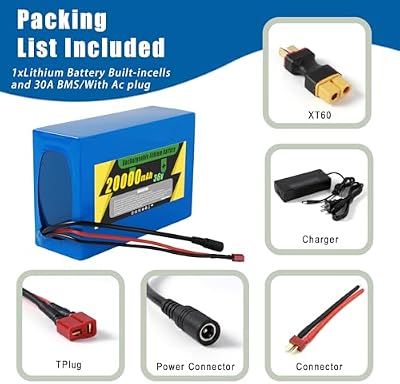
Charging is the other half of the arithmetic, and the listing leaves it open. The kit includes a charger, but the page never states its output. The details table lists Amperage 5 with no unit and no statement of what it refers to. On the class-norm 2A charger, a 36V pack draws about 72W, so 720Wh is ten hours from empty, and real charging runs longer once you count losses. If the included charger really is a 5A unit, a full charge takes around four to five hours. Ask the seller before you plan a daily commute around it.
Buy it for a small 36V build, not for the title's number
The right buyer for this pack runs a kids' ride-on, a small conversion under 800W, or a DIY project where a bag-mounted brick is fine. For those uses, 720Wh is a lot of runtime and the kit arrives with the connectors already fitted.
The wrong buyer wants three things this listing doesn't offer. A 1000W or larger motor exceeds the BMS output the seller's own bullet states. A frame-mounted pack is out, because the brick shape has no mount. And a warranty backstop is thin: the details table states a three-month manufacturer warranty, which is a quarter of the one-year norm several brands in our table carry.
Battery University's reference on lithium-ion aging notes that manufacturers specify consumer packs at 300 to 500 full discharge cycles. Nothing on this page names a cell brand, a chemistry, or a cycle count, and Grade A cells is a seller word rather than a spec you can check. Treat the three-month window as your test period. Charge the pack full, check the voltage, ride close to home, and meter a full discharge if you can, all inside the window where a return or a claim is still easy.
Frequently Asked Questions
Does it fit standard ebike frame mounts?
No. It is a plain brick 7.87 x 5.03 x 2.71 inches with no case that matches Hailong or Shark-style mounts. You mount it in a frame bag, on a rack, or with straps, and the XT60 and T connectors make the electrical side simple.
Can it run a 48V controller?
No. This is a 36V pack for a 36V system. A 48V controller expects a higher voltage than the pack can give, and the BMS cutoff points will not match what the controller is designed around.
What charger comes with it?
The kit includes a matching charger, but the listing never states its output. On the class-norm 2A charger the pack needs about ten hours from empty. Ask the seller for the charger's amp rating before you buy if charge speed matters to you.
Is the Grade A cells claim checkable?
No. The page names no cell brand, no chemistry, and no cycle count. Consumer lithium-ion packs across the industry are specified at 300 to 500 full cycles, and any claim far above that band deserves the same skepticism here as anywhere else.
What does the three-month warranty mean in practice?
It means your test window is short. Unbox, charge full, measure the voltage, and take a few rides near home in the first weeks. A pack that is going to arrive weak usually shows it early, and the meter reading you take inside three months is the evidence that supports a claim.
For a small 36V build the Generic 36V 20Ah pack does the job its honest 800W ceiling allows. Compare it against every other pack in our 36V battery table before you decide, and check our blog for more battery guides.