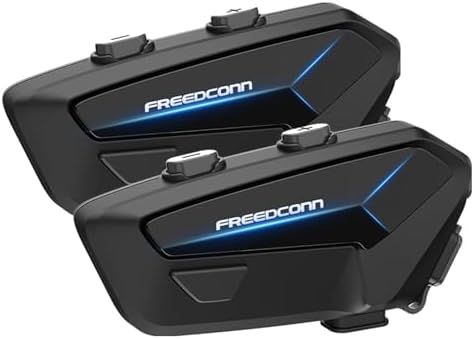
Mesh intercom used to be the thing that differentiated expensive headsets from everything else. FreedConn’s FX Plus offers mesh (auto-join) for up to 16 riders in a two-pack priced significantly lower than competitors’ prices for the same feature. This headset uses a Qualcomm chipset, is rated as IP67 sealed, and was designed with someone who wears winter gloves in mind. You sacrifice the ecosystem surrounding it.
Mesh Is the Whole Point
That tradeoff is worth naming before the next section.
Chipset, Audio, and the 75mph Claim
Here is where the spec sheet stops helping and judgment starts.
Controls, Battery, and Everyday Use
This is the part most listings skip past, and it decides the buying call.
What You Give Up Against the Premium Brands
That tradeoff is worth naming before the next section.
Frequently Asked Questions
Here is where the spec sheet stops helping and judgment starts.
Can this connect to other brands of intercom?
This is the part most listings skip past, and it decides the buying call.
Does it really work at 75mph?
That context matters because the next part of the review is where the money question gets answered.
How long does the battery actually last?
Bluetooth connects riders end-to-end in a straight line. When rider three loses signal, riders four through six lose the entire conversation. Riders pull over at the next gas station. Some person fiddles with a button. And the group reconnects while the ride timer continues. Anyone who has ridden with a Bluetooth-only group understands exactly how that afternoon is spent.
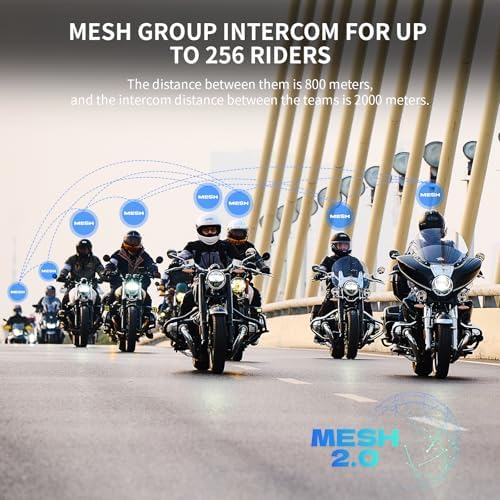
Mesh does not function like this. Each headset functions as a relay for the others, so when a rider loses signal or a truck gets between two bikes the network self-heals. The FX Plus states that it automatically connects up to 16 riders without requiring any manual pairing, and that’s the part that matters far more than the total number of riders. 16 riders is a marketing figure. Having to re-pair after a gas stop is a real one.
The listed range for intercom communication is 1200 meters, which in mesh systems refers to line-of-sight communications between two consecutive riders, not from the front of the group to the rear. Wind, trees, buildings and hills drastically reduce this distance. Plan on approximately 400 to 600 feet between each bike in actual terrain and you won’t be disappointed. We compare these distances in our chart.
Will it survive rain?
FreedConn developed this using a Qualcomm CSR chipset running Bluetooth 5.1 and they claim the connection will remain intact at speeds of 75 mph. The issue here is not just radio quality but also wind and vibration caused by air flow around a helmet at high speeds causing microphones to become swamped and produce a hissing sound. To combat this, FreedConn uses CVC (Convolvutive Volume Control) noise canceling plus what they call AI noise canceling.
I don’t know the difference between CVC and AI noise canceling, and neither is a formal definition of standards, so think of AI noise canceling simply as additional processing. What CVC does consistently is remove low frequency background wind noise, which is typically the biggest contributor to interference above 50 mph.
Music streaming happens via helmet-mounted speakers. They list sharing playlist functionality between two headsets while keeping the remaining members of the group communicating via intercom as “nice” functionality for couples who ride together or as a pair who ride within a larger group. These speakers aren’t capable of producing deep bass response, nothing can.
Is 16 riders realistic?
The buttons are large and tactile, and that singular design decision may improve your ability to use the product daily more than any spec on the sheet. If you can’t operate your helmet communication system with gloves on, then you’ll probably pull over somewhere to fiddle with a button and get reconnected again before continuing your ride.
Multi-function button control allows users to make calls, manage music playback, and initiate voice commands via Siri or S Voice, thus eliminating the need to take one of your hands off the handlebars to navigate.
Battery life is estimated to be 20 hours of talking time and 30 hours of listening time. While these numbers seem strong, mesh networking typically requires higher power levels than simple Bluetooth connections, so we suspect the actual battery life will be somewhat less than these estimates. For example, assuming you’re in an area with very little cell coverage and your phone is actively searching for connectivity, you could easily consume all your battery life during a full weekend of short day rides with no opportunity to recharge. However, as long as there’s some opportunity to plug in and recharge overnight, you should have enough juice to make it through even longer tours.
Dual-device switching provides the capability to connect two different devices (e.g., one phone that has maps installed and another phone that receives work calls). As long as there are always valid GPS locations being sent to your maps app, and you receive important work-related phone calls, this feature becomes incredibly useful. Finally, as mentioned earlier, the unit is fully sealed against water intrusion (rated IP67), which is perfect for helmets mounted on either side of a face shield.
Does the two-pack include everything for two helmets?
Support for O/S Updates/Firmware Updates: Large manufacturers provide software updates for their products for years, and maintain smartphone applications that actually get updated too. That level of maintenance support is included in the cost of purchasing a premium product. FreedConn did not specify how they plan on delivering future firmware updates for this product. Therefore, if a problem arises with the mesh protocol eighteen months from now, you shouldn’t expect a solution to magically appear.
Interbrand Cross-Mesh Support: FreedConn mesh connects only other FreedConn mesh headsets. If half your riding friends already own headsets from a competitor, this unit will connect to those headsets over regular old Bluetooth at best, thereby losing the main benefit of owning this product.
You can the FreedConn listing on Amazon if this matches your build.
If your riding group plans on buying communication gear together, but none of you currently own existing mesh-based systems, this product will allow you to purchase a valuable feature for group riding at a price point where everyone in the group can afford to join in. However, if you are going to add a new headset to an existing riding group, you’ll need to choose an option that matches what they currently use.
You can check the FreedConn price on Amazon if this matches your build.
You can look at current pricing on Amazon for this product. Additionally, our hands-on review compares other competing products.
The long-term question is the honest limit here: nobody has years of ownership data on a product this new, so treat the cycle-life claims as the maker's math rather than proven fact. Buy from the return window, test hard in the first week, and let time do the rest of the verification.
Browse more hands-on reviews.
Pull up the intercom comparison table to see where this lands.