The Fodsports FX4 Pro is the cheapest credible four-way group talk with decent speakers and voice assistant access, and our intercom table agrees on the value. The architecture is a Bluetooth chain rather than mesh, so latency grows with each hop and the top of the claimed range is aspirational. The recurring voice-cut complaint is mic positioning rather than defect, and twenty careful minutes at install decide it. Budget groups who ride close should buy it.
Four riders on a chain: what works and where the seams show
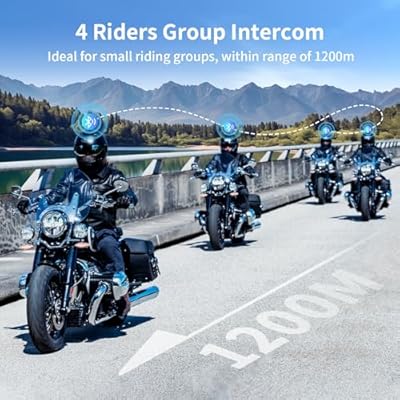
Bluetooth conference intercoms daisy-chain or bridge riders, and every hop adds processing delay. Category testing puts the practical full-duplex limit at three to four riders before latency becomes noticeable and audio quality degrades, and the FX4 Pro sits exactly at that boundary by design. For a crew of two to four riding in reasonably tight formation, it works as intended. Beyond four, or with the group strung out, the seams show.
Range needs the standard discount. The listing claims 1000 meters, and Fodsports' own newer page says 1200. Category norms put real-world Bluetooth intercom range at 30 to 50 percent of claims, so plan on 300 to 500 meters of reliable coverage in terrain, less when the chain forces the signal through multiple riders. A field review claims stable, clear audio at 75 mph, with the qualifier that pairing and mic positioning must be done correctly. Tight formation is the operating assumption.
The upgrade path matters for the buying decision. If your group outgrows four riders or spreads across hills, a Bluetooth chain will fight you regardless of brand, and the move is to mesh: the Fodsports FX7 at similar per-seat cost or the ASMAX S1 slightly cheaper. For couples and tight trios, the FX4 Pro's chain is not a limitation in practice.
The voice-cut complaint decoded: mic positioning, not magic
The consistent owner instruction across sources is to keep the boom mic close to the mouth or the voice cuts out. The mechanism is simple: the CVC noise reduction processes outgoing voice, and a mic sitting an inch too far back feeds wind instead of speech, so listeners hear noise or nothing. This is install care rather than defect, but it will bite anyone who rushes the setup, because a shifted mic produces exactly the intermittent cutting that reads like hardware failure.
The honest failure-mode picture has two tiers. Most voice problems trace to positioning and fix themselves with a careful reinstall. Rarely, a unit genuinely fails: one verified buyer reported communication that worked exactly once and never again, an all-or-nothing hardware case. That is what the warranty channel is for, though our FX6 research records one support request that went unanswered. Knowing which tier your problem sits in saves a frustrating week of blaming the radio for what the helmet did.
One more practical note from the field review: highway-speed clarity depends on both riders doing their part, the sender with mic placement and the receiver with speaker seating against the ear. Intercom is a chain in the acoustic sense too.
Voice control, auto-answer, and the conveniences that earn their space
The AI voice control is a double-tap on the volume button that triggers your phone's assistant, covering calls, navigation, and music without helmet-button gymnastics. It is assistant passthrough, so the phone does the processing and a cellular connection is required, unlike the ASMAX S1's offline engine. For gloved riders at a stoplight it is genuinely useful, and it costs the unit nothing extra to include.
Auto-answer puts calls through within twelve seconds by default. Riders split on this: hands-free convenience versus taking calls mid-ride without choosing to. It is disableable, and the setting is worth finding during setup rather than discovering on a ride. The battery voice alerts (100, 80, 50, 25 percent, and low) matter more than they sound, because the FX4 Pro has no app display, and spoken battery percentage is how you avoid a dead radio two hours from home.
FM radio rounds out the package with full-band coverage from 76 to 108MHz. It works phone-free and doubles as the backup when the battery or the link dies on a long day.
Battery, speakers, and install reality
The claims are fifteen hours of music, twelve of talk, and 350 hours of standby from a three-hour charge. Treat 8 to 10 hours as the planning figure with heavy intercom use, because constant group talk drains faster than the moderate pattern the claims assume. Owner feedback on battery is consistently positive across the review base, which suggests typical mixed use holds up fine for a full weekend day, and the spoken battery alerts cover the rest.
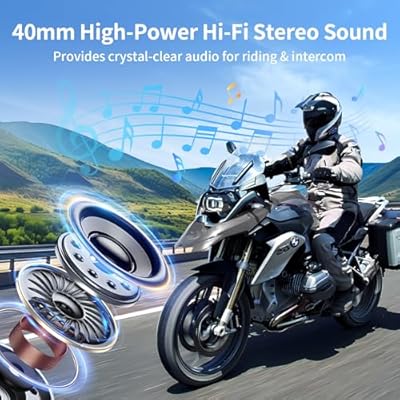
The 40mm speakers hit the budget-class standard, and owner quotes call them loud with music that holds up as speed rises, which is more than the 32mm entry tier manages. Installation uses a clip mount or 3M adhesive and reviews describe it as easy. The step that actually matters is the one the manual underplays: position the boom mic close to the mouth and check it after the first ride, because that single decision separates the satisfied owners from the ones writing about voices that cut out.
Couples doing the math should compare the single at under sixty dollars against the dual-pack variant, and groups of three or four should just multiply accordingly. The per-seat picture is on the current table.

Who should buy it, and who should spend differently
Buy it if your crew is two to four riders who stay reasonably close, you want the best per-seat value in the class, and you will spend twenty careful minutes on the mic install. It is the strongest value position of any four-rider unit we track, and the price gap to the B4FM buys nothing a four-rider group actually needs.
Spend differently if your group grows past four or spreads across terrain, because chain latency and range will frustrate the conversation no matter what this listing promises. Spend differently if you want self-healing mesh, which the FX7 and ASMAX S1 provide at comparable per-seat prices. And spend differently if you want voice control that works without a phone signal, because this is assistant passthrough, not offline processing. The FX4 Pro is a budget win exactly as long as your group fits its shape.
Frequently Asked Questions
How far does the intercom actually reach?
The claim is 1000 meters. Plan for 300 to 500 meters of reliable range in real terrain, less when a strung-out chain forces the signal through multiple riders.
Why does the voice cut out during calls?
Almost always mic positioning rather than hardware defect. Keep the boom mic close to the mouth, because a shifted mic feeds wind instead of voice and reads like intermittent failure.
Can I connect more than four riders?
No. The protocol is 4-way, which is also the practical daisy-chain limit before latency and audio degradation become noticeable across the category.
Does the AI voice control work offline?
No. It is a double-tap passthrough to your phone's assistant, so it needs a cellular connection. The ASMAX S1 is the budget unit with offline voice processing.
How does it compare to the B4FM?
The FX4 Pro wins on per-seat price and adds voice control. The B4FM wins on rider capacity and review depth. Both are practical for four riders riding in a chain.