Budget ebike batteries all promise the same thing, so the differences hide in the parts of the listing nobody formats nicely. Which cells are inside is a question the seller answers by omission, and whether the charge-time figure is real is a question you settle with the arithmetic the bullet skipped.
The CXZCXZ 48V 20Ah pack is a case study in that. It's one of the cheapest packs we track per watt-hour, and its title manages to claim two different voltages in the same line. As for the review record, it's a perfect score that's two texts long, and the longer one has an update worth reading.
I pulled the listing apart, checked every figure against the spec table, and went through both written reviews. Here's what holds up, what doesn't, and what you should verify before the return window closes.
The CXZCXZ 48V 20Ah sits in the cheapest fifth of the 301 packs we track on price per watt-hour, and that's the strongest fact on the page. You get 960 watt-hours, a 30A BMS that covers the claimed 1000W ceiling with margin, and a compact case.
You also get a title that calls the pack 48V and 52V in the same line, a 4-5 hour charge claim with no charger specified, and a 2000-cycle promise sitting over a 6-month warranty. The 5.0 rating comes from 2 reviews, and the more detailed one already contains a charger that failed inside a month.
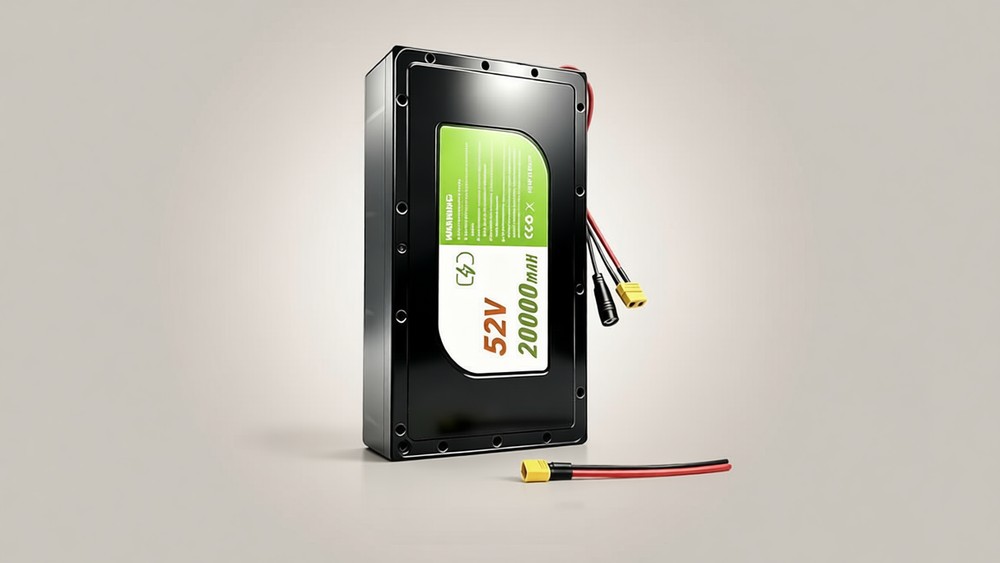
One title, two voltages
The title reads '48V20Ah Universal Power Pack, 48V/52V Battery Pack with Case'. A pack can't be both.
A 48V battery is 13 cell groups in series, and it charges to 54.6V. A 52V battery adds a 14th group in series, and it charges to 58.8V. em3ev's 52V buyer guide lays out the distinction plainly, because it decides which charger you plug in and what cutoff your controller expects.
This listing never picks a side. There's no charger output stated anywhere in the spec table, no series count, and the Included Components field reads 'non'. The dual label is either a way to show up in more searches or a sign the seller doesn't track its own configuration, and neither possibility helps you order the right charger.
What to confirm before ordering
Ask the seller one question and read the answer carefully: what voltage does the supplied charger output?
A 54.6V charger means a 13S 48V pack. A 58.8V charger means 14S and a different controller conversation. Getting this wrong either undercharges the pack or stresses it past its full-charge voltage, and a 6-month warranty is a thin safety net for that kind of mismatch.
The charge-time claim, checked
The bullet promises a full charge in 4-5 hours. Do the math and that claim makes a demand the listing never meets. 960Wh in 4 hours takes about 240 watts, which at 48V is a 4A-class charger.
The listing states no charger output at all, and the common charger in this class runs 2A, which lands near 11 hours on a 960Wh pack.
So the claim is true only if a fast charger ships in the box, and the spec table doesn't list one. The more careful reading is that the number was borrowed from a smaller pack. Plan for an overnight charge unless the seller confirms otherwise, and consider a 4A upgrade the first accessory worth pricing if you ride daily.
The page's care level
The details matter because they predict the QC you can't see. The weight appears as 10 lb in one place and 9.5 lb in another. The case is claimed waterproof with no IP code stated anywhere, and the PVC wrap is described as both wear-resistant and low-melting-point in the same bullet.
None of these is disqualifying on its own. Together they tell you the page was put together quickly, so the figures you care about deserve a second source. The physical size, 9.8 by 5.6 by 2.79 inches, is compact for 960Wh, and that part I'd trust because it matches the photos.

A perfect score with a charger problem inside
The rating sits at 5.0 from 2 ratings, and both written reviews are five-star texts tied to actual orders. One review is two words long. The other is the useful one, and it has a shape worth reading in full.
A buyer reports the pack working well on an e-bike build, then updates that the charger already has problems. They contact the seller, wait two weeks, and are sent a new charger. The battery keeps working.
Read that as the first quality signal on the record rather than a complaint. Chargers fail first in this class because they're the cheapest component to make badly, and a seller that replaces one in two weeks has told you something useful about support. A perfect average can hold a failure inside it, and this one does.
What nobody has reported is just as important. There's no range figure, no bike the pack is confirmed to fit, no rain exposure, nobody has metered it, and no cell maker named behind the 'automotive-grade' phrase. With two texts, the record can't carry that weight, so you'd be filling every one of those gaps yourself.
Six months of warranty under two thousand cycles
The promise gap on this listing is wide enough to walk through. The bullet claims 2000-cycle life with no chemistry named behind it, and Battery University's BU-808 puts the consumer lithium-ion specification at 300 to 500 full cycles. Manufacturers set that figure conservatively, and packs often beat it, but a 2000-cycle claim needs a test condition attached and this one has none.
The warranty the seller actually stands behind is 6 months, half the 1-year norm in this class. That's the commitment that counts when a pack fades early.
The practical response is to meter the pack young: once inside the return window, and again before the warranty ends. A multimeter and one full charge-and-drain cycle tell you more than any bullet.
A cheap pack that asks you to verify three things
Here's the decision this pack forces. The value is real: cheapest fifth of the 301 packs we track, 960Wh, and a 30A limit that runs the claimed 1000W ceiling with room to spare. What you accept is a spec sheet that doesn't answer its own questions.
Buy it if you're willing to confirm three things early: which voltage the pack actually is, what charger ships with it, and whether it meters close to 20Ah.
Do that inside the return window and the 6-month warranty period, and the price makes sense for a scooter or light ebike build in the 200W to 1000W range. Skip it if you want a listing that answers those questions itself, because the comparison table has packs a bit higher up the value band that do.

Frequently Asked Questions
Is it a 48V or a 52V battery? The listing says both, and that's not possible. A 48V pack is 13 cell groups in series charging to 54.6V, a 52V pack is 14 groups charging to 58.8V. Confirm the charger voltage with the seller before ordering, because it tells you which configuration you actually have.
How long does it take to charge? The bullet claims 4-5 hours, but that needs a 4A-class charger the listing never specifies. On the 2A charger common to this class, 960Wh takes about 11 hours. Plan for an overnight charge unless the seller confirms a fast charger is included.
How long will the pack last? The bullet claims 2000 cycles with no chemistry named. Consumer lithium-ion is specified at 300 to 500 full cycles, and the seller's own warranty runs 6 months. Meter the capacity early and treat the warranty period as the real commitment.
What do buyers report? Two five-star texts, both purchase-confirmed. One is two words. The other reports the pack working well, then a charger failure inside a month that the seller fixed by sending a new charger two weeks later. No range figure, fit report, or capacity measurement appears in either.
Is it good value? Yes, on the math that matters. It sits in the cheapest fifth of the 301 batteries we track on price per watt-hour, and the 30A BMS supports the 1000W motor ceiling with margin. The value is genuine. The checking is what you trade for it.