A two-pack of intercoms for 48.69 is the entire pitch here, since the price works out to about 24 per headset. The catch is that the listing can't keep its own numbers straight: the title promises 600 meters, a bullet promises 1000 meters, and a third line rates the best riding speed at "below 70 yards", which is a distance pretending to be a speed.
The buyer record is small, 32 ratings at 3.7 stars with 10 written texts, and 8 of those texts sit on confirmed purchases. They split 5 English and 4 Spanish, and they divide into pairs and town-speed conversations that work against a hard volume ceiling that shows up above 40 mph.
One of those owners also learned something about the mounting tape the hard way, and it's the kind of detail a spec sheet will never tell you.
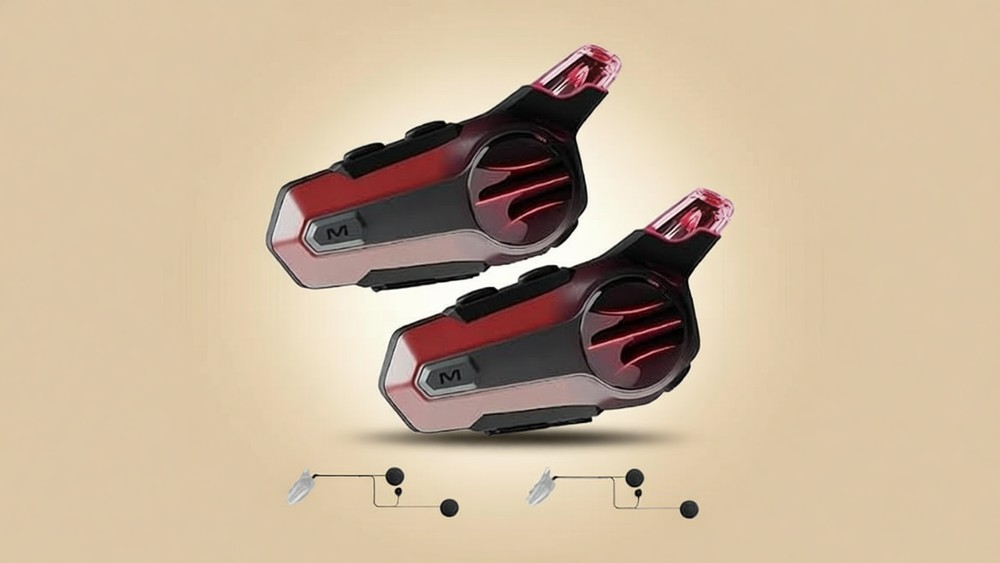
What the listing promises, and the numbers it argues with
The spec sheet reads like most budget packs: Bluetooth 5, CVC noise cancellation, IP67 waterproofing through nano coating, a 1000mAh battery, big glove-friendly buttons, a buckle-type clip, and a color changing taillight on the back. It even claims operation down to minus 20 degrees Fahrenheit, which no owner has come close to testing. The model is the E1-LED, the spec sheet lists the weight at 5.3 ounces, and it sits at #297 in Powersports Bluetooth Headsets.
Then the listing argues with itself three times. The title says 600 meters. The second bullet says two riders can talk within 1000 meters. Those aren't the same promise, and neither one gets a test condition. The spec table lists Control Method as Touch while the bullets describe physical buttons you press through gloves, so even the controls disagree with themselves. And then there's the speed line: "the best riding speed is below 70 yards". Yards measure distance. Whatever the translator meant, probably a km/h figure, the listing doesn't say it. I've read a lot of translated listings, and this is the first one I've seen rate a speed in yards.
Some range context helps, because 1000 meters is a big number for this radio class. Bluetooth 5 supports 40 to 400 meters at best, and in its most common low-power mode the typical range is 10 meters, per the radio standard's own figures. Claims far beyond the radio class depend on open air and line of sight, with no obstacles between two helmets. On our intercom table this pack sits near the middle of the 192 units we track on price per rider, which is where an unbranded two-pack should sit.

The only range report in the record
Exactly one owner in the record reports a measured range, and it came from an unusual helmet setup. They ride with baseball-cap style helmets, the kind with a flat brim and no room beside the ears, so they stuck the earbuds and the microphone on the bill of the cap. From there they report a normal conversation at a quarter mile apart, which is about 400 meters, used mainly to warn each other about cars and dogs.
That 400 meter report sits below the 1000 meter bullet and below the 600 meter title, and it is still the best range data anyone has written down. Two Spanish-language owners back the direction of it, one calling the connection stable at good distance and another just saying the range is good. Nobody reports riding at the claimed maximums.
The speed picture is bleaker. A buyer who liked the idea of the pack reports you can't hear the other person over 40 mph, and wishes these were made for stronger speeds. Put the two data points together and you get a realistic envelope: a working two-rider link at town and backroad speeds, up to roughly 400 meters, and no evidence at all for anything past 40 mph. My advice is to treat 400 meters at town speeds as the honest spec, because it's the only one an owner actually measured.
Mounting is a one-way decision
The adhesive bracket is the part of this pack nobody should improvise with, because the record shows it doesn't forgive mistakes. One owner, in their own words excited, placed the bracket upside down on the first helmet and found there was no getting it off without damaging the helmet or the bracket. The headset still works, but the buttons now sit where you wouldn't put them, and they live with it.
The same owner adds two more placement lessons the listing skips. Helmet curvature matters, and a slightly curved spot made it hard to seat the headset on its bracket. And the second helmet went on with care after the first mistake, so placement is the one decision you get to make once. The listing's buckle-type clip is supposed to be the removable alternative, but no owner in this record describes using it.
Setup itself is where the pack earns its praise. The battery arrived partially charged and finished in a couple of hours, a long press wakes the headset, and a short press on the mode button switches into intercom. One caution from the cap-helmet owner carries over to anyone with off-ear earbuds: at maximum phone volume, music might not get loud enough, which matches the volume ceiling other owners hit on the road.

Sound quality splits, and one text sells the listing back
The 3.7 average comes with a histogram that explains itself: 34 percent five-star and 35 percent four-star against 15 percent three-star and 16 percent one-star, with no two-star reviews at all. Buyers either get along with these headsets or bounce off them, and almost nobody lands in between.
The praise side is consistent about the right things. A Spanish-language owner gets stable connection between both riders, clear voice, and hi-fi stereo music, and trusts the IP67 rating in rain. Another calls the sound loud and says the headsets do the job while warning they aren't high-resolution audio. A third owner weighs cost against benefit and lands on good sound and buttons with well chosen functions. Even the one-star detractor keeps it short and specific: terrible sound quality, not worth the money.
The record also carries one text worth discounting, and I want to flag it because it looks like evidence. It's unbadged, it repeats every listing claim in order, 600 meters, CVC crisp even at high speeds, excellent HiFi, all-weather IP67, a thoughtful taillight, and it contains no personal detail, no install note, and no fault. It reads like the listing reprinted as a review, and it's the least useful text in the record. The 4-star rating next to it is the only thing holding up that end of the spread, and I don't buy it.
Who this pack fits
For two riders on a budget who stay at town and backroad speeds, this pack does the job the record says it does. The pairing is easy, the conversation at 40 mph and under works, the quarter-mile warning calls are real, and the taillight adds visibility the cheap packs usually skip. If your helmets are baseball-cap or open-face styles where speakers can't sit beside the ears, the bill-mounted setup one owner worked out is proof there's a placement for almost anything.
Pause on it if highway riding is your normal, because the only speed datum in the record is a wall at 40 mph. Pause again if you want more than two riders: an owner of several helmet radio types confirms these connect to one other device only, by design, while the multi-headset systems stay complicated and expensive. And if the taillight is the reason you're here, know that one buyer received the wrong unit with a tail light that did not light up, the only fulfillment complaint in the record. Check your pair before the sticky tape goes on, because after that you're committed.
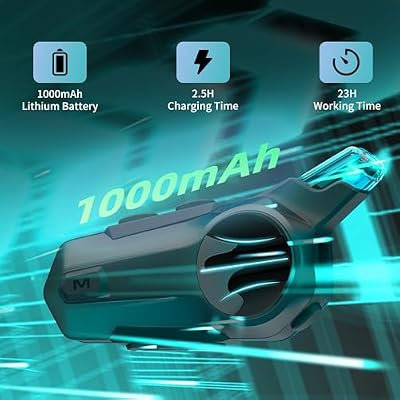
On price per rider this sits mid-field among the two-rider units we track, and the live figure renders in the specs box above, so check the comparison table before you decide.
Frequently Asked Questions
How far does it actually reach?
The only measured report in the record is a normal conversation at a quarter mile, about 400 meters, between two baseball-cap helmets. The title says 600 meters and a bullet says 1000 meters, and no owner has reported either figure. Bluetooth radios in this class top out well below those claims in real conditions.
Is it really waterproof?
The listing claims IP67, which under the IEC standard means dust tight plus 30 minutes submerged a meter deep. No owner reports rain, immersion, or any water event at all, so the rating is untested by the only people who bought it. Treat it as a claim, not a report.
Why is the rating only 3.7 stars?
The histogram splits hard: 69 percent of buyers leave four or five stars, 16 percent leave one star, and nothing lands at two stars. The one-star texts cite sound quality and one speed wall at 40 mph. Buyers who ride at town speeds tend to be happy, and buyers who want more get nothing in between.
Can it connect to more than one other rider?
No. An owner who has used several helmet radio types confirms each headset pairs with one other device only. Multi-rider chain systems exist in this category, and they cost more and set up harder, which is the trade this pack doesn't make.
Can the mount be repositioned after it sticks?
The record says no. One owner placed a bracket upside down and couldn't remove it without damaging the helmet or the bracket. Decide the placement, check the helmet curvature, and get it right the first time, because the adhesive doesn't offer a second attempt.
How is the battery life?
The listing gives a 1000mAh battery and no hour figure. The record holds one charging report: the battery arrived partially charged and reached full in a couple of hours. Nobody reports a runtime measurement, and the listing's own silence on hours tells you what the maker wants to commit to.