Budget helmet shopping on Amazon is an exercise in reading around the claims. The photos are clean, the bullets are confident, and the certification sits in a title where you cannot check it. Half shells make that worse, because the ones that skip paperwork look identical in a thumbnail to the ones that carry it.
The CARTMAN half shell with the pull-down sun visor sits right in that gap. It costs less than a tank of premium fuel, it sells well enough to rank inside the category's top 20, and its buyers have left a record you can actually read. That record agrees on comfort and on the visor, and it disagrees on something you would rather know before ordering: the fit.
What follows works through what 336 ratings and the written texts actually say, what the certification claim does and does not come with, and the ten-second checks worth making when the box shows up.
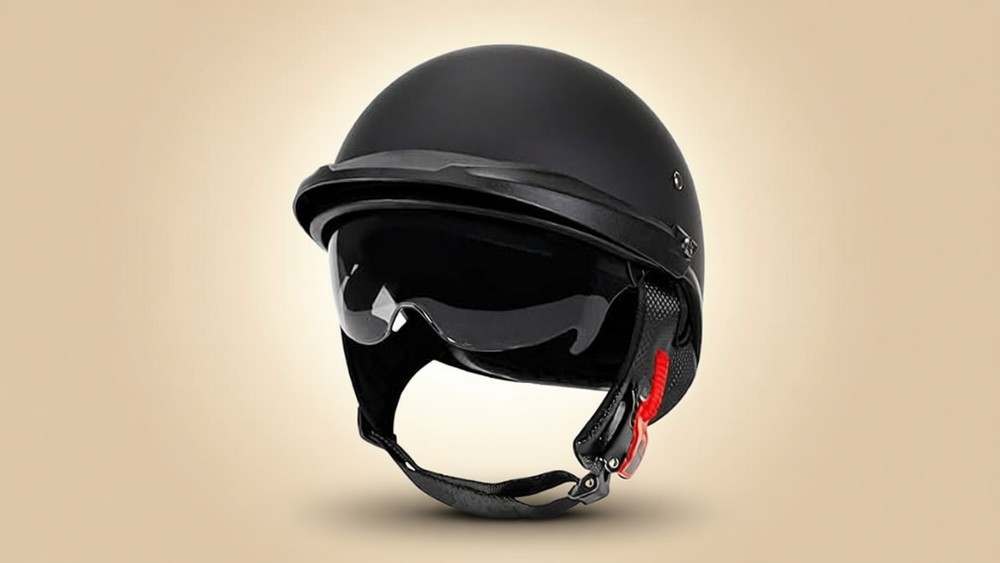
The CARTMAN half shell is a matte black open face with an ABS build, a listed weight of 2.66 pounds, and a checked price of 37.99. That price sits in the cheapest fifth of the 257 helmets we track, and the specs box on the helmet comparison table renders exactly where it lands.
The record behind it is real. The helmet holds 4.4 stars from 336 ratings, 73 percent of them five-star, and it ranks number 17 best seller in the helmet category. Twenty-three of the twenty-four texts I pulled carry the confirmed-purchase badge.
Three catches run through the writing: the DOT claim has no paperwork row behind it, the sizing texts split in two directions, and one owner reports the shell lifting at 55 to 60 with the straps snug.
The DOT claim, and what the page does not do with it
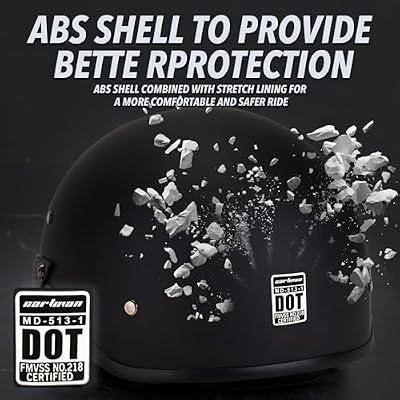
The title and a bullet claim this helmet is DOT certified, but the details table lacks a Certificate Type row and a Specification Met row, and nothing on the page mentions a stitched label. Because the photos don't show the inside of the shell, you can't verify the mark before you buy.
In the United States, helmets are self-certified under FMVSS 218, which means no agency tests a helmet before it goes on sale.
The maker asserts compliance and the buyer holds the proof. That matters more than usual here, because helmets cut the risk of head injury by 69 percent and the risk of death by 42 percent, and a helmet whose certification you can't confirm is a helmet you are taking on faith.
Inside the written record sits a challenge: one owner has noted that their motorcycle instructor said the helmet isn't DOT-certified, so they couldn't use it for a training course.
The most-endorsed text on the page asserts the opposite, calling the helmet DOT certified, but that buyer is repeating the listing's claim, not showing a label. That is one report against a page that claims certification in its title, and the capture can't settle either of them.
What settles it is the artifact: check for the stitched DOT label inside the shell when it arrives, while the return window is still open.
A sizing record that runs in both directions
The sizing record splits. Five separate recent texts lean one way: larger than expected, a small fitting more like a medium-to-large, plain oversized, fits big, and one owner calling the fit ridiculously huge. The top texts lean the other.
Two say the helmet fits accurately per the size chart, and one buyer who wears XL in a full-face brand found this one too large in that size and exchanged it for an L.
Even the return went quietly. A five-star text reports the largest size could not fit their head, and the buyer left without a word of complaint about the shell. Both patterns come from confirmed purchases, which is the strange part.
The details table adds to the muddle by listing the shape as both Round and Intermediate Oval in the same row.
Measure your head before you order and expect an exchange. A size you already wear in another helmet brand is a starting point here, not an answer.
Speed, sun, and one thin strap
One owner has reported that the shell lifts up and back at 55 to 60 on the main highway, even with the straps pulled snug, and the rider calls it an almost-wreck.
No other text in the record mentions aerodynamics either way. An open-face half shell has no chin bar to weight the front down, so treat lift at sustained speed as the risk class you are buying into, not a proven defect of this one helmet.
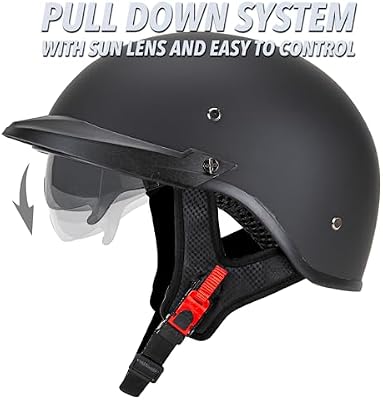
The visor is the part buyers like. One owner reports the visor sits far enough off the face to make wearing eyeglasses comfortable, and the top-voted text says it fits right over the glasses and flips out and back in smoothly. Another owner disagrees on the glasses: theirs didn't fit on the face well.
A scooter rider loves the shade itself, because the visor is small enough not to cover the face but dark enough that the sunglasses worn over regular glasses stay home. On tint the record splits again: the top-voted buyer says it isn't too dark, and a three-star owner says it isn't dark enough, adding that finding a replacement shield has been impossible.
Two catches attach to that visor. The replacement-shield problem stands on its own: for a part the design makes central, one owner's failed search is worth knowing before you order. And one four-star owner likes the buckle but calls the strap thin, which is a small thing until it is the thing between you and the road.
Nobody in the record reports an impact, wind noise figures, or how the helmet holds up past a few months. The record is short-tenure comfort talk, and it says so.
Who gets their money's worth here, and who should spend more
The fit list is long. Scooter and moped commuters, cruiser riders at town speeds, ATV and property use, anyone who wants sun protection without carrying sunglasses. The spec side supports the price: a 2.66 pound ABS shell, a moisture-wicking liner, a quick-release buckle one owner likes, and a one-year warranty.
On our numbers the CARTMAN sits in the cheapest fifth of everything we track. The motorcycle helmet comparison shows the whole field with prices, weights and where each lid ranks, and the specs box on the CARTMAN's row carries the live figure.
You should spend differently if your riding is sustained highway, where the lift report and the open face both argue for a full-face lid.
Spend differently too if a course or an employer requires verifiable DOT paperwork, because this page's claim rests on a title bullet with no certificate row behind it. And if you need a dark tinted shield out of the box, one owner's experience says you will be looking for a part that is hard to find.
Frequently Asked Questions
Is the CARTMAN helmet DOT certified?
The title and a bullet say so, but the details table lists no Certificate Type row and no Specification Met row.
DOT is self-certified in the United States, so the proof you can hold is the stitched label inside the shell. One owner reports their motorcycle instructor said the helmet isn't certified. Check on arrival, inside the return window.
Does it run big?
The record splits. Five recent texts say it runs large, two top texts say it fits accurately per the chart, and one buyer exchanged their usual XL down to an L. Measure your head and expect a possible exchange.
Can I wear glasses under it?
Two owners say yes, one because the visor rides clear of the face and one because it fits right over the glasses. A third says theirs didn't fit on the face well. The shell is open at the front, so it depends on your frames and your face.
Is the sun visor dark enough?
Dark enough is debatable. One owner says the shield isn't tinted dark for bright conditions and could not find a replacement shield anywhere. If you ride in strong sun, plan on sunglasses under the visor.
Will it lift at highway speed?
At 55 to 60, one owner reports lift with the straps snug. No other text mentions it either way. Open-face half shells carry that risk as a class, because there is no chin bar weighting the front down.