An internal sun visor is a feature that usually appears two price brackets above this one. The Cartman Motorcycle Open Face Helmet puts a drop-down visor, a scratch-resistant anti-fog shield, a moisture-wicking liner, and DOT certification into a matte black lid that costs about what a decent pair of gloves does. The compromise is not in the feature list. It is in the materials and the wind noise.
The Drop-Down Sun Visor Earns Its Place
Riding into a low sun with only a clear shield means squinting, or stopping to swap to a tinted visor, or wearing sunglasses under a helmet that was not designed for them. An internal visor removes all three problems with a slider you can reach with a gloved thumb.
The consequence when you don't have one is worse than people admit. Late afternoon glare on a west-facing road genuinely reduces how much of the traffic ahead you can read, and the moment you decide to squint through it rather than stop is the moment your reaction time gets worse. A visor you can drop in half a second while moving fixes that.
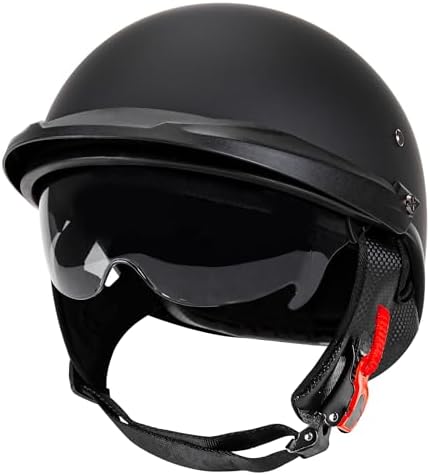
Budget internal visors do have a recurring weakness worth knowing about. The slider mechanism and the pivot are usually plastic on plastic, and after a few hundred cycles they can develop play, which shows up as a visor that creeps down on its own over bumps. I can't test the longevity of this one personally, so I'll say only that it is the part I would expect to wear out first on any helmet in this class. Our comparison table puts it next to other lids we cover.
The Main Shield, Fog, and Scratches
The outer lens is described as scratch-resistant and anti-fog. Both of those are coatings rather than material properties, and coatings wear. Scratch resistance on a shield is mostly a question of how you clean it, and the fastest way to ruin any visor is wiping road grime off dry with a glove. Water first, then a soft cloth. Always.
Anti-fog coatings on budget helmets tend to be adequate rather than exceptional. They handle a cool morning fine and struggle when you are stopped at a light in the rain breathing hard. If you ride year round in a damp climate, plan on a proper anti-fog insert as an accessory, because no coating alone matches a dual-pane insert.
Open face geometry helps here. Airflow through the chin opening clears moisture much faster than in a full face, so the fogging situations that trap you are fewer to begin with. That same opening is what leaves your jaw exposed, which is the permanent tradeoff of the style.
Comfort, Retention, and Everyday Wear
The liner is moisture-wicking, which is the feature you appreciate in August and forget about in October. Sweat that stays in the padding is what makes a helmet smell after one season, and a wicking liner moves it into the airflow instead of holding it against your head. Check whether the liner is removable before you buy, since a washable liner extends the usable life of a cheap helmet more than any other detail.
The quick-release chin strap is the right call for a helmet you take on and off repeatedly. Adjusting tension with gloves on is genuinely easier than fighting D-rings, and for street riding the retention difference is negligible. Racing organizations still specify D-rings, and that tells you which system is stronger under extreme load, but street crashes are not track crashes.
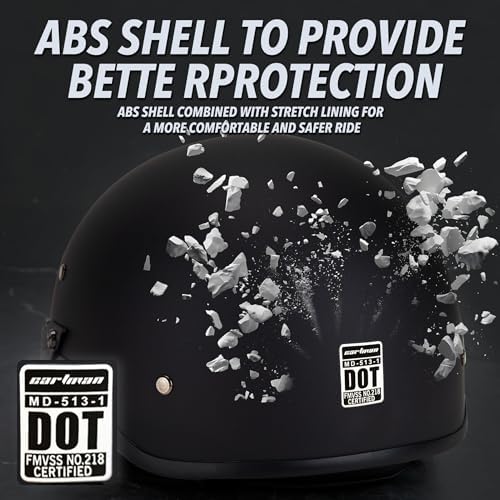
The shell is lightweight ABS. On an open face lid the weight is manageable, and the bigger comfort factor is how the shell edge sits against your ears and jaw. Sizing matters more than material here, so measure your head circumference and buy to the chart rather than guessing at large. You can check current price on Amazon once you have your number.
Who It Suits
Commuters and cruiser riders who want more coverage than a half helmet without giving up the airflow and peripheral awareness of an open face. It is a good scooter helmet, a good around-town helmet, and a reasonable choice for anyone who rides in hot weather and hates the closed-in feeling of a full face.
It is not a touring helmet. Wind noise on any open face at sustained highway speed is loud enough to cause hearing damage over long rides, and earplugs become mandatory rather than optional. It is also not the helmet for anyone who wants chin protection, which remains the strongest safety argument for full-face designs. Our hands-on reviews cover full-face alternatives.
The blunt version: this helmet gives you a feature set that punches above its price, in a category that carries a permanent safety compromise. If you have already decided on open face, the sun visor alone makes this worth a look.
Frequently Asked Questions
Is the internal sun visor worth it on a cheap helmet?
Yes, because the alternative is sunglasses or a visor swap, and both are worse. The mechanism is the most likely part to develop slop over time on any budget helmet, so treat the slider gently. Even a visor that gets loose after two seasons has earned its keep by then.
How does an open face compare to a full face for safety?
An open face gives you the same skull coverage but no chin bar, and the chin area takes a significant share of real-world impacts. It is a genuine step down in protection. What you gain is airflow, peripheral vision, and the ability to talk to someone at a stop without lifting anything.
Will it fog up in cold weather?
The anti-fog coating handles moderate conditions, and the open chin gives you far better airflow than a full face has. Sitting still in cold rain is the situation that beats any coating. A dedicated anti-fog insert solves it if you ride through winter regularly.
How do I choose the right size?
Measure your head circumference about an inch above the eyebrows and match it to the manufacturer's chart. A correct fit is snug without pressure points, and the helmet should not rotate when you shake your head. Sizing to the chart matters more on budget helmets, where shell sizes are fewer.
Can I use it with a Bluetooth intercom?
Generally yes. Open face helmets are usually easier to fit comms into, since there is more room around the ear pockets and no cheek pad to remove. Confirm there is a usable shell edge for a clamp mount, or plan to use adhesive mounting.
How should I clean the visor?
Wet it first, always. Wiping bugs and grit off a dry shield with a glove is how scratch-resistant coatings get scratched. Warm water, a soft cloth, and patience. Skip solvents and glass cleaner, since ammonia attacks visor coatings.
More features than the price suggests, with a usable drop-down sun visor, a wicking liner, and a strap that works in gloves. The coatings and the visor mechanism are where the budget shows, and open face geometry means accepting no chin protection and serious wind noise above town speeds. For hot-weather town riding it is a lot of helmet for the money.