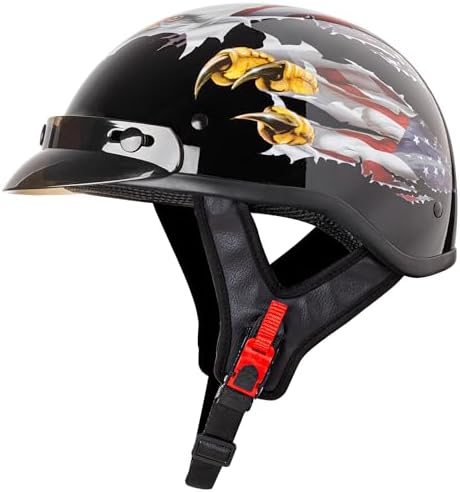
DOT certified (the US Federal standard) in an "extra-large" fit with an ABS shell, a vented high-density liner, and "eagle graphics," this helmet will either please or mortify you. Inexpensive and meeting the US Federal Standard, it won't, however, provide protection to the portion of your face that strikes the pavement first.
What DOT Certification Actually Means
Shell, Liner, and Fit
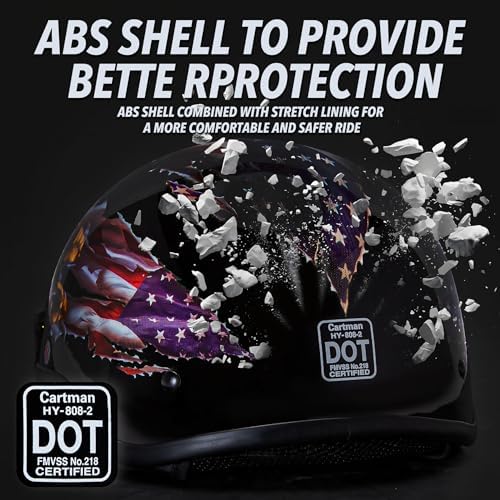
FMVSS #218 is a legitimate standard with legitimate testing behind it. Impact Attenuation, Penetration Resistance, Retention System Strength and Peripheral Vision Requirements. Any helmet bearing a legitimate DOT mark was constructed to meet those testing criteria and the manufacturer is liable under law for making such a claim.
The standard does not rate helmets. There is no rating. No stars. No grading. Either a helmet complies with FMVSS #218 or it doesn't. As such, a 50 dollars helmet and a 300 dollars helmet both bear legitimate DOT certification and perform drastically different in the aspects of a collision that the testing does not account for. That is the void that ECE and Snell certifications attempt to fill.
Rash data continues to show that the chin bar area absorbs a significant amount of the forces imparted during an accident. However, due to their design, half shells lack a chin bar altogether. Therefore, if you purchase this helmet you knowingly give up that benefit (chin bar protection), primarily for reasons of warmth, increased visibility, and many riders may choose not to ride in a full face at all.
Regardless, a helmet worn will always beat a helmet left in storage. Our comparison table compares various full-face models with these models.
The Buckle and the Graphics
The shell is made of lightweight ABS (standard material for products at this price). It is durable. It will absorb an impact well. And it does not possess nearly the same stiffness-to-weight ratio as a composite or carbon shell. Because there is much less shell to carry in a half-shell vs. A full-shell, the weight disadvantage of an ABS shell is significantly less apparent.
As previously stated, the liner is said to be dense, high-density and fully ventilated. Density is what matters here. Crushable expanded polystyrene will absorb energy. How it is calibrated will determine how the helmet responds to an impact. Ventilation via the liner represents the primary functional differences between a helmet you can wear throughout a hot summer traffic stop and one that becomes a steam room at every red light.
Fit represents perhaps the biggest failing of low-cost helmets. This model comes in specific sizes, as opposed to a generic size. That is somewhat beneficial. Use your measurement (circumference of your head approximately 1-inch above your eyebrow line) to match your size. Don't rely on your shirt size. If a helmet rocks forward when you move your head after placing it on your head, it will not provide adequate support during a potential crash. Click here to find the latest pricing information on Amazon once you've determined your size.
Who Should Wear This and Who Should Not
The quick-release buckle represents the best aspect of functionality for this helmet. While traditional D-rings represent the safest method of retaining a helmet (and are admittedly quite inconvenient to operate when using gloves), the quick-release allows you to easily remove the helmet at a gas station without having to pull off your gloves, as well as provides easy adjustment of tension in mere seconds.
While convenient, this feature comes at a slight expense. Like micrometric buckles and quick-release buckles, D-rings represent both certified and safe methods of retaining helmets. However, they continue to serve as the benchmark for retention strength. Although this distinction is largely irrelevant for casual street riding, it could potentially become relevant for serious riders attempting to adhere to racing regulations.
The graphics depicting eagles serve as the rationale for this helmet existing as a unique product, and aside from taste being subjective - they are printed onto the helmet rather than applied via decals - print graphics typically lose color and contrast due to UV degradation within several months of continuous sun exposure.
Frequently Asked Questions
Those riders engaged in short, slow, warm weather excursions on cruisers receive the greatest value from this type of helmet. Town riding at moderate speeds - below 30 mph - offers sufficient ventilation and visibility for cruising and scooter/moped riders in similar conditions.
For highway riders, consider alternative options. Wind noise associated with half-shells traveling at 70 mph is deafening. Hearing damage resulting from prolonged exposure to wind noise at these speeds is documented. Additionally, facial exposure to debris and insect splatters creates rapid boredom with this type of helmet at higher speeds. Highway commuting riders should utilize full-face helmets exclusively. Our hands-on reviews detail superior alternatives suitable for longer commutes.
The blunt assessment of this helmet is that it provides correct DOT certification for extremely inexpensive comfort as a half-shell. The limitations of this product pale in comparison to the limitations inherent in the category. Consider purchasing based upon style choice with informed decision-making regarding style-based limitations inherent in this helmet. This helmet accomplishes its intended function.
Is a DOT half helmet legal everywhere?
Here is what matters next.
How safe is a half helmet compared to a full face?
In the United States, DOT certification fulfills federal standards. States with mandatory helmet laws generally accept DOT certification. Some jurisdictions impose additional standards or define areas requiring specific types of coverage. Therefore, consult local statutes prior to selecting an optional half-shell. Abroad, ECE certification commonly serves as proof for regulatory purposes.
How do I get the right size?
Significantly safer. While safety performance of helmets is directly related to manufacturing quality and materials utilized (as well as fit), geometrically speaking a full-face protects the lower jaw/face region which constitutes substantial portions of an individual's facial structure during accidents. Conversely, a half-shell protects only the upper surface of the cranium/skullcap along with lateral surfaces leaving all remaining areas unprotected.
Will it fit over glasses?
Determine your circumferential measurement by wrapping a flexible tape measuring device around your head (approximately 1-inch above your brow line). Refer to manufacturer-provided charts referencing appropriate sizing based upon measurements obtained. "Extra-Large" refers to a size designation. Not an assurance of fit. Your helmet should be tight enough that slight movement occurs when you shift your head back-and-forth.
Does the vented liner actually help?
Yes. Although minimally effective during high-speed travel (i.e., wind blasts prevent air flow through vents), slow-town riding scenarios present ample opportunity for ventilation through the liner to provide noticeable relief during warmer temperatures.
When should I replace it?
After any impact (even one producing no external signs of damage), since internal crush damage cannot be reversed by the liner. Additionally, use as a general guideline to replace your helmet every 5-years from its date-of-manufacture as liners de-grade from sweat exposure, solar radiation degradation and time.
You can the CARTMAN listing on Amazon if this matches your build.
An affordably-priced half-shell with a true vented liner and an easy-to-use buckle that works with gloves on. The eagle graphics will fade faster than expected. Wind noise on highways will be loud. And the absence of chin-bar protection represents a known limitation accepted at initial purchase. For casual town riding on cruiser motorcycles, it does precisely what it claims - for very little money.
You can check the CARTMAN price on Amazon if this matches your build.
Click here for current pricing on Amazon
See how it stacks against the rest in the comparison table.