Most conversion kit listings sell you one motor. This one sells two and lets the checkout decide which arrives. The title reads BBS02B and BBS-HD in the same breath, the part number on the page spans 500, 750 and 1000 watt variants, and every headline figure on the page, from the 37 mph top speed down to the 160 N.m torque claim, belongs to the biggest motor of the three. Which box shows up at your door depends entirely on the option you pick.
That's the first thing to understand about the BAFANG BBS02B kit. The second is that its 4.8 rating rests on twelve ratings and six written reviews, and not one of those texts runs longer than two sentences. There is real information on this page. The CAN bus electronics and the fit range are genuinely well specified. But the numbers doing the selling are catalog claims, not measurements, and I'll separate the two.
Which motor you are actually buying
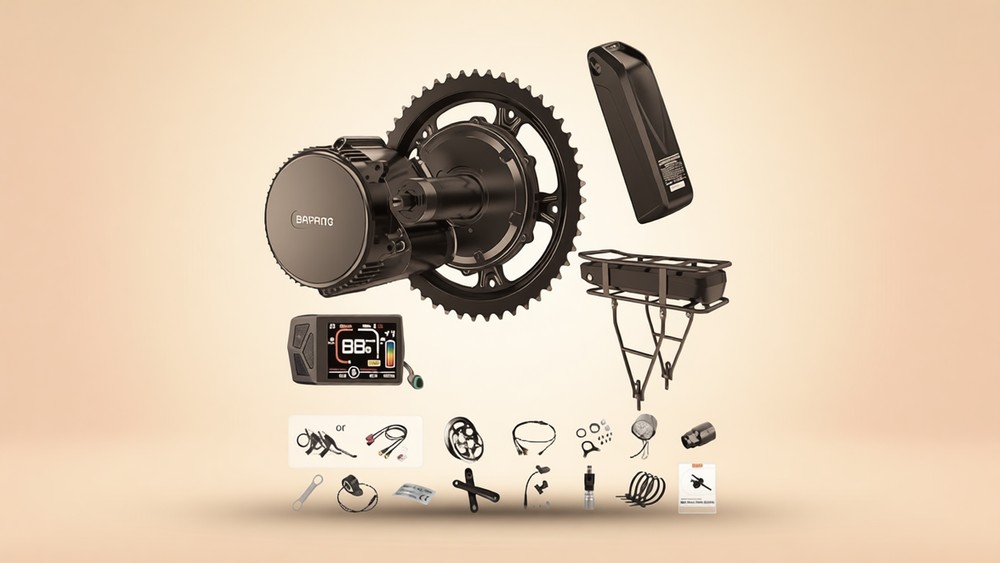
Dedicated Bafang spec sources draw the family line clearly. The BBS02B is the 48-volt middle motor of the range: 500 to 750 watts rated, 120 N.m of torque, a 25 amp controller, a cadence sensor and about 4.0 kg of motor weight. The BBSHD is a physically larger 1000 watt motor with its own heavier case. They are not the same motor with different stickers, which is why the combo listing matters. Buy the wrong option and you get a different machine than the review you read.
The title also says 36V, and the spec sources do not agree with it. They list the BBS02B as a 48-volt motor, full stop. Maybe the 36V figure covers a variant we can't see from the listing's structure. Maybe it's carried over from the wider Bafang range. Either way it's a claim on the page that the motor's own documentation doesn't back, and it's not the only one.
The speed figures are the loudest example. The bullets promise 37 mph for the 1000W option, 34 for the 750 and 28 for the 500. Those are catalog maximums with no rider weight, terrain or battery condition attached, and every one of them meets or beats the legal ceilings in the United States three-class e-bike framework, where class 1 and 2 cut out at 20 mph and class 3 at 28. That doesn't make the kit illegal, it makes it off-road equipment as configured, and you should know that before the box arrives, not after.
One figure the page never states is the controller's amperage, and it matters more than the watt sticker. A 25 amp controller only performs if the battery can supply that current continuously. An undersized pack cuts assistance on climbs and the motor gets blamed for a fault it didn't have.
What the kit includes, and what it does not
The contents list is generous for a mid drive at this level: motor, sprocket, crankshaft, throttle, brake sensor, speed sensor, installation tools and cables, plus a taillight cable with brake light functionality. What it does not include is a battery on this option. The motor wears an XT60 male connector, and the page tells you to check your pack matches before ordering, which is advice worth taking because a pack that doesn't plug in stops the whole project on the bench.
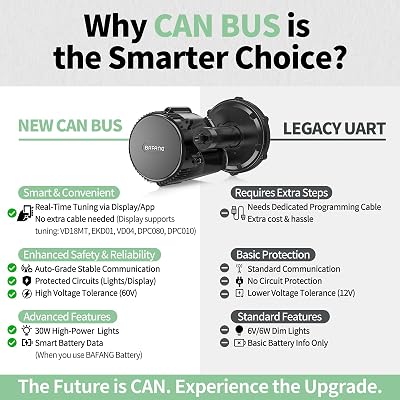
The battery side has a second catch worth naming. The bullets advertise CAN bus communication with smart packs, and then quietly add that intelligent battery management requires a battery whose BMS speaks the compatible protocol. Run a standard pack and the kit falls back to plain voltage detection. Nothing breaks, you just don't get the battery data the display promises.
Programming splits into two paths. If your kit ships with one of the non-programmable displays, the VD03, VD618 or VD18MT, tuning parameters means adding a USB programming cable that isn't in the box. The programmable displays, the DPC080, DPC010, VD04 and EKD01, adjust from the screen or an app without wires. Check which display your option carries before you plan any tuning.
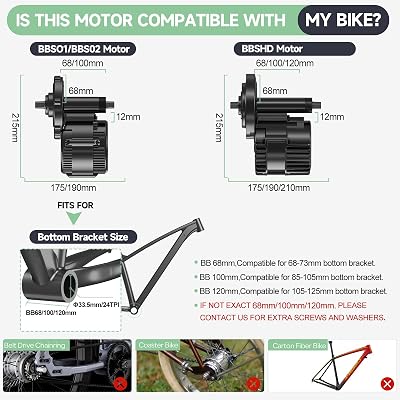
Fit is better specified than most listings manage: bottom bracket shells of 68 to 73mm, with 100mm and 120mm long-axle versions for wider frames, an inner diameter between 33.5 and 36mm, shell thickness under 12mm, and explicit exclusions for carbon fiber frames and coaster brakes. Warranty is 30 days for return and 365 days for repair or replace.
Twelve ratings and six short texts
Here is the complete written record, all six texts, every one tied to an actual order. October 2026, five stars: a shipping error was corrected with ease, everything arrived and worked, super easy to set up, mounted on a cargo bike with no extensions needed. September 2026, five stars, the entire text: Works. Another September five-star is titled Motor runs well for replacement and reads, in full, Pretty good this time. The word replacement and the phrase this time are the only hints in the record of an earlier unit or an earlier problem, and neither text says what happened.
August brought a four-star titled Keep trying, and remember it's all about the taste/fun of it, with the body reading all about taste, mine makes mine easier, plus emoji. June's four-star reports a late delivery, complete except for one item shipped separately that the buyer hoped would show up soon. And January's five-star, the only text anyone found helpful, with two helpful votes, calls it the best mid drive for the money, used on higher end ebikes, with aftermarket accessories available.
I've now written everything the record contains. No owner reports a range figure, a measured speed, a hill climb, a noise observation, a programming attempt, a failure or a warranty claim. The 4.8 average with nothing below four stars is a good sign on its face, and a record of twelve ratings and six short texts is too thin to carry the weight the headline numbers place on it. Both things are true, and the second one is the reason to read this section before you order.
Who this kit fits
The category sources put the BBS02B's real audience in hilly commutes, loaded touring and mixed terrain, the rides where torque through your own gears earns its keep and where a mid drive's low, centered weight changes how the bike handles. Two cases where it's the wrong tool. A strictly flat urban commute never calls on the 25 amps, and there the legal status of a 34 mph machine matters more than its muscle. Heavy cargo work or daily mountain use calls for the BBSHD we reviewed separately.
The asking price sits in the pricier third of the 191 kits we price, and a battery lands on top of that. That's a below-average value position, said plainly. The live position renders in the specs box of our conversion kit comparison table, and you can pair it with any of the packs sorted by price per watt-hour in our battery table. Check both before you commit, because the motor is only part of the project's cost.
Frequently asked questions
Which motor actually arrives from this listing?
The one your selected option names. The listing spans the BBS02B at 500 and 750 watts and the BBS-HD at 1000, and the part number confirms all three variants ship under this page. The 37 mph and 160 N.m figures belong to the 1000W BBS-HD configuration, not to the BBS02B the title leads with.
Does the 36V setting in the title work?
I wouldn't count on it. Dedicated spec sources list the BBS02B as a 48-volt motor only, and the entry-level BBS01B is the one that takes 36 volts in Bafang's lineup. The 36V figure in this title may cover a different variant, but nothing on the page explains it. Buy a 48V or 52V pack and the question disappears.
What battery do I need?
A 48V or 52V pack, 13 to 20 amp-hours per the page's own suggestions, with a connector that matches the motor's XT60 plug. Two requirements the page doesn't spell out: the pack must sustain the controller's current draw continuously or it will cut out on climbs, and if you want the CAN bus battery data, the pack's BMS must speak the compatible protocol.
Will it fit my frame?
Measure before ordering. You need a threaded bottom bracket shell of 68 to 73mm, or the 100mm and 120mm long-axle versions for wider frames, an inner diameter between 33.5 and 36mm, and a shell thinner than 12mm. Carbon fiber frames and coaster brake bikes are explicitly excluded, and press-fit bottom brackets sit outside the standard entirely.
Is it street legal?
Not as configured in any US class. The three-class framework cuts class 1 and 2 assistance at 20 mph and class 3 at 28, and this listing's own maximums start at 28 and run to 37. Where that leaves you depends on your state and your appetite for gray areas, and it's a question to settle before purchase rather than after the first ride.
For a second opinion on the bigger motor in this family, our Bafang BBS-HD review covers it, and the 750W BBS02B listing under the same brand name gets its own write-up. Check the current BBS02B price on Amazon.