Helmet intercoms used to start near a hundred dollars, and that floor shaped who bought them. Riders on dirt bikes, pit bikes and old commuters simply rode without one and shouted at stop lights.
Budget brands have pushed that floor into the twenties, and the A19S is what that money now gets you: a genuine two-way intercom, dual-phone pairing, a waterproof rating and a spec sheet that makes claims no unit at this price has ever earned.
The question is not whether a cheap intercom works. It is which parts of the listing you can trust, and the buyer record answers that unevenly. Here is what held up, what broke, and what the page promises that nobody has confirmed.
Twenty-five dollars, a real intercom, and a review section that reads like a press kit
The AURISOM A19S costs less than a pair of decent riding gloves, yet it carries a full-duplex two-way intercom, dual-phone Bluetooth 5.4 pairing, a Type-C charging port and a one-year warranty. On price per rider it sits in the cheaper third of everything we track, which you can check against the rest of the field in the live comparison table.
It holds a 3.8 rating from 18 ratings, and the histogram is as split as a small record can be: more than half the raters gave five stars, about a sixth gave one star, and almost nothing landed in between. No three-star middle exists on this page.
The written record explains that split. Four of the nine five-star texts carry no purchase confirmation, all four landed in a single month, and several read like press copy.
One of them restates the Bluetooth version, the speaker size, the battery capacity and the playback hours in sequence, in the same order the listing does. Every defect report in the record, meanwhile, is order-confirmed.
That is the shape of this article: what the confirmed buyers have found, what the page claims that nobody has backed up, and who should still spend the money.

The spec table promises things the bullets never mention
The details table claims active noise cancellation, transparency mode and adjustable levels. The bullets, every one of them, describe something different: DSP audio mixing, ENC voice enhancement and wind-noise reduction on the microphone. That is processing for your voice going out, not cancellation for the noise coming in.
Speaker-side noise cancellation with a transparency mode is a feature class that shows up on flagship units costing several times as much. It doesn't appear anywhere in the bullets, and not one owner text mentions hearing it. The unconfirmed five-star that reads like press copy repeats a "three-layer noise cancellation" phrase straight from the listing language, which is the only place the claim lives.
The honest read: treat the A19S as a mic-processing intercom. Your voice gets cleaned up on calls and intercom. The wind and the engine still reach your ears, and nothing on the page, outside that one contradictory table row, says otherwise.
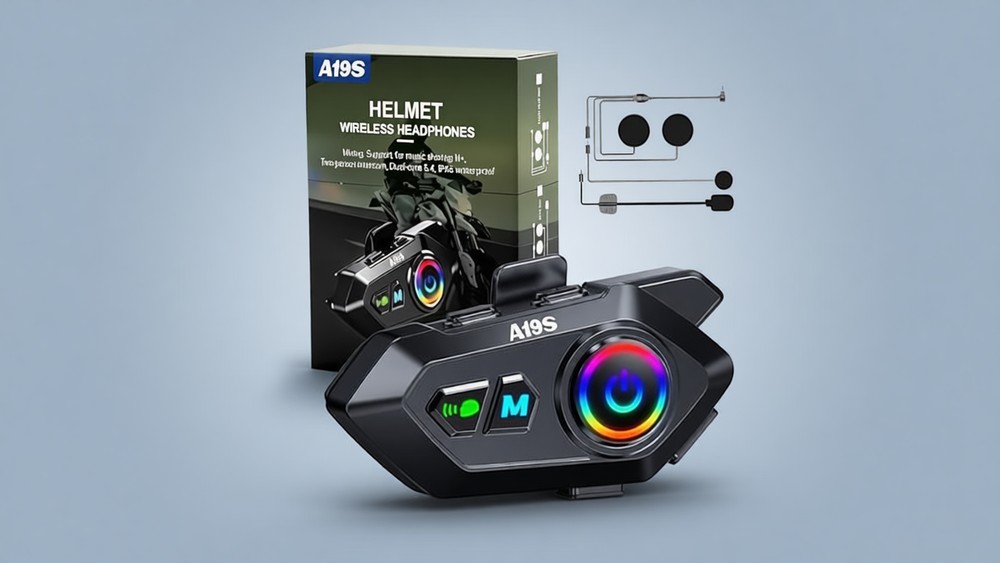
What broke, what did not, and who is happy
The failures are all order-confirmed, and they are concrete. One owner has found the left speaker dead inside a week of riding, and no reset brought it back. Another reports the opposite problem to the loudness claims: with wind coming hard at the helmet, nothing was audible at max volume.
The confirmed wins are real too. A pair of off-road riders bought two units and came away glad they skipped the expensive options: pairing to the phone took seconds, the speakers fit the helmet's built-in slots, the wires are long enough to position everything, and the sound held up. Their verdict was that you cannot go wrong at this price.
A parent running one in their helmet and one in a child's dirt-bike helmet reported loud audio at quarter volume on a slow pit bike and a link that held three blocks apart. That owner also mapped the music-sharing quirk exactly: shared music blocks talking while it plays, but if each rider plays their own track, you can talk over your own music.
The extremes match the histogram. Two foreign-language one-liners sit at opposite ends, one word of praise and one word of complaint.
Nothing in between. And the endorsement signal is nearly absent: the most-endorsed texts on the page tie at a single helpful vote each, so no review here carries community weight behind it. One five-star text is a video review whose written words the page replaces with a player card, so there's no checking its content either.
A thousand meters is a radio class away
The title promises a 1KM two-way intercom in open terrain. Typical real-world range for Bluetooth 5 runs 40 to 400 meters, and the units that hold a link past hills and buildings do it with mesh radio, which the A19S does not have. A kilometer claim on a plain Bluetooth link needs flat ground, open air and nothing between the helmets.
The record can't settle it. The longest intercom distance any owner describes is roughly three city blocks. Nobody reports a test at open-terrain distance in either direction, so the thousand meters stays a lab-shaped number.
The cross-brand pairing bullet sits in the same spot. The listing says the A19S pairs with many mainstream intercom brands, a big promise at this price. Not one captured text describes pairing it to anything but a phone.
Then there is IPX7. Under the IEC 60529 standard that means the A19S survives a dunk to one meter for thirty minutes in a lab.
It's a rating about water depth and time. It says nothing about spray pressure, and nothing about how a unit clipped to the side of a helmet sits in a crosswind rain. Nobody in the record has reported riding this thing in a storm.

The battery claims are the tallest on the page, and this is who should still buy it
The listing claims 120 hours of music, 60 hours of talk time and 600 hours of standby from a 1000mAh battery, topped up in one hour over USB-C. Flagship intercoms from the two biggest brands claim roughly 10 to 17 hours of talk on similar capacity, so the talk figure here is several times the class norm. It may be true.
Nothing in the record tests it: no owner text reports battery life at all, in either direction, and a one-hour charge implies an aggressive charge rate for a budget unit.
So who should buy it? A rider pair who want to check in on trails, talk at low speeds, and treat a dead unit as an affordable loss, which is exactly how the off-road buyers used theirs. At this price the downside is capped. If you want both helmets covered in one order, the same model sells as a two-unit pack under a different brand name, and we checked that SUOOKC A19S two-pack separately.
Who should keep looking? Anyone who needs a range figure with evidence behind it, a battery claim an owner has actually confirmed, working cross-brand pairing, or a known support path after a failure. The record answers none of those questions, and the one confirmed hardware failure recovered through no reset anyone describes. The comparison table shows what the rest of the field costs per rider, and at the other end of it sit units with owner records that can actually answer those questions.

Frequently Asked Questions
How far away can I stay from another rider?
Standard Bluetooth 5 links typically reach 40 to 400 meters in the real world. The listing's 1KM claim is an open-terrain best case, and the longest distance an owner actually describes is about three city blocks. Plan around the class norm, not the title.
Can we listen to music together and talk?
You can share a single music stream with another rider, but talking stops while that shared audio plays. One order-confirmed owner found the workaround: if each rider plays their own track, you can talk over your own music without dropping it.
Is this headset safe in heavy rain?
The IPX7 rating means a one-meter dunk for thirty minutes in a lab. It isn't a rating about spray, pressure or mounting angle, and no owner in the captured record has reported rain use either way.
How does it handle wind noise?
The record splits both ways. One order-confirmed rider reports nothing audible at max volume once the wind picks up. Another reports clear, loud audio at quarter volume on a slow pit bike.
Speaker placement against the ear decides much of this on any helmet unit, and neither report names the helmet.
What happens if a speaker dies?
One owner's left speaker failed inside a week, and no reset fixed it. The spec table carries a one-year warranty. No support outcome, good or bad, appears anywhere in the record, so the warranty is a promise on paper with no evidence behind it yet.