Replacing a 36V battery is one of those jobs where the measurements matter more than the marketing, and the annesc listing makes that unusually literal. The title says 21Ah.
So does the spec table. Even the model number, HL3621, says 21. And then the box list, the part of the page that tells you what actually arrives, says 20AH.
That is not a typo-level discrepancy you can shrug off, because 36 volts times one amp-hour is 36 watt-hours, and the two readings differ by exactly one of those. Which number is real decides what the pack weighs in your range math and what it is worth per watt-hour. The listing never picks a side.
So this review walks the listing the way a careful buyer should: what 40 amps of BMS actually covers, what the two same-day five-star reviews do and do not establish, the physical details that decide whether the thing fits your compartment at all, and a range estimate built on stated assumptions instead of the seller's silence.
One battery, two capacity figures, one price
The annesc 36V battery puts 756Wh on paper if you believe the title, and 720Wh if you believe the box list.
Either way the money math works out well. At the asking price, the pack lands in the cheaper third of the 301 batteries we track by cost per watt-hour, about 28 cents per watt-hour on the bigger reading, and our comparison table shows the live position, which shifts with the price. That is real value for a 36V pack with a 40A BMS, and it is the strongest thing this listing has going for it.
The record behind that value is thin enough that you should look at it directly.
Five stars from two ratings. Both written reviews carry the same posting date, March 3, 2026, and neither one carries a purchase behind it. There is nothing here that proves the pack is bad, and nothing that proves it is good.
The honest position is that the spec sheet is plausible and unproven, and the first question to put to the seller is which capacity actually ships.
What 40 amps covers, and what the 80-amp line cannot show
Forty amps at 36 volts is about 1440W continuous on a fresh pack, and that covers nearly every 36V motor anyone actually rides. In our own comparison data, 30A is the common BMS figure among the 36V packs that state one, so the BMS here gives you room most of its class does not.
The title's own ceiling is 1500W motors, and the arithmetic says that top end sits in burst territory rather than sustained output, since the continuous figure leaves no headroom above it. A 750W motor, like the one in the first review, sits comfortably in the middle of what this BMS can feed.
The bullet that claims 80A instantaneous maximum deserves no such trust. It is spelled "instaneous max discharger curret" in the original, it appears nowhere else on the page, and no spec table backs it.
A listing that cannot spell its own headline spec should not get the benefit of the doubt on the number itself. Plan around the 40A continuous figure, and treat anything above it as marketing.
One more spec-table tell is worth naming. The chemistry field says Lithium Metal, and a true lithium metal battery is a non-rechargeable primary cell, which is exactly why the name exists to separate it from rechargeable lithium-ion. A 36V pack you charge a thousand times is not a primary cell, so the field is mislabeled.
On its own that proves nothing about the cells inside, but it is one more sign the listing was assembled quickly.
Two five-star texts, one posting date, zero confirmation
The whole written record fits in two paragraphs, which is why it is worth reading closely. Both texts went up on March 3, 2026.
Neither shows a confirmed order behind it. The first calls it a great replacement battery for a 750W electric bike, says it charges quickly and holds charge well, and reports no issues with fit or performance so far. The second says it arrived well packaged and fully charged, installed easily, and fits perfectly.
The second text also makes the boldest claim on the page: range is better than the reviewer's old battery, lasting a full week of commuting without a charge. There is no mileage attached, no commute distance, nothing you can check.
A week between charges can mean five short trips or fifty miles, and the text does not say which. Both reviews stay at the level of impressions that could be written without opening the box, and neither mentions a detail that requires having one: no dimensions, no photo, no specific gripe, no number except that week.
What nobody has reported matters more on a listing with a capacity contradiction. No buyer has metered the actual capacity, so the 21-versus-20 question stays open. Nobody has described the BMS under a real load, water exposure, the USB port, or long-term use.
The first genuine owner report on this page should settle several of those at once, and until one lands, a perfect 5.0 on two ratings is a record of two people, not a record of quality.
Measure the compartment, then read the box list twice
The physical spec worth more than any electrical one here is the footprint. The bullet gives 14.5 by 3.74 by 5.43 inches. The spec table gives only two of the three, 4.8 by 14.47 inches, which reads as the depth pair collapsed into one number.
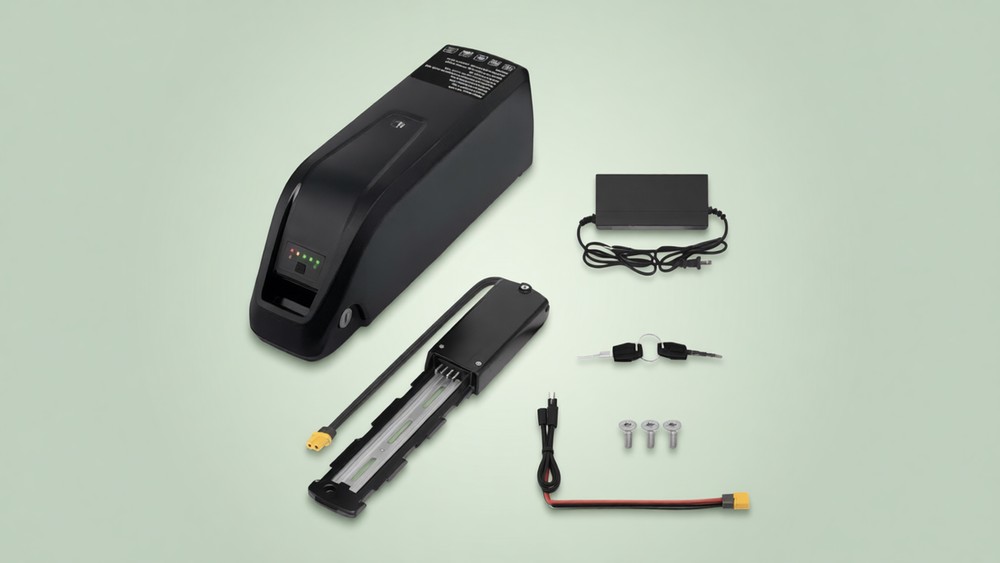
The listing itself tells you to measure your compartment before ordering, and on a pack whose capacity is already self-contradictory, that advice deserves to be followed rather than skimmed. The 4-pin holder mounting plate in the box means this is not a drop-in for a standard downtube or shark mount, it is a pack that brings its own hardware.
What ships: the pack, the 4-pin plate, a male XT60 discharge connector, two keys for the safety lock, and three screws. The lock, an LED charge indicator, and a power switch are the practical extras here, and they are the kind of small features you notice daily rather than on the spec sheet.
756Wh over 5.5 kg works out to about 137Wh per kilogram, a claimed energy density that passes the smell test for a complete pack without tripping into the impossible range some listings publish. Even on the 20Ah reading it is about 131Wh per kilogram, a claimed figure in the same plausible band.
One instruction in the bullets earns its place: plug the cable into the battery first, then connect to power. That is a real charging-order note, the kind of detail that suggests someone thought about how people actually damage packs and chargers. What the listing does not give you anywhere is the charger's amperage, which matters more, and I will come back to that.

Range is arithmetic here, because the listing gives you nothing else
No range figure appears anywhere on the page, so the honest move is to build one with the assumptions on the table. An e-bike battery usually lasts 25 to 75 miles per charge, with the spread driven by how much the motor does the work.
Take a gentle pedal-assist draw of roughly 20Wh per mile and the 756Wh reading lands in the high thirties of miles. Run it throttle-heavy at about 35Wh per mile and you are in the low twenties. The 720Wh reading shifts both answers down by a mile or two, which is the quiet good news inside the capacity fight: the 21-versus-20 dispute matters less than your riding style does.
What you cannot compute is charge time, because the charger's amperage is stated nowhere. The listing says a charger is included and calls the setup fast charging, but a fast-charge label means nothing without a current figure.
On a pack this size the gap between a 2A and a 5A charger is hours, and the page leaves you guessing. Ask the seller before ordering if charge time matters to your routine.
Frequently asked questions
Is the annesc 36V battery 20Ah or 21Ah?
The listing does not settle it. Title, spec table and model number say 21Ah, the box list says 20AH, and both readings have been in this article's arithmetic.
The way to know what you received is to meter a full charge through a watt-meter on the bench, which takes one cycle. If you order, keep the packaging until you have that number, because the two figures differ by 36 watt-hours.
Will it fit a standard downtube or shark mount?
No. This pack ships as a rectangular unit with its own 4-pin holder plate and screws, so it mounts where you put the plate, not into an existing frame cradle. Measure your compartment against the bullet's 14.5 by 3.74 by 5.43 inches before ordering, and remember the spec table only confirms two of those three numbers.
Is the 80A peak rating real?
Treat it as unproven. The claim appears in one bullet that misspells two of the four words around it, and no spec table on the page repeats it. The 40A continuous rating is the figure the listing states consistently, it works out to about 1440W at 36 volts, and that is the number your motor math should run on.
What is the USB output in the title for?
Nobody knows from this page. The title mentions USB output once and nothing else on the listing, bullets or spec table, describes it again, not the port's output rating and not how you access it. Do not buy this pack for that feature, because the page gives you nothing to hold the seller to.
How long does a full charge take?
There is no honest answer available, because the charger's amperage is stated nowhere on the listing. Any charge-time figure would be invented arithmetic, and this review does not publish invented arithmetic. The one charging instruction the page does give is worth following: battery cable first, then the wall.
If the capacity contradiction does not scare you off, the value case is real, and the current price on Amazon is worth checking against our battery comparison table before deciding.
For more 36V options with longer review records, browse our other battery reviews and compare how the established packs in this class report out. You can also browse 36V ebike batteries on Amazon to see the alternatives side by side.
