Dual 720p cameras in 2026 could be ridiculous if the am prime wasn’t completely waterproofed to an ip67. You have to make a trade-off here. In order to create a dual channel system with a waterproofed casing, you will lose some pixel density. Depending on what type of riding you are doing, whether or not that is a good deal versus a bad compromise will depend on you.
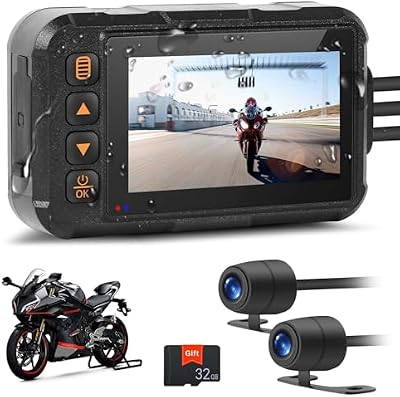
Cameras, Screen and video quality
Both sides of the am prime shoot at 720p. That’s the issue. A frame from a 720p camera in 2026 looks pretty soft. License plates appear to be very clear in close proximity (10 - 15 ft). However, at about 30 feet the license plates start to get blurry. And at about 50 feet you won’t know if there is a license plate on the vehicle. With Two cameras at 720p, you don’t receive anywhere near the same plate capture distance that you would with a single 1080p unit.
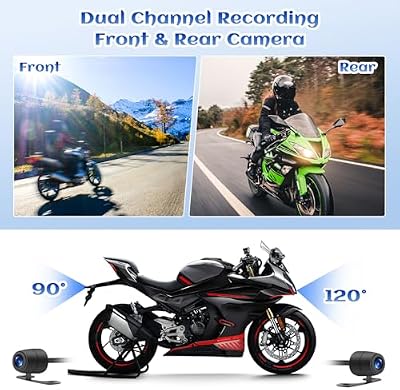
With a wider 150 degree field of vision, you will capture more vehicles in your shot. However, because the camera has such a wide fov, the details at the edge of the picture stretch outward. When a car cuts you off from a side angle and you attempt to zoom in on the license plate, it will look much worse than had the vehicle been right dead-center in the frame.
If maximizing plate resolution is your top priority then you’re going to be unhappy with a 720p dual system. Your best bet is going to be to opt for a single 4K channel pointing in the direction of the action. On the other hand, if you just need video from both ends of your bike, then a 720p dual system will suffice.
The 3 inch IPS Screen plays back video fine enough for you to quickly scan it and decide what was important during your ride. You can watch the video from your ride immediately after you complete it and pull out your phone. The Screen isn’t extremely visible when exposed to direct sunlight. I doubt you’ll be able to read anything on it while stopped at an intersection. As far as viewing your video goes, it’s probably better to do it inside, in a lit room, where you can easily read what’s being shown on the Screen and it’s visible and adequate.
There are three ways to configure loop recording: 1 min, 3 min & 5 min. Regardless of which option you choose, the older file(s) will continue to be written over until all available space on your memory card is consumed. This is typical behavior for any dashcam. the included memory card contains 32 GB of storage space. Based upon what you set the clip duration as, you may expect to get somewhere between 1 hr & 2 hrs of continuous dual-channel video based upon the total amount of available space and how many files you write to that space.
Using a shorter clip duration like 1 min will provide more granular control for when old files are deleted. however, you will end up writing more files to the memory card and consuming all of the available space quicker. A 5 min clip duration will result in fewer files overall. therefore, less time spent searching through them when looking for a particular piece of video after an event occurs.
The wdr (wide dynamic range) feature combined with an f/2.0 aperture results in decent nighttime video performance. While the sensor will still produce a lot of noise in low-light situations, headlamp glare from opposing traffic will still cause blown-out highlights. The wdr will help bring the image closer to balance. however, there’s only so much a 720p sensor can accomplish.
You’ll be able to obtain a usable record of whatever happened at night. however, don’t expect to be able to tell what license plate number is printed on a bike’s license plate located Two bike lengths ahead of you under streetlights.
When a collision is detected, the g-sensor freezes the relevant portion of video preventing it from being overwritten by newer recordings due to loop recording. The parking monitor provides additional functionality allowing the camera to wake up when motion enters its lens’ field-of-view while the bike is parked. If a collision is detected while the bike is parked, the camera automatically records. To operate continuously (i.e., all day), the parking monitor requires a constant power supply. thus requiring a hardwire kit. No, the kit is not provided with the camera.
Without one, the camera only operates while the bike is turned on using either the USB port or cigarette lighter adapter.
Weather resistance and parking mode
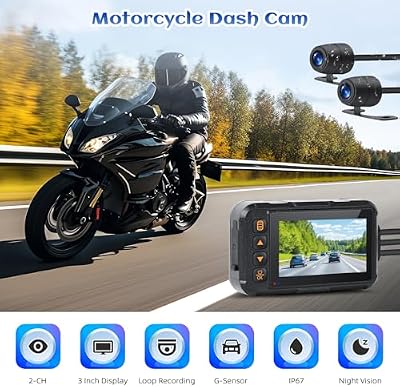
While many people talk about ip ratings as though they were some sort of magical mojo that guarantees products won’t ever be damaged by water, they are nothing more than testing standards for determining the level of environmental resistance for electronics. The am prime exceeds this standard with an ip67 rating which essentially states that it is dust-proof and capable of withstanding temporary immersion in water at depths up to one meter for thirty minutes.
Motorcyclists know that water is often directed directly at their cameras while they are riding due to rain, road spray and washing down streets. The ip67 seal helps protect against damage caused by water entering areas where lesser units would fail. Although there are numerous tests used to determine compliance with various levels of ip ratings, this is an industry-wide accepted method used specifically for evaluating how resistant electronic equipment is to moisture.
The rear camera attaches to the front unit utilizing a cable routed along the frame of the motorcycle. The weakness in the waterproofing of this system lies in the area where the cable exits through the rear camera housing. The connector itself remains watertight in most cases. however, those who regularly park their motorcycles outside for extended periods of time should remove this cable and inspect it periodically for signs of water seepage. Waterproof dielectric grease applied around the mating faces of this connector extends its lifespan and minimizes its chance of failure.
In addition to triggering recordings based on motion activity detected within its field-of-view, this camera includes an option called “collision detection”. Once triggered by a sudden physical impact while parked, this feature allows the camera to begin recording regardless of whether motion activity has occurred within its field-of-view.
Here’s why this creates an added expense:
The parking monitor consumes constant power. hence, it continues to draw current from its power source even when the bike engine is off. Normally, power only flows into this device when it receives power from the ignition switch or an accessory switched circuit. Since neither source provides power when the engine is off (and typically not even during prolonged periods of idling), riders must install a separate hardwire kit. This kit provides an alternative path for power to flow into the device providing 24 hour-a-day monitoring capability. There is no such kit provided in the packaging with this product.
Installing a separate power bank can allow limited parking coverage when needed. however, installing a true hardwire installation (that doesn’t require batteries or bulky enclosures) is generally neater and easier to manage. Many average diy motorcyclist types will feel confident with making simple hardwire connections using basic tools. although many may prefer working on a professional basis (for obvious reasons).
What do amazon reviewers say about it?
The am prime motorcycle Dash cam currently averages approximately 4.1 stars among Twenty-one amazon customer reviews. Twenty-one reviews are relatively few in terms of establishing statistical significance. however, it indicates most customers are happy with their purchases , albeit too few reviews exist to indicate whether satisfaction rates vary across different buyer demographics.
Buyer complaints generally focus on resolutions. Poor nighttime video performance is equally commonplace in this budget class of dashcams as is poor daytime resolution at this price point.
At 720p resolution, any person expecting to obtain plate-level readability from a dual-camera budget model will likely be disappointed with their experience. The wdr and f/2.0 aperture improve upon these limitations. yet, they can only compensate so much for a sensor with behind a 720p channel.
Reviewers tend to comment favorably regarding both g-sensor locking functionality and loop recording capabilities. Customers tend to appreciate that accident videos remain intact on memory cards rather than looping over with new recordings.
Only a handful of reviewers have commented negatively regarding the Screen size being inadequate for real-time preview usage during rides. however, all reviewers agree that it functions adequately for post-review playback purposes.
Which buyers will benefit from this camera?
Based upon specifications and pricing strategy employed by manufacturer, there are Two distinct categories of motorcyclists targeted by the am prime: those interested in obtaining dual-channel coverage but unwilling/unable/wanting-to-spend big money on a single-channel high-definition camera. Commuter-type scooter riders who frequently travel short distances through congested city traffic where license plate recognition at 10-15 feet can meet minimum state insurance requirements.
If capturing maximum resolution license plates is your primary concern , i.e., you want a single channel hd camera pointed at where-ever you are experiencing an incident , then this camera is not for you. Consider purchasing a higher-resolution camera with greater plate capture distance , visit our Dash cam comparison chart to explore single-channel options prioritizing plate capture distance above dual-channel coverage , or consider skipping this camera altogether if hard wiring for parking mode functionality seems too involved.
Check the current AMprime listing on Amazon to confirm what ships in the box today.
Frequently Asked Questions
What card size does the AMprime use?
The AMprime uses a standard microSD card. A 32GB card is included. The unit supports cards up to 128GB. For longer sessions or if you replace the included card, use a high-endurance microSD rated for dash cams. Class 10 or higher is required for dual-channel recording.
Is 720p enough for license plate capture?
At close range, yes. Within 10 to 15 feet, 720p resolves characters clearly enough for identification. Beyond that, plates blur and become unreadable. If plate capture at 50 feet or more matters to you, 720p will not deliver. A higher-resolution single-camera unit handles that use case.
Is a hardwire kit required for parking mode?
Yes. The parking monitor requires constant power. The default power path through the ignition or accessory circuit only works while the bike is running. A hardwire kit connects the camera to an always-on 12V source. The kit is not included. Without it, the parking monitor cannot function unless you attach an external USB power bank, which adds bulk and compromises the hidden-mount design.
Is the camera waterproof in rain?
The IP67 rating protects against dust and temporary water submersion. Rain, road spray, and washing should not cause water ingress. The cameras record in heavy rain. The connector between the rear cable and the front unit is the one point to inspect after long-term wet exposure.
Does the camera record both cameras at once?
Yes. Both front and rear record simultaneously in 720p. The 3-inch IPS screen shows the front feed. The rear camera records in the background. You cannot view the rear feed live, but both channels are stored on the SD card for playback later.
How large is the screen?
The AMprime features a 3-inch IPS display. Use it for navigating menus and reviewing footage after a ride. It is not bright enough for direct sunlight, so check footage in shade or at home. The size works for reviewing quality and selecting files but is not practical for monitoring while riding.
See where this fits against the rest of the market in the comparison table.
Browse more riding and buying guides on the blog.