Converting a small-wheel bike is where budgets go to die quietly. The bike cost little, the kit looks affordable, and then the quotes for a proper 48V pack start arriving. So a front hub kit that undercuts most of the category by a wide margin is going to get clicked on, and this one also arrives with the tire and tube already fitted to the wheel.
The catch with a one-review listing is that the review cannot warn you about anything. Here there is exactly one owner text, from March, and it says the kit works and the speed readout needed a spoke magnet fitted. That is the entire recorded history of the kit.
Everything else you can know comes from the listing's own numbers, and from checking whether those numbers survive arithmetic.
This review walks through what 128.99 actually buys, what the one owner account does and does not cover, whether the speed claims hold up on paper, and where the listing makes promises the spec rows cannot cash.
The wukaeiue 20-inch 1000W front hub kit is one of the cheapest front-hub conversions we track, sitting in the cheapest fifth of the comparison table, and its single owner account is positive.
The motor's speed claims survive their own arithmetic, which is rarer than it should be in this price band. What you are buying is a complete front wheel, not a complete electric bike, and the listing leaves the controller, throttle and pedal-assist parts unnamed.
For a 20-inch folder or a compact frame with standard 100mm forks and a disc brake up front, the price makes it worth a look. For anyone who wants owner evidence before spending, the record here is one text long.
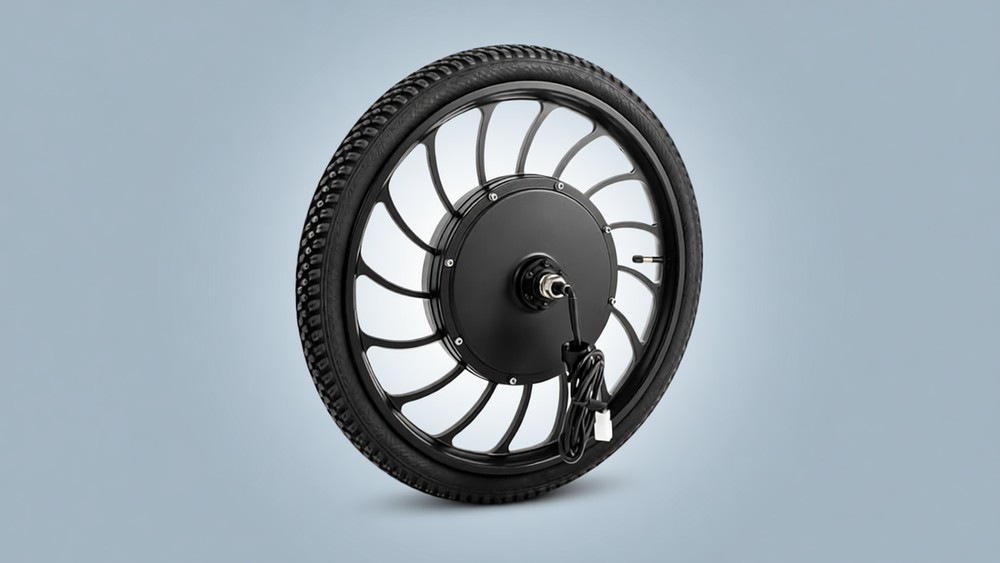
A complete front wheel with the motor inside it
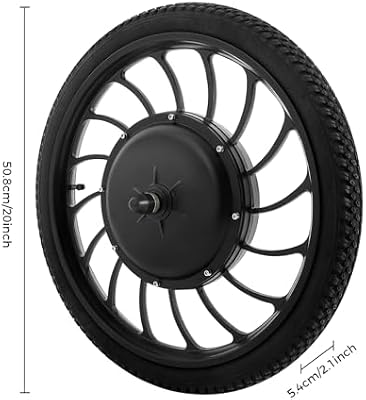
The box holds one thing: a 20-inch front wheel with the motor built into the hub. The listing calls it an integrated wheel, and the claim that matters for fit is the hub width, 100mm, which is the standard front fork spacing on adult bikes.
A tire and inner tube come fitted, so the wheel is ready to go on the bike rather than arriving as a bare hub you have to lace. It supports standard 6-hole disc rotors, and the construction is aluminium, iron, copper and magnet with a baked finish.
The motor itself is brushless and gearless. Gearless means direct drive: the motor shell is the wheel, with no planetary gears inside to wear out or whine. The trade is mass.
A direct-drive hub carries more rotating weight than a geared one of the same power, and all of that weight hangs on the fork of a small-wheeled bike.
Price is the reason this kit gets attention. In the cheapest fifth of the 191 conversion kits we track, it undercuts most front and rear 1000W listings by a wide margin, and you can see exactly where it lands in the live specs box on the comparison table.
There is a sibling in the family too: the rear-hub version of the same 20-inch kit costs about 11 more and swaps the wheel to the back, which changes the fit question and the handling question both.
The one-review record, and the spoke magnet lesson
One owner has rated the kit five stars, and that same owner wrote the only text. The text is from March 2026, it is a confirmed purchase, and 3 people have found it helpful. In full, the account says the kit works great so far with no issues, and that the buyer did have to get the magnet number for the speed readout, and that they highly recommend it.
That spoke magnet note is the single most useful sentence in the record. Hub motor kits count wheel speed by watching a small magnet pass a sensor on the fork, and until that magnet is fitted, the display shows nothing. The buyer's account is the second time this lesson has come up in this brand's family: the rear-hub sibling's only owner text reports the same fix.
Budget ten minutes for it on install day and the mystery is solved before it starts.
Everything else is a gap the record does not fill. Nobody has described the kit after a month, let alone a season.
No owner has mentioned how the pedal assist behaves, whether the controller gets warm, how the kit climbs, or what the front end feels like with 1000W pushing through it. A five-star average from one rating is not evidence of reliability. It is evidence that one person is happy so far, and the article can only carry that so far.
The speed arithmetic is the rare claim that checks out
Start with the numbers the listing gives: 420rpm maximum, 40km/h top speed, and a range of 0 to 24.85mph. Those last two look like different claims. They are the same claim twice, because 40km/h is about 24.9mph, and the mph bullet is just the metric figure wearing a different unit.
The rpm figure is the one worth checking, because it is testable on paper. A 20-inch wheel rolls about 1.59m per turn. At 420 turns a minute, that is about 11.2m every second, which works out to about 40km/h with no load.
So the headline speed and the rpm figure agree with each other, and both land at roughly 25mph before rider weight, hills, or a small battery's voltage sag pull the real number down.
The other figures decode cleanly too. 1000W at 48V is about 21 amps of continuous draw, which is the number to keep in mind when sizing the pack.
Torque is listed up to 35N.m, and at a 20-inch wheel's quarter-metre radius that is about 140N of push at the ground. The same torque on a 26-inch wheel would give about 105N. That is the quiet case for small wheels: the same motor number turns into more force when the wheel is smaller.
None of this is measured performance. It is the listing's own arithmetic agreeing with itself, which on this tier of the market is not a given.
Where the listing oversells, in three places
The first oversell is precision. The listing claims an efficiency conversion rate of 88.7 percent, stated to a tenth of a percent. Real efficiency depends on load, speed, temperature and voltage, and no listing backed by one owner review has measured anything to that decimal.
A claim like that is marketing dressed as engineering, and the honest reading of it is "over 80 percent, probably".
The second is weather. The kit claims reliable operation from -20 to 50 degrees Celsius. The motor may well survive that band.
But the kit includes no battery, and no lithium pack you could pair with it performs well at -20C, where capacity drops sharply, so the claim can only describe the motor in isolation. Ride in real winter cold and the battery, not the hub, is what gives up first.
The third is silence. Across seven bullets, the listing never names a controller, a throttle, a pedal-assist sensor, or a charger. It sells a wheel with a motor in it and leaves the rest of the conversion undefined.
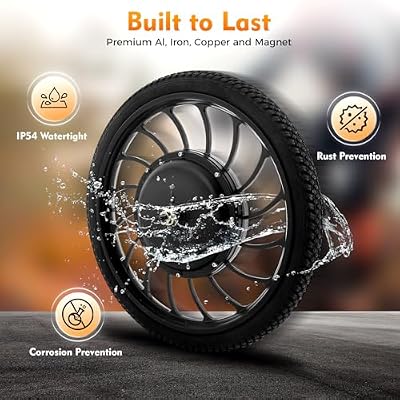
That does not mean those parts are missing, but it does mean the buyer should confirm what ships with the seller before ordering, because the price only looks complete until you price the parts it does not name. The IP54 rating, meanwhile, means dust protection and splashing water, not submersion, and it is the least bold claim on the page.
A front hub changes the bike it goes on
Put the motor in the front wheel and the wheel you steer becomes the wheel that drives you. That is the whole front-hub trade in one sentence.
The motor's weight rides on the fork, and a hub motor concentrates its mass in the wheel, which affects handling through the higher dynamic wheel load, per Wikipedia's hub motor overview. On a small folder the effect is milder than on a long-frame bike, but it is there, and front forks feel it first.
The fit checks matter more than usual because of that. Measure the fork spacing first: 100mm is the standard, and this kit is built for it, but folders and older frames vary. Check the front brake next.
The hub takes a 6-hole disc rotor, so disc-brake bikes bolt straight in, and rim-brake bikes are a question the listing never answers, because a motor hub has no braking surface for pads to reach.
And look at what the fork is made of. The listing never mentions a torque arm, the flat bar that stops a powerful hub motor from winding itself out of the dropouts, and front dropouts take that force head-on. Whatever the fork material, that absence is worth a question to the seller.
One more check sits outside the bike entirely. 1000W puts this kit above the 750W cap that defines the three legal e-bike classes in the United States, so it rides outside the class system, per Wikipedia's e-bike overview. Where you can ride it, and at what speed assist is tolerated, depends on local rules rather than on the class stickers a 250W or 750W kit gets to wear.
FAQ
Does the wukaeiue 20-inch front hub kit include a battery?
No battery is named anywhere in the listing, so budget a separate 48V pack. The motor draws about 21A at full power, and a 48V 10Ah pack would run flat in under half an hour at that draw. A 15Ah to 20Ah pack is the sensible floor for this motor.
Is this the front or rear version?
This one is the front hub kit. The brand sells a rear-hub sibling at about 11 more, and the two are easy to mix up because the titles differ by one word.
How fast does it go?
The arithmetic says about 25mph with no load, from 420rpm on a 20-inch wheel. No owner has reported a real-world top speed, so treat 25mph as the ceiling, not the promise.
Why does the speed readout show nothing?
The spoke magnet is missing or misaligned. One owner has confirmed the fix: fit the magnet to a spoke so it passes the sensor, and the readout comes alive. The rear-hub sibling's owner text reports the same lesson.
Is a 1000W kit street legal?
In the United States, the three e-bike classes cap motors at 750W, so this kit sits outside them. Check local rules before riding trails or paths that require a class-labelled bike.
Will my rim brakes work with this wheel?
The listing supports 6-hole disc brakes and says nothing about rim brakes. A motor hub has no braking track, so a rim-brake bike needs either a different kit or a front disc conversion, which is its own project rather than an add-on.