Most budget conversion kits are built for 26-inch wheels, which leaves road bike and hybrid owners scrolling through listings that will not fit their frames. A 700C rear hub kit is one of the few wheel sizes the cheap end of this market still ignores, so a listing that names 28 and 29 inch compatibility gets attention whether it earns it or not. The SRTYGHW kit sells exactly that: a 1000W gearless hub laced into a 700C rim, with an LCD display and a controller in the box.
It also sells a promise in its title that the parts list does not back up, a warranty row measured in months rather than years, and a five-star average resting on two texts that read like the bullet points rewritten. None of that makes the kit a bad buy on its own. It makes it a kit you should buy with the right questions already asked.
This article walks through what the listing claims, what the two-text record can and cannot confirm, and where the kit sits in our own price data. The numbers below come from the live listing and our comparison table, checked against each other.
The honest verdict first: the SRTYGHW 700C 1000W rear hub kit is a plausible buy for a road or hybrid frame and an unpersuasive buy for anyone who needs proof before spending it. The record behind it is about as thin as records get, the three-month warranty is the shortest in its price band, and the pedal assist sensor the title advertises never appears in the box list. I'd only call it worth it if your frame is genuinely 700C and you're comfortable asking a seller to confirm contents before the box ships.
A five-star average built on two texts
The detail page shows 5.0 out of 5, and the histogram backs it up: 100 percent five-star, nothing in any other band. What the histogram doesn't show is how small that base is. Two global ratings, two written texts, and both dated July 7, 2026, the same day.
The shape of those texts matters more than their score. Neither carries a purchase badge. Neither has drawn a single helpful vote. And both reuse the listing's own vocabulary to an unusual degree: the first text calls the wheel "well-made with aluminum alloy," "strong, rustproof," and able to "easily support 264lbs," which is bullet five of the listing compressed into a sentence. The second text's "runs quietly, accelerates smoothly" and "requires almost no maintenance" track the motor bullet's "smooth, fast acceleration and low noise operation" and its maintenance claims just as closely.
I can't tell you these texts are fake. I can tell you what a careful reader does with them: treat the 5.0 average as a data point about the listing's presentation rather than a record of ownership, and look for the substance elsewhere. In this case the substance is thin. No text mentions installation, wiring, the display in daily use, or how the kit behaves on a real commute. The kit comparison table tracks 191 kits, and plenty of them carry deeper records than this at the same price.
The PAS in the title and the parts in the box
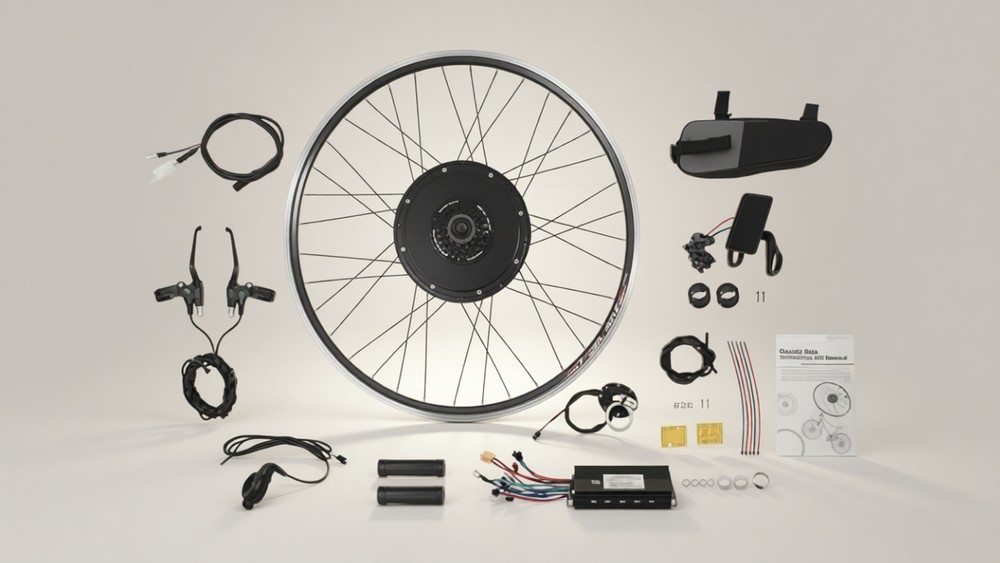
The title promises "LCD Display & PAS." The parts list is where that promise goes quiet. Included Components reads: one motor wheel, one display, two brake levers, one controller, and one thumb knob handle. There's no pedal assist sensor in that list, no strap, no bracket, nothing that mounts to a crank arm or chainstay.
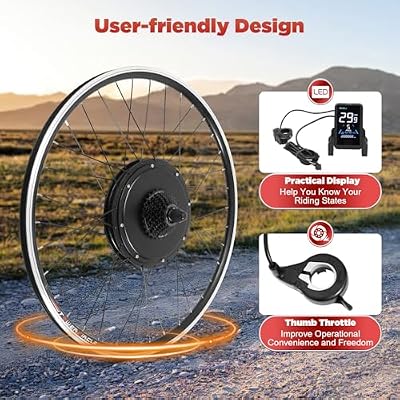
That gap matters because PAS changes what the bike is. A throttle-only kit is legal in fewer places and rides differently: power on demand rather than power that follows your legs. The listing's bullet copy leans on the five speed gears and a cruise function you enter by holding a button for two or three seconds at speed, which is throttle behavior, not pedal sensing. If PAS is the reason this listing caught your eye, message the seller and get the sensor named on the invoice before you order. If you're happy with a thumb throttle, the title's wording costs you nothing, but you should know it's wording.
The same parts list also confirms what most kit listings bury: no battery, no charger, no torque arm. You'll match this motor to a 48V pack you already own or buy separately, and our battery table is the place to price that half of the build.
The 45-55 km/h claim, decoded
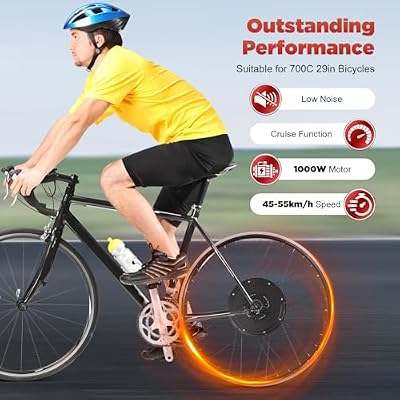
The motor bullet says the kit can reach 45 to 55 km/h, which converts to roughly 28 to 34 mph. On a 700C wheel with a circumference near 2.1 meters, holding 45 km/h takes about 360 rpm of the wheel, and the top of the band asks for around 440. Those are numbers a direct-drive 1000W hub can produce with the wheel off the ground and a full battery, which is exactly why the top of a speed band always reads optimistic. Add a rider, a headwind, and a battery sagging under 21 amps of draw, and the realistic figure lands somewhere in the middle of the range rather than at its ceiling.
That 21-amp figure is worth a moment, because it decides whether your battery can even feed this motor. 1000W divided by 48V is about 21A at full output, so a pack with a 20-amp BMS sits at its limit and a 25- to 30-amp BMS has room. Pair the motor with a pack that can't deliver and you'll see voltage sag and cutoffs that the motor gets blamed for.
The five speed gears and the cruise hold give the kit a usable control scheme once it's moving, and the brake levers cut motor power the moment you pull them, which is the safety behavior you want on a heavy direct-drive wheel.
Three months of warranty on a wheel you cannot test
The spec table's warranty row reads three months, printed in capitals of all things. Not three years, not one year, three months. Among the kits we track in this price band, one-year rows are common and the INPAITOO 20 inch 1000W kit reviewed alongside this one states a year against manufacturer defects outright. Three months covers the unboxing and maybe the first serious rides. It does not cover the failure mode hub motors are known for, which arrives gradually: bearing wear, hall drift, water past a seal.
The controller's dual-mode design is the listing's most interesting spec, and the bullet describes it more honestly than most: the motor runs with Hall sensors, and if that component fails, the controller switches to non-Hall mode and keeps the wheel turning. That's a fallback for a failed sensor, not a performance feature, and it's a fair thing to promise. What it doesn't promise is that the switch happens without a hiccup, and no owner text exists to describe what the bike feels like after the controller drops to sensorless running.
A short warranty on a wheel you can't test before buying shifts the risk onto you. I'd price that in: the kit's 170.00 sticker is really a bet that the first 90 days of riding go cleanly.
Living with a gearless 700C wheel
The gearless label is the spec that shapes daily riding. A direct-drive hub has no planetary gears inside, so there's nothing to strip and nothing to whine, but the motor is heavier than a geared equivalent and it drags against your legs when you pedal with the power off. On a 700C road frame that drag is noticeable on any stretch you ride unassisted.
There's also the physics of hanging a motor on a wheel. Hub motor weight rides below the suspension, as unsprung mass, which hurts ride quality and handling, and the motor itself is less shielded from shocks and road debris than a frame-mounted drive, which shortens its life (Wikipedia's wheel hub motor article covers both points). On a rigid road bike there's no suspension to soften any of it, so tire pressure and rim tape become your ride quality. The 264lb load figure in the bullet is the wheel's rating, stated as a capacity, and it's a reasonable number for a laced aluminum rim.
The 700C fit is this kit's real reason to exist, though. Budget rear hub kits cluster around 20 and 26 inch wheels, and a road or hybrid frame with 700C rims has few options that don't involve adapter tricks. If your frame takes a 28 or 29 inch tire, you're shopping a much thinner shelf, and this kit sits in the cheaper third of everything we track by price, at about 0.17 per watt, which puts it in the middle of the 71 tracked 1000W kits by that measure. The exact position renders in the specs box on our kit table.
Frequently Asked Questions
Does the SRTYGHW kit include a battery?
No. The parts list names a motor wheel, display, two brake levers, a controller, and a thumb knob handle. You supply a 48V pack, and at 1000W the motor draws about 21A at full output, so the pack's BMS needs at least that much headroom.
Is the pedal assist sensor in the box?
The title says PAS, the parts list doesn't. Nothing in the Included Components names a sensor, so treat pedal assist as unconfirmed and ask the seller before ordering. The five speed gears and the cruise function work from the throttle side.
Can I trust the five-star rating?
Treat it as a signal about the listing, not the kit. It stands on two texts written the same day, neither badged as a purchase, neither with a helpful vote, and both repeating the bullet points' own phrases. There's no owner account of installation, range, or daily use.
Will it fit my bike?
The kit is laced for 700C rims, which fit 28 and 29 inch tires, so a road or hybrid frame with those sizes is the target. Measure your rear dropout width before ordering, and confirm your frame can accept the torque the motor puts through the dropouts.
What should I check before buying?
Three things: that the seller confirms the PAS sensor question in writing, that your battery's BMS handles about 21A continuous, and that you accept a three-month warranty window on a wheel nobody in the record has described riding beyond a product-promise restatement.