A 1000W front hub motor kit at this kind of price is the kind of listing that would make a seasoned DIY builder stop and scroll. Generally, a 1000W front hub motor kit will be priced at least twice that amount.
The inclusion of a true 1000W brushless motor, an LCD display, lever operated brake switches with cutoff, and a thumb throttle in a single package, while being relatively rare, certainly deserves a close inspection. The drawback is in the fine print. No battery is provided with this kit and there are very few customer reviews available.
As such we took a deeper dive into the SRTYGHW 1000W ebike conversion kit on Amazon to see if the value proposition is valid.
Features and Build Quality
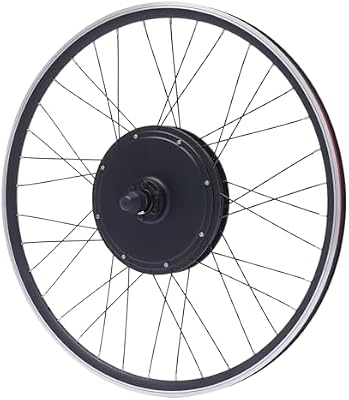
At its core, this kit includes a 1000W brushless gearless hub motor, which is housed within an aluminum alloy wheel. Since it's gearless, this design provides a more reliable unit due to the fact that there are no internal gears that may strip. However, a trade-off exists in terms of added weight and some degree of magnetic drag during coasting. But the primary reason to opt for a direct drive hub is the simplicity factor. It's a characteristic that allows budget direct drive hubs to continue operating for years.
The wheel is designed to accommodate 700C rims, thus providing compatibility with 28 and 29 inch tires. Therefore, it will suit road bikes, hybrid commuter bikes, as well as most gravel bikes. However, it won't fit fat tire cruiser bikes unless modifications are made.
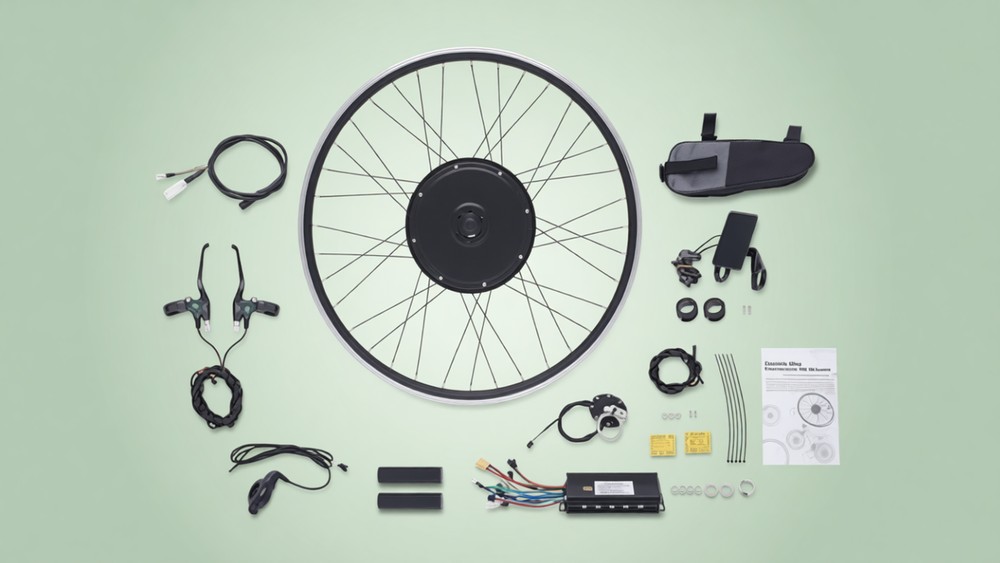
Below is what comes in the box. In addition to the motorized wheel itself (motor, hub), the box contains a controller, an LCD display, two brake levers equipped with motor cut off switches, a thumb throttle, a controller mounting bag, and a manual. All components necessary to complete the drivetrain are included (except for a battery and your existing bicycle frame).
At this price point you can anticipate basic build quality rather than high-end precision machining. Be certain to inspect spoke tightness and rim trueness upon arrival of the wheel, since budget wheels are often shipped slightly out of true.
Please note that you may wish to refer to the current Amazon listing for the latest component specifications.
Motor Performance and Speed
As stated earlier, the direct drive 1000W motor in conjunction with a 48V system produces substantial amounts of energy. According to the manufacturer's claims, the maximum speed achieved by the motorized wheel is 45 to 55 km/h, or approximately 28 to 34 miles per hour, on level terrain. Top speed will vary according to several factors including rider weight, tire pressure, battery voltage under load, and wind resistance. In most cases this will put this build outside of class 2 and class 3 legal limits, so please verify local regulations prior to construction.
The LCD screen offers multiple power settings, allowing the rider to dial back assistance when additional range is desired. Additionally, cruise control is offered via a hold function. Press and hold the throttle for two to three seconds and the motor will maintain your present speed so you can relax your hand grip on the throttle on long stretches of flat terrain. This is a feature that is typically omitted from higher-cost conversions.
The controller operates using a dual-mode setup. It utilizes Hall sensors to provide smooth power delivery. However, if a Hall sensor should fail it automatically defaults to a sensorless non-Hall mode. Hall sensor failures are quite prevalent among lower-priced hubs, so having this fall-back option is beneficial.
Both brake levers are equipped with a mechanical switch that cuts power instantly when squeezed. This is an important safety feature that ships with the kit as opposed to being sold as an add-on. They are basic units with switches instead of magnetic sensors, yet they operate correctly.
Assembly and Requirements
You have options regarding whether to assemble this kit onto your front or rear wheel. While assembly onto the front wheel is generally easier to accomplish and eliminates the complexity of changing your rear wheel, specifically changing your freewheel and adjusting your dropouts, there are potential drawbacks. Specifically, a strong front hub like this can make the front end of your bike feel light when fully throttled and create torque steer, especially when traveling uphill. Thus, while installing onto the front wheel is less complicated and preserves your rear drivetrain, it creates potential issues related to steering stability and potentially even creates conditions conducive to losing traction.
Installing onto your rear wheel addresses those concerns by distributing the power delivery more evenly throughout your bike and placing weight further aft. As such it tends to be more stable when fully throttled. Unfortunately, installing onto your rear wheel introduces other challenges including hub width and axle length as well as whether or not your dropouts can withstand the forces generated by your motor's output. Regardless of which method you choose, installing a torque arm is recommended.
The torque produced by a 1000W motor generates considerable rotational force on your axles. If you don't install a torque arm, you run the risk of having your axle spin inside your dropout and subsequently damage your frame or fork. Installing a torque arm for protection costs virtually nothing compared to repairing damaged components.
Once you've selected which wheel installation method you prefer, standard DIY installation follows. Install the controller into the bag supplied with the kit, route all wiring along your downtube keeping it clear of all moving parts, attach the LCD screen and throttle to your handlebars, and install the brake levers. If you're utilizing hydraulic brakes you'll need to replace your brake levers, because the ones included with this kit utilize mechanical switches instead of magnetic sensors.
The biggest issue here is that no battery is included in this kit. A 48V system requires a proper 48V battery pack, another major expense (and likely equal to or greater than your overall build cost). Please do not assume you can simply slap this kit together and ride once purchased. Plan ahead and account for purchasing a battery along with possible replacement brake levers and a torque arm.
Customer Reviews on Amazon
This area is where things become somewhat murky. Currently, this SRTYGHW kit has only four customer reviews, each of which sits at a flawless 5.0 stars. Four reviews represent an extremely small sampling size. It demonstrates that individuals who gave it a shot were satisfied, however, it indicates almost nothing about failure rates, reliability of individual components over longer periods of time, or how consistent component quality will be.
Newer products like the Srtyghw can only guarantee satisfaction among early adopters. Early buyers of budget kits often receive the highest-quality assembled units, and problems typically arise only after numerous consumers have purchased. As such, while these reviewers found no glaring issues, do not place too much stock in their perfect scores due to the extremely limited number of customers that have reviewed it. Also consider the risks associated with buying something brand-new that has few buyers.
If you don't mind troubleshooting wiring glitches yourself, then maybe the low review count isn't an issue for you. On the flip side, if you want an easy set it and forget it build supported by dozens of verified customers, this is probably not going to meet those expectations.
Who Should Purchase This Kit?
If you're an experienced DIY builder already possessing a suitable 700C frame style bike, and possess sufficient funds for purchasing a 48V battery pack, and are willing to invest time debugging wiring issues or adding a torque arm, then a 1000W front hub at this price represents an acceptable means to attain an e-bike at a lower cost than many production models.
This presents an excellent opportunity for novice builders to gain experience building their first project. Parts used in this kit are straightforward to understand and connect properly, wiring connections are largely plug-and-play, and direct-drive motors are relatively low maintenance.
If you seek confidence in reliability that's been vetted by dozens of others' similar builds, require batteries included, or have hydraulic brakes but dislike swapping brake levers, then this is probably not for you. Furthermore, if you are someone who doesn't want nervous moments when riding fast with a heavy front wheel attached, then this might not be ideal for you either.
To compare this kit against other conversion options by price per watt, check our Conversion Kit Comparison Table, or browse more reviews in the Review Section.
Frequently Asked Questions
Is a Battery Included with This Kit?
No. This kit ships with the motor wheel, controller, LCD display, brake levers, throttle, and mounting bag, but you need to supply your own 48V battery pack, which is a significant added cost to budget for.
What Size Bike Does This Kit Fit?
The wheel is designed for 700C rims, which covers 28 and 29 inch tires on road bikes, hybrid commuter bikes, and most gravel bikes. It will not fit fat tire cruiser bikes without modifications.
What Is the Top Speed?
The manufacturer claims a maximum speed of 45 to 55 km/h, roughly 28 to 34 mph, on level terrain. Actual speed depends on rider weight, tire pressure, battery voltage, and wind resistance.
Does It Work If a Hall Sensor Fails?
Yes. The controller runs in a dual mode. It uses Hall sensors for smooth power delivery, and if a sensor fails it automatically switches to a sensorless non-Hall mode so the motor keeps running.
Do I Need a Torque Arm?
A torque arm is strongly recommended. A 1000W motor generates a lot of rotational force on the axle, and without one the axle can spin inside the dropout and damage your frame or fork.
Is a Rear Wheel or Front Wheel Install Better?
Front install is simpler and preserves your rear drivetrain, but it can make the front end feel light and create torque steer. Rear install distributes power more evenly and is more stable, but it introduces hub width, axle length, and dropout strength considerations.