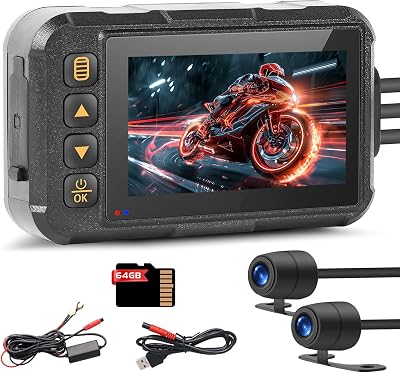
The Realdio dual front and rear dash cam sells the most complete cheap kit in its corner of the category: two cameras, a 3-inch split screen, a hardwire kit, and a 64GB card in the box. On paper it's the sort of listing that ends a shopping search. On paper is where the good news mostly stays.
Its rating sits at 3.5, and the record behind that number splits in a way worth understanding before you spend anything.
The five-star pool is large, but a close read shows a good slice of it isn't owner evidence. The real information lives in the critical texts, and those texts agree with each other more than you'd expect. One component draws fault reports from five separate buyers.
This article walks through what the record actually contains, why the rear camera is the part to test first, and what the box's Full HD label has to do with any of it.
Read the one-star pool first
The listing page shows 44 ratings at 3.5 stars. The written-review side counts 35, and the star filters break down as twenty five-star, five four-star, three three-star, two two-star, and five one-star. I'm quoting both counts as printed, since Amazon's dp page and review page don't reconcile here.
The badge split is the part that changes how you read this record. Twenty-five distinct texts are readable once duplicates are dropped, twelve carry Amazon's purchase badge, and thirteen don't. The verified texts are mostly one-liners or fault reports.
The unverified ones include almost every detailed five-star text, and several of those read like the listing itself. One unverified July text opens by praising the ad copy, then pastes the listing's bullets verbatim under the heading "Partial ad copy for quick reference." I've never seen a review admit to being an ad before, and I don't count it as owner evidence.
So the 3.5 average carries less signal than it looks like it does. The buyers with badges report a mix of satisfaction and specific failures. The unverified five-star chorus reports exactly what the bullets promise.
When those two groups disagree, I weight the badged texts, and the rest of this article does the same.
The rear camera is the fault center
Five separate texts report rear-channel failures, and they don't repeat one complaint. A verified one-line text says the rear image renders reversed with no way to change it. Another verified owner has the same problem and adds the detail that matters: nothing in the settings fixes it.
Another verified text describes the rear camera cutting in and out, which caused the recorder to reset, until they disconnected the rear camera and ran front-only. An unverified account calls the rear camera hit-or-miss for the same dropout reason. A fifth verified text reports rear focus so poor the footage was unusable.
The front channel has no comparable pattern in the record. Two texts call the front footage decent for the price, and nobody reports a front-camera fault at all.
The resolution split explains part of the risk. The front camera records 720p across a 120-degree view. The rear records 480p across 90 degrees, which is below even the 720p that Wikipedia's dashcam article, current as of late 2026, calls a common back-camera figure.
The cheapest part of the system is carrying the most faults, in the record and on the spec sheet at the same time.
Full HD on the box, 720p and 480p in the cameras
Two independent texts flag the same packaging discrepancy, and neither owner knows about the other. The text with the only helpful votes in the record, three of them, comes from a self-described twelve-year dash cam user. They point out that the listing says 720p and never names the video sensor, while the outside of the box claims Full HD, which they call inaccurate.
An unverified teardown says the same thing: box says Full HD, cameras record 720p front and 480p rear, and the footage struggles with license plates and street signs even at the highest settings.
Wikipedia puts 1080p as the standard resolution for dash cams, so both channels here sit below the category norm and the box label doesn't describe either camera. That's not illegal, and it's not rare in this price band. It's just the difference between what you think you're buying and what you get, printed on the box you'll throw away.
On price, this sits in the cheaper third of the 82 dash cams we track, and the exact spot moves with every price change, so check the motorcycle dash cam table for the live figure. The kit completeness is real at this price. The resolution is what the price implies.
What IP67 does and does not promise
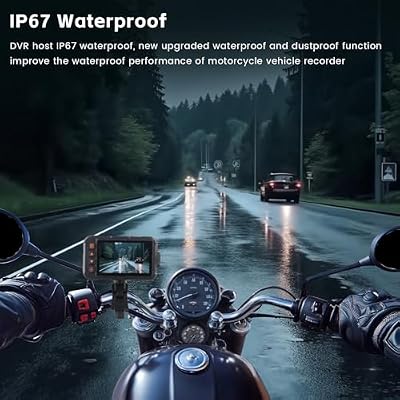
The listing rates the main unit IP67, and it's worth being precise about what that means. Wikipedia's IP code article defines IP67 as dust-tight, plus immersion in a meter of fresh water for up to thirty minutes.
The same article points out that water ratings don't stack: an IPX7 device isn't necessarily rated against jets, and a pressure washer is a jet. That distinction gets concrete in this record, because one owner reports that the display itself warns against pressure-washing, which sits oddly next to a waterproof special-feature row.
The riding evidence is thinner than the label. One unverified text says the waterproofing has held up fine in the rain. One verified owner whose recorder died never got it wet at all.
And the bullets scope the IP67 rating to the main unit, leaving the two cameras' rating unstated anywhere on the listing.
My reading: rain exposure looks survivable on the one account that mentions it, but the cameras are the unproven part and the pressure-wash warning is the listing hedging its own spec row. Wash the bike with a bucket, not a lance, and keep the cameras' seals untested.
Test the rear camera before the return window closes
Three texts converge on the manual being the weakest item in the box. One buyer couldn't find the card format option anywhere on day one. Another reports the instructions run English on one side and Chinese on the other.
The twelve-year dash cam owner calls them short, poorly translated, and incomplete on the features, and says technical knowledge got them through the menu. None of these are dealbreakers on their own. Together they set expectations: plan on figuring parts of this system out yourself.
The longevity record is one datapoint, and it's bad. A verified owner's unit was dead within two weeks, stuck in a reboot loop on every power source, and had never been wet. One text doesn't prove a trend, but it's the only durability evidence the record offers.
The return-window lesson comes from the other end. One verified owner discovered the poor rear focus after flying home from the US, with no practical way to return the recorder and no way to make it right.
Combine that with the rear camera being the fault center, and the advice writes itself. If you buy this, mount it fully, record test footage from both cameras, and check the rear image for the reversed-picture fault inside the window, not after a season.
The honest summary: you're paying for a complete kit at a budget price and accepting a rear channel with a documented fault pattern, a box label that overstates the cameras, and a manual you'll work around. If your evidence needs are basic and your return plan is disciplined, it can work. If you want the rear camera to be reliable, this record doesn't support that yet.
The OBEST recorder, which we covered the same week, costs less, hides nothing about its 480p rear channel, and skips the IP rating it can't support.
If the rear channel is what puts you off, the brand also sells a front-only camera, and we've rebuilt that listing too. The Realdio single front dash cam review covers a 1080p unit that had no buyer record at all when we checked it.
FAQ
Does the Realdio dash cam include a memory card?
Yes. A 64GB microSD card ships in the box, and loop recording overwrites the oldest files when it fills. Two texts mention the included card, and one notes the card slot is recessed, which makes computer transfers fiddly.
Will 720p capture license plates?
At close range, sometimes. Both channels sit below the 1080p Wikipedia calls the category standard, and one owner reports footage that struggles with plates and street signs even at the highest settings. If plate detail matters to you, this isn't the camera for it.
Is the parking mode any good?
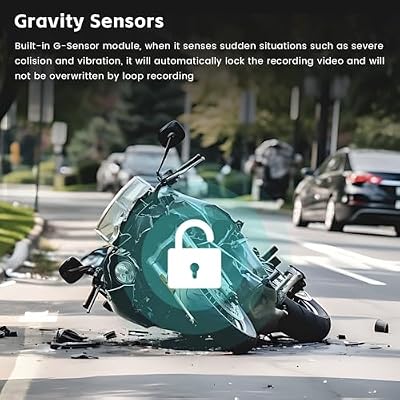
The hardwire kit is included, the G-sensor locks footage on impact, and motion detection starts recording when someone approaches. What the record can't tell you is whether parking mode has ever caught a real incident, because no owner mentions using it beyond setup.
Does it fit bikes other than motorcycles?
The spec row lists tricycles, golf carts, and side-by-sides, and one owner has installed it on an e-bike. The bracket adjusts to standard handlebars, and the 12-24V to 5V step-down cable covers most small electrical systems. Nobody has reported the four-wheeler fitments, so treat those as untested.