A five-star rating is only worth what sits behind it, and the LXYIUTRW 20in 1000W front hub kit has two unverified texts posted on the same day behind its five stars. It sits in the cheapest fifth of the kit prices we track, and its warranty row reads, plainly, No warranty.
That combination makes this a listing to study rather than a kit to order on impulse. The parts list is complete for a front-wheel build minus a battery and charger, the title sells front and rear wheels while the box holds one front wheel, and the manufacturer field carries an alias name. This review reads every row, quotes both texts, and shows what can and can't be checked before you spend anything.
Where that leaves you: there's a decent cheap front-hub build hiding in this listing for a 20in bike, but nothing on the page proves it yet, and you'd be buying the spec table, not the record.
The listing sells both wheels and ships one
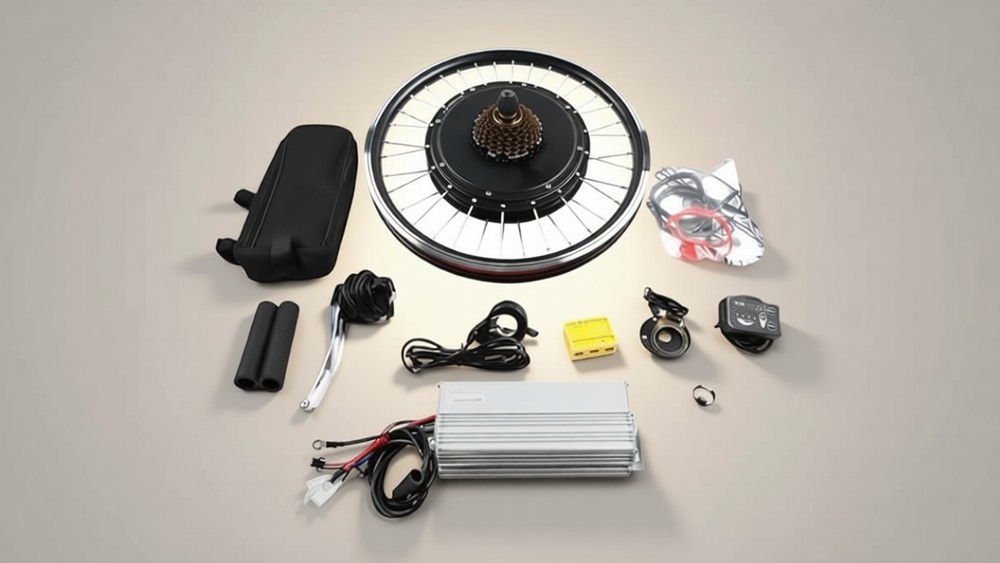
The title promises a Front/Rear Wheel hub motor kit, the parts list says 1* Front Wheel, and our own comparison row's stored title says Rear. That's three answers about which wheel arrives, from three places that should agree. The live buy box today serves the front variant, so that's what I reviewed.
The oddities multiply once you read the table closely. Wheel Size 20 inches prints twice, Rim Size says 39.5 centimeters, which matches nothing else printed on the page, and the manufacturer field reads Bepritm behind the LXYIUTRW brand name, with model HJU-21 underneath. None of that proves the kit is bad. It proves nobody proofread the listing, and a listing nobody proofread is exactly where fitment mistakes live.
My favorite piece of template junk sits in bullet 2, which promises the motor will have you weaving through a time and space tunnel intertwined with technology and speed, perfectly interpreting the aesthetic of speed. I quote it because it's a tell. Prose like that is generated to fill space, and the same feed that wrote it wrote the contradictory rows.
The parts list itself is one place the listing behaves. It names the front wheel, brake lever, LED display, thumb throttle, brushless controller, controller bag, junction box, handles, crankshaft speed sensor, and manuals. The bullet about that sensor garbles the physics, claiming it detects the movement speed of the controller, when a crank sensor reads your pedaling cadence. A small error, but it's the same proofreading hole showing through.
The whole record is two texts from one day
Two texts carry the entire record, both posted October 17 2026, and neither carries a confirmed-purchase badge. The first thanks the listing for compatibility with both mainstream disc brakes and V-brakes, reports braking that feels fast and stable, and repeats the bullet's exact 286.6 lb load figure.
The second is closer to an owner's shape. It describes bolting the kit onto an old hardtail in about an hour, clear instructions, a solid aluminum wheel, a handy thumb throttle, and 1000W getting up hills without bogging down. It even sounds like a person. But it recycles the bullets' own claims, names no battery, no speed, and no bike model, and landed the same day as the first text.
I've watched this pattern before in this category, most recently on the two SRTYGHW listings, where five copy-shaped texts landed on a single July day across two ASINs. Same-day unverified texts that restate the bullets aren't owner evidence, they're promotion.
So what does the record support? Nothing yet. No speed report, no range report, no failure report, no support report, and not one confirmed purchase. The five stars are two unverified texts, and that's the whole story the reviews page tells.
How to judge a kit when the record tells you nothing
When the reviews are worthless, the listing itself becomes the evidence, and there's a short checklist I run before any zero-record purchase. First, read the spec rows against each other for contradictions. Second, read the parts list against the bullets. Third, check who actually stands behind the box. Fourth, weigh the price band against what can't be verified.
This listing does part of the work for you. The parts list is internally consistent for a front build, the brake compatibility claim names both disc and V-brake systems, and the LED display and three-speed thumb throttle appear in both the bullets and the box contents. What it never says is the important part: no fork spacing, no dropout width, no battery, no charger, and no warranty.
That missing fork measurement is the one I'd insist on before buying any front-hub kit, because a motor axle only fits a fork built for its spacing, and guessing means a returned wheel. Message the seller, get the spacing in writing, and check your fork's brake mount at the same time, since the kit claims disc and V-brake compatibility in one line.
The alias manufacturer and the explicit No warranty row answer the third question on their own. If a front-hub motor fails a month in, the row already told you the answer. What you're buying is the spec table and the price band, nothing else, so decide whether that's a bet you want to hold.
What the numbers decode to
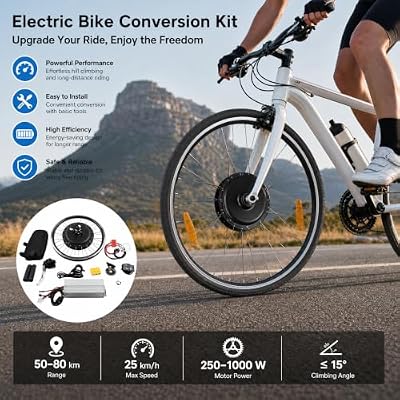
The one claim on this listing that survives checking is the speed figure. 440rpm on a 20in wheel rolling about 1.6 meters per turn is about 42km/h with the wheel in the air, which matches the bullet's own 42km/h max no-load claim exactly. It's an honest ceiling stated as a ceiling, which is rarer than it should be in this category.
A ceiling is not a riding speed, though. Under a rider, hills, and wind, a no-load figure lands lower, and the legal ceiling lands lower still. The motor draws about 21 amps at 48V for its 1000W, and the battery you attach decides everything about range, which neither the listing nor its record mentions once.
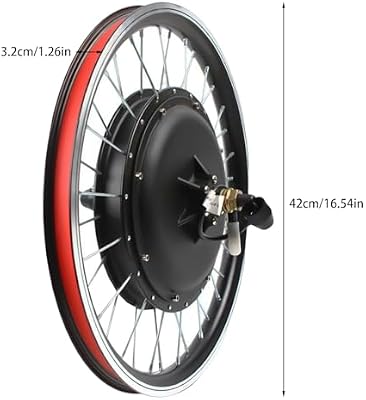
The weight and load figures are the two that matter for a small bike. 18.3lbs is a light motor wheel for a 1000W kit, which your fork will appreciate, because on a front-hub build the drive wheel is also the steering wheel and the motor's whole mass rides on the fork. The claimed 286.6lb load rating covers most riders plus cargo, but the wheel is also unsprung, taking every road hit directly, per Wikipedia's wheel hub motor article.
The 20in format trades top speed for push. A small wheel turns the same torque into more force at the ground because force equals torque divided by radius, so this kit should feel stronger off the line than its numbers suggest, and it will run out of ceiling sooner. For a folding bike or a compact commuter, that's usually the right trade.
No warranty row, one alias, and a 1000W motor
Most kit listings we've read simply omit the warranty row, which leaves you guessing. This one prints No warranty, and I'd rather have the honesty than the silence, because it changes how you budget: if the controller or motor dies, the replacement comes out of your pocket.
The ranking tells the same story from another angle. The listing sits at #192 in Bike Hubs, deep enough that it lives on price alone, and the manufacturer alias means the brand behind it has no history to check. Nothing here disqualifies the kit on a budget build. All of it is risk you're choosing to hold.
The wattage carries its own weight in the decision. A 1000W motor sits above the 750W continuous cap most US states set across e-bike classes, per Wikipedia's e-bike article, so where a build around this hub can be ridden legally depends on local law. Check before you buy, not after.
This kit suits a rider with a 20in bike, a fork that measures right, a battery, and an appetite for unverified listings at the bottom of the kit price table. It's the wrong kit for a first build, and it's wrong for anyone who wants evidence before money changes hands. Check the latest price on Amazon.
FAQ
Will it fit my 20-inch folding bike?
The listing claims 20in fitment and ships a front wheel, but it never prints the fork spacing, and that number decides fitment, not the wheel size. Measure your fork's axle spacing and brake mount, get the seller to confirm the hub matches in writing, and only then order.
Does it come with a battery?
No. The parts list names the wheel, controller, throttle, display, brake lever, sensor, and manuals, and no battery or charger appears anywhere. On a 1000W motor drawing about 21 amps, the battery is the expensive half of the build, and our battery comparison table sorts that cost separately.
Front or rear?
The title sells both, the box holds a front wheel, and our table row's stored title says rear, so ask the seller which variant they're shipping before you order. The difference matters more than usual here: a front hub puts the motor's mass on the fork and makes the drive wheel the steering wheel.
How fast will it go?
About 42km/h, roughly 26 mph, with the wheel in the air, which is the listing's own claim and it checks out against the 440rpm figure. A rider on hills sees less. Nobody on the record has reported a real riding speed, so that ceiling is all the evidence that exists.