A 1000W hub motor kit for the price of a decent tire set is exactly the kind of listing that pulls you in and then leaves you standing there with nothing to go on. You want power on a budget, you have a road or hybrid bike with 700C wheels, and the price per watt here beats most of the field by a wide margin.
The problem is the record. This listing family is really two kits, a front variant and a rear variant, and between them they carry one text-free 4-star rating each. No install accounts, no complaints, no praise you can weigh.
All the talking gets done by the listing itself, in identical copy on both pages.
That isn't automatically a scam, but it does change how you should shop. This review walks through the twin listings and their price gap, what actually ships in the box, whether the speed claim holds up to arithmetic, the wheel-size question that trips people, and how to de-risk a purchase when the owner record is empty.
Here's the verdict up front. The Jiabailie 700C 48V 1000W conversion kit prices well below almost everything we track, and the parts list is complete enough for a first build, but the evidence that it works is one anonymous rating per variant and nothing more.
If you want the cheapest credible entry into a 1000W build and you're comfortable testing a kit yourself inside a return window, it's a defensible gamble. If you need someone else to have found the faults first, this isn't your kit.
Two listings, one set of copy
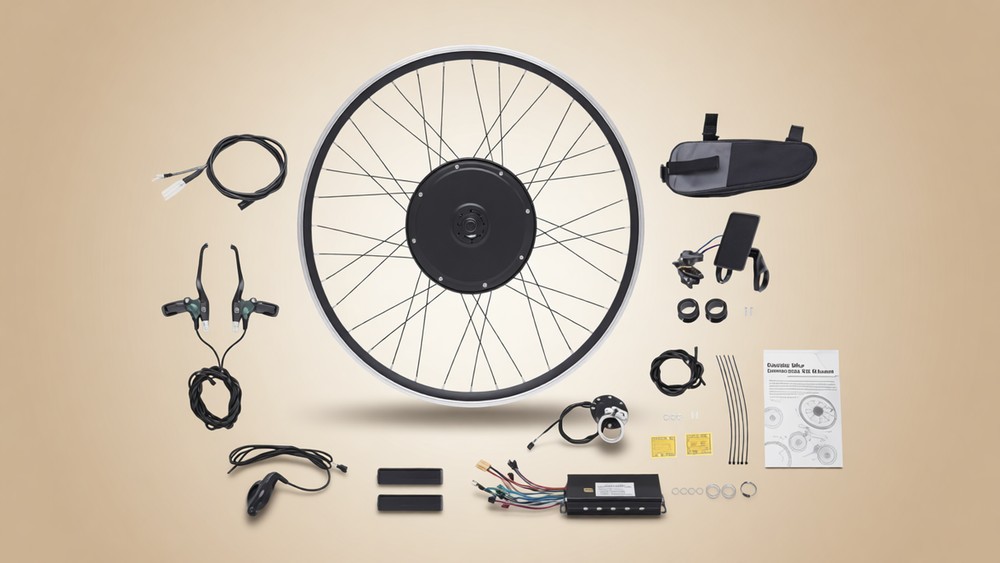
The family splits into a front-wheel variant at 107.99 and a rear-wheel variant at 123.62, a gap of 15.63 for the rear hub and its dropout hardware. Everything else on the two pages matches word for word: the same five bullets, the same parts list, the same claims.
Only the UPCs differ, along with something stranger. The rear variant's best-seller rank sits in Sports & Outdoors, while the front variant's rank sits in Industrial & Scientific, two categories that have nothing to do with each other. That's the signature of copy pasted between listings without anyone checking the results, which matches the rest of what you see here.
On price, both variants sit in the cheapest fifth of the 191 conversion kits we track, and the front variant is close to the very cheapest. That's the honest pull here, and you can check it against every other kit in our conversion kit comparison table. Nothing in the owner record supports or undercuts it, because the record doesn't exist yet.
What the box holds, according to the listing
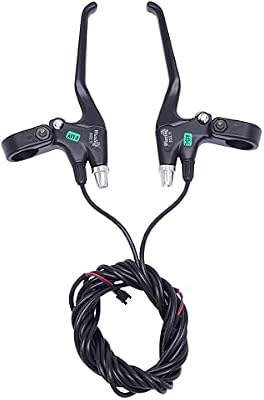
The parts list reads: one motor wheel, one display, two brake levers, one controller, and a thumb knob handle. That's a complete throttle-based kit. What it doesn't hold matters just as much: no battery, no torque arm, and no pedal-assist sensor anywhere on the list.
You'll supply a 48V pack, and on a 1000W hub you should supply a torque arm too.
The rear variant's spec table is unusually thin. It names the brand, the model, a UPC and a rank, and stops there. There's no wheel size row, no wattage row, no voltage row, and no warranty row on either variant.
When a listing omits the basics this way, the practical move is to message the seller and confirm the parts before you order, because you have no second source for any of it.
The two features worth noting are the five-gear speed adjustment and a cruise function, which engages when you hold the button key for two to three seconds at a steady speed. Both come from the bullets, and neither is unusual for a kit with an LCD display, but they're the difference between a basic wheel swap and something you can ride comfortably on a long flat commute.
The speed claim has no numbers behind it
The bullets claim a maximum speed of 45 to 55 km/h, which is about 28 to 34 mph. That's a wide band for a claim, and the listing gives you nothing to check it against: no rpm figure, no wheel size row, no continuous current rating.
The only arithmetic the page supports is current draw, and 1000W at 48V works out to roughly 21 amps. Your pack, wiring and connectors all need to be happy at that level.
A gearless motor like this one is a direct-drive design. There are no internal gears to strip, which is the good news, and the trade-offs are a heavier wheel and a magnetic drag you feel when coasting with power off.
Budget controllers in this class often run sensorless or fall back to sensorless mode, and a sensorless controller infers rotor position from the back-EMF the spinning motor generates, which is why some of them start awkwardly or briefly turn the wrong way before locking in.
One more number that isn't on the page: US three-class law caps a street-legal ebike's continuous motor power at 750W. A 1000W kit sits above that line, so where it's legal depends on your state's treatment of off-road and registered vehicles, not on this listing.
Will it fit your bike
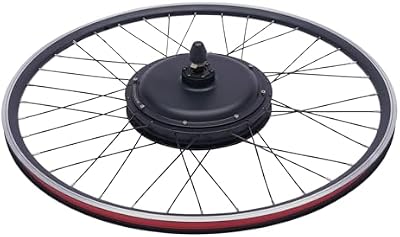
Here the title is more honest than it looks. 700C and 29-inch wheels share the same rim standard, a 622mm bead seat diameter, so a kit sold for 700C and 28 or 29 inch wheels is describing one rim size three ways. That's the sizing Wikipedia's bicycle wheel page spells out, along with the detail that matters here: 27.5-inch wheels run on a 584mm rim and won't accept this wheel regardless of what the tire sidewall says.
Measure your dropout spacing and check your axle type before ordering, because the thin spec table won't answer either question for you.
The front-versus-rear choice is mostly about where you want the compromises: the front variant is cheaper and leaves your drivetrain untouched, while the rear variant puts the weight at the back of the bike and spares your fork. If you go front, the fork material matters, because a 1000W hub can twist a weak aluminum fork blade under hard acceleration. A torque arm costs little and spreads that load.
Buying on the listing when the record is empty
This is the actual decision the listing forces, so it deserves a straight answer. One text-free 4-star rating per variant tells you nothing except that someone, somewhere, was satisfied enough to tap four stars and leave. It doesn't tell you the wheel arrived true, the display paired, or the controller survived a month.
What protects you instead is process. Order inside the return window and plan to test early. Check spoke tension and rim trueness the day the wheel arrives, because budget wheels often ship slightly out of true.
Meter the motor's phase wires with a multimeter before you lace a tire on. Confirm the parts list with the seller in writing, since the spec table omits so much. And keep the box until you've ridden it, because a 1000W hub that misbehaves under load is a return, not a tuning project.
If that sounds like more project than you want, the alternative is paying a little more for a kit with owners behind it. Sort the field by price per watt in our conversion kit comparison table and you'll find several at similar money with actual records.
FAQ: the battery you bring yourself, the 622mm rim rule and the speed claim that stands alone
Does the kit include a battery?
No. The parts list holds the motor wheel, display, brake levers, controller and thumb throttle, and nothing that stores charge. Budget for a 48V pack rated for at least 21 amps continuous, which is what 1000W at 48V draws. Our battery comparison table sorts the field by price per watt.
What wheel sizes does it fit?
The kit targets the 622mm rim standard, sold as 700C, 28 inch and 29 inch. A 27.5-inch wheel runs on a 584mm rim and won't fit. Measure your rim's bead seat diameter or check the ISO marking on the tire sidewall if you're unsure.
How fast will it go?
The listing claims 45 to 55 km/h, about 28 to 34 mph. Nothing in the owner record confirms or contradicts that, because the record is a single text-free rating per variant. Treat the claim as the seller's number, not a measurement.
Should I buy the front or rear variant?
The front variant costs 107.99 and the rear 123.62. Front is easier to install and leaves your drivetrain alone, but it loads your fork and can affect steering.
Rear costs 15.63 more and adds hub width and dropout questions. Pick based on your fork's strength and your appetite for drivetrain work.
Is there a warranty?
Neither variant's spec table lists a warranty row. Ask the seller in writing before you order, and keep the reply with your order records.