A front hub kit is the cheapest way into an electric bike, and it's also the one place where the motor you pick changes how your bike steers. Put 1500 watts in the front wheel and every launch loads the fork, not the frame. Most kits at that money ask a quarter of that from your bike.
The gaebeoih kit sits at a fat 26-inch wheel, a gearless hub, and a spot in the cheaper third of the 191 kits we track. LCD, throttle, and controller are all in the box per the listing. It also claims the motor can turn a 26-inch wheel at 50 to 60 km/h, and it shows a perfect 5.0 rating.
That rating comes from two reviews. Both went up the same day in September 2026, neither has a purchase badge, and both read like the bullet points written out as sentences. What follows is what you actually get for the money, what a 1500W front hub asks of your fork, which claims nobody has tested, and what to check before you spend.
My read up front. The gaebeoih 26-inch 1500W front hub kit is a cheaper-third pick on our price comparison across 191 conversion kits, and the box inventory is generous for the money: the fat snow tire comes mounted, and the controller, throttle, brake cut-off, and LCD are all named on the page. What it is not is proven.
The entire quality signal is two same-day reviews with no purchase badges, the listing names no battery, and the motor loads the one part of a bike that was never built for torque.
Two texts, one date, and a 5.0 nobody has earned yet
Two five-star reviews appeared on the same day in September 2026. Neither carries a purchase confirmation, and both restate the listing's bullet copy in sentence form: the aluminum-and-steel materials line, the quiet brushless motor, the quick acceleration from a stop.
One of the two collected a pair of helpful votes, which tells you other readers found it useful, not that the person who wrote it ever bolted the wheel to a bike.
The rating itself is a perfect 5.0 from just two global ratings. That is not a record of satisfaction, it is the absence of anyone disagreeing yet, and on a listing first available in May 2026 there has barely been time for anyone to disagree. The five-month age matters when you read every claim below.
Depth of record is the whole story here, because the hardware spec is not the hard part. A 1500W gearless hub at this price is a known category of product. What nobody can tell you yet is whether this particular one survives contact with an actual bike, and that is the question a rating of two cannot answer.
What ships in the box, and the purchase you still owe
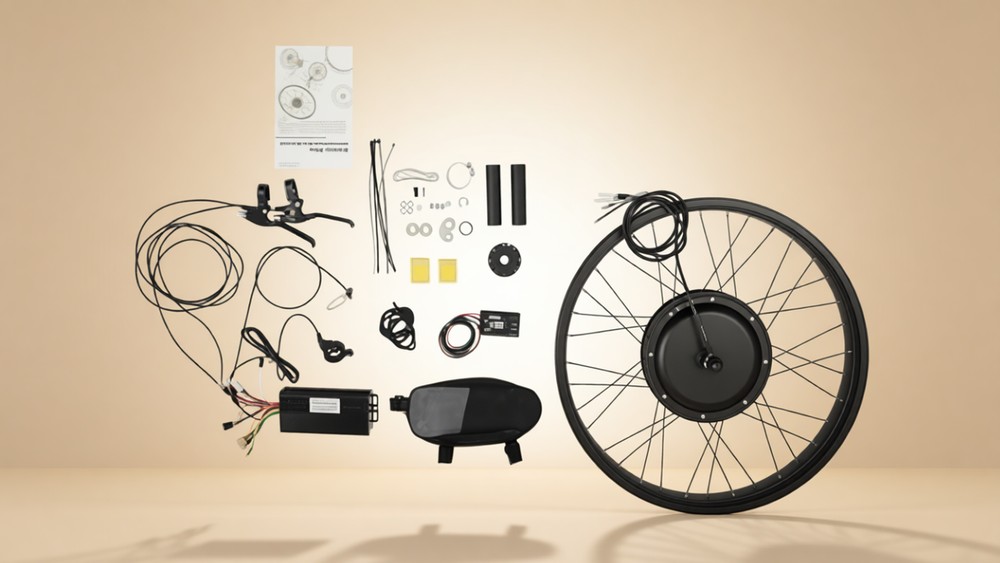
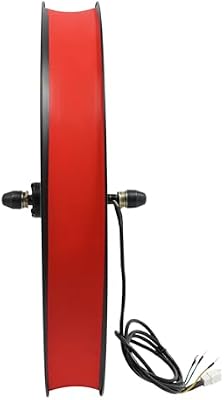
The inventory is the strongest part of the listing. You get the 26-inch fat snow tire already mounted on the 1500W gearless hub, a sine-wave FOC controller, a throttle, a brake cut-off switch, a VA color LCD that shows gear, speed, mileage, and battery level, and the wiring to tie it together.
One captured text lists exactly that set and says the install took an afternoon, with mounting the controller and routing the wires as the real work of the job.
The listing names no battery and no charger. That is the purchase you still owe, and it is not a small one: a 48V pack in the 15-20Ah range, which is the natural pairing for a controller drawing 1500W, typically costs as much as this kit does or more on our ebike battery table.
If you have not priced one yet, you can browse current 48V packs on Amazon to calibrate the second half of the budget. Without a pack, the kit is a 31.4 lb wheel.
On our comparison of 191 conversion kits by price per advertised watt, this one sits in the cheaper third at roughly 11 cents per watt, and the live figure renders in the specs box under the comparison table.
The listing priced at 170.39 showed only 6 left in stock when checked. The price is the argument for this listing. Nothing else on the page has been tested by anybody.
A 1500W hub hanging on a fork
This is a front wheel kit, and that placement deserves more thought than the wattage does.
A front hub hangs all of its drive torque on the fork and steers with the driven wheel. At 250W to 500W that is a proven pattern with decades of use behind it. At 1500W it loads the dropouts and fork blades in a way most standard forks were never designed around, and the rear of the frame never sees any of the force.
No buyer in the record says one word about fork stress. Nobody names the bike they mounted it on. That silence would matter less at 500W.
At this power it is the first thing a buyer should check: steel or reinforced dropouts, no thin suspension legs, and a torque arm where the dropout design allows one.
Then there is the law. The US federal definition of a low-speed electric bicycle covers pedals, a motor under 750W, and assistance that stops under 20 mph, and machines above those limits are governed by the states, many of which cap their e-bike classes below this power (Wikipedia, Electric bicycle laws).
A 1500W kit sits well above the federal motor ceiling, so treat it as an off-road machine unless you have checked your own state's rules.
The claimed riding speed of 31.07 to 37.28 mph is a translation artifact: 50 to 60 km/h restated in miles, the same artifact class you see across imported listings. Nobody in the record reports a top speed against it.
Every number on this page is unexercised
Run the claims one at a time. The five adjustable speed gears and the fixed-speed cruise function: no text mentions either.
The Hall-to-non-Hall fallback that supposedly keeps the motor turning if components break down: untested by anyone. Quiet running: one text agrees, and that text reads like the listing. Wet-road stability at speed: one text claims it, with no purchase badge behind it.
The arithmetic gives the speed claim some benefit of the doubt. A 26-inch wheel turning 520 times a minute covers about 40 mph with no load, so a riding claim of 50 to 60 km/h under load is at least physically coherent, whatever it says about legality.
What the record cannot do is get you past the durability question. The aluminum-and-steel pitch comes from a listing five months old.
Nobody has owned a kit through a season. Nobody reports braking behavior with the cut-off, and nobody says which battery they paired with it. The first-tester checklist is short: verify the fork before you mount anything, meter the battery you pair, and test the brake cut-off in an empty lot before the first real ride.
A fat-tire front kit that needs a strong fork and a skeptical buyer
The decision this record forces comes down to appetite for being first. It can suit a builder who wants 1500W-class power at a cheaper-third price, already owns or has priced a 48V battery, rides off-road or lives somewhere the power is legal, and knows what their fork is made of. You can compare it against the rest of the field on the conversion kit table for kits with longer records.
It should not suit anyone who needs a field record before spending, because two same-day unverified texts are the entire quality signal. It should not suit a suspension fork of unknown strength.
And it should not suit anyone assuming a 1500W kit is street legal by default. If I were sizing up this listing, the fork question comes before the price question, and the record gives you nothing on either.
Common questions about the gaebeoih 1500W front kit
Does the kit include a battery?
No. The listing names no battery and no charger, and no captured text mentions one. A 48V pack is a separate purchase, and a 15-20Ah unit typically costs as much as the kit itself.
Is a 1500W kit street legal?
Not everywhere. The federal low-speed e-bike definition stops at 750W and 20 mph, and the states set the rules above that (Wikipedia), with many capping their classes below 1500W. Check before you ride on pavement.
What comes in the box?
The motor wheel with the fat tire mounted, the controller, a throttle, the brake cut-off switch, the LCD, and the wiring, per the listing bullets and one captured text.
How fast does it actually go?
The listing claims 31.07 to 37.28 mph, which is 50 to 60 km/h restated. No owner has reported a top speed, so the claim is unexercised.
Can you trust the 5.0 rating?
Treat it as an empty signal. It comes from two ratings, and both written texts are same-day, unverified, and mirror the listing copy. Wait for purchase-backed owners before you count the rating as evidence.