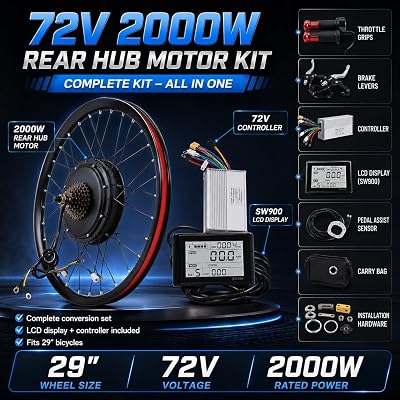
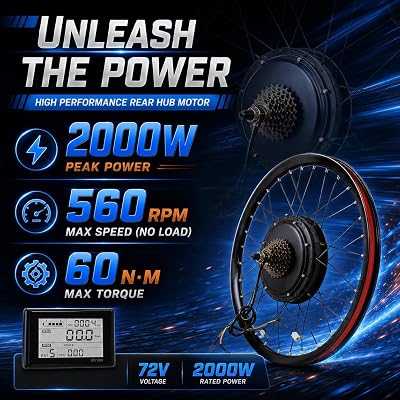
Most ebike conversion kits go as far as 48 volts and stop there. The COFECO 72V 2000W rear wheel conversion kit doubles the voltage and it shows up in nearly every spec that matters. A 560 rpm motor, 60 Nm of torque, and a 9-speed rear wheel in a 29 inch diameter, all bolted onto a standard bicycle frame.
One look at this ebike conversion kit on Amazon tells you it was not built for a mellow bike path commute. Browse our ebike conversion kit comparison to see how it lines up against other high-power builds.
Specifications
The specs here really stand out. Most of the other 2000-watt e-bike kits are 48-volt systems. These systems deliver wattage via very high amp draws. COFECO opted for 72 volts. Therefore, the motor delivers its maximum power at lower amps. This reduces the stress put on the controller, wiring, and battery connectors.
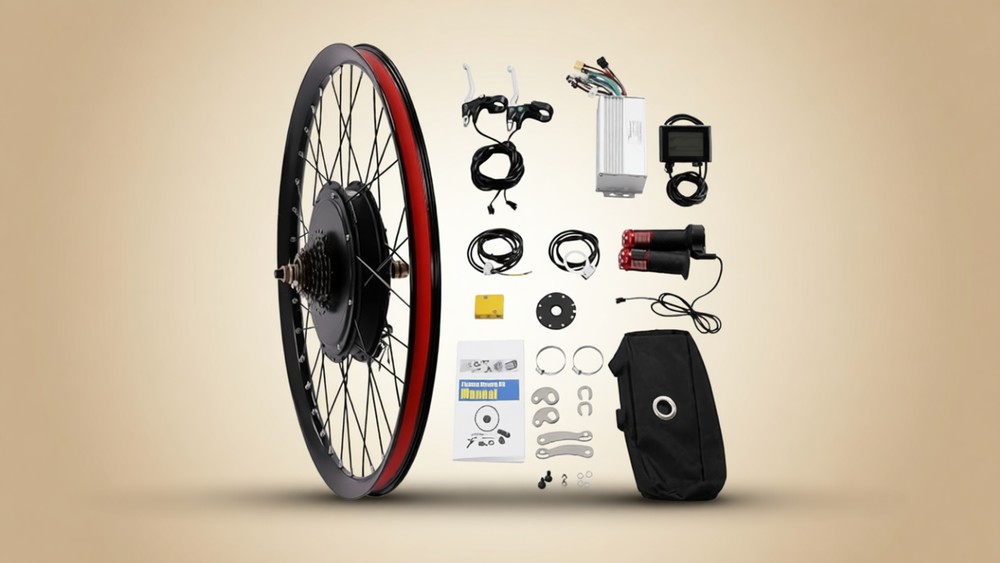
The items included in the package:
- Motor: Brushless and toothless (slotless) hub motor, rated for 72 volts and 2000 watts.
- Speed rating: 560 rpm (no-load).
- Torque: 60 Nm. Plenty for steep hills and rapid acceleration, even though this is a hub motor at this power level.
- Wheel size: 29 inch rim made of high-quality aluminum. The spokes are arranged for the torque load.
- Gearing: 9-speed rear cassette. Your mechanical shifting range remains intact as opposed to using a single speed.
- Display: Simple to read, yet functional LCD display showing speed, miles traveled, battery voltage, and assist level. Nothing fancy here.
- Controller: Sine wave controller for quieter operation. Square wave controllers produce more audible noise and harsher magnetic fields.
The toothless motor design is worth a closer look. Most hub motors use a slotted stator with iron teeth between each winding. Turn the wheel by hand on one of those and you feel the magnetic cogging from those teeth. The COFECO motor is slotless, so the windings are encased in epoxy within a smooth bore.
Performance
72 volts is a huge difference maker for a hub motor. Comparing a 48 volt system to a 72 volt system at the same 2000 watt output, the lower amp draw of the 72V setup produces much less heat in the motor windings, puts less stress on the controller's FETs, and greatly reduces voltage sag under load.
The result is a system that feels stronger at virtually every throttle position. Since the slotless motor does not have the startup cogging you get from many hub motors, acceleration from a dead stop is smooth and linear. Once you are moving, the 60 Nm of torque keeps pulling.
On flat ground with a reasonably sized battery, this kit cruises well past standard ebike speed limits. That is the whole point of a 72V build.
Hub Motor Hill Climbing Basics
Climbing steep hills on a hub motor bike comes down to how well you manage heat. The rotating components and the copper windings sit close together inside the hub, and they get no help from gearing the way a mid-drive does. As soon as you start up a steep grade, the motor draws more current than usual and that current turns into heat.
While slotless designs help improve upon cooling characteristics compared to traditional slotted designs at the same power ratings since they have reduced magnetic resistance in the air gap (meaning that more of the electrical energy is converted directly into motion rather than being lost as heat), extreme steepness can cause prolonged heat buildup.
If your route includes long steep climbs, be judicious about how hard you lean on the motor.
Nine Speed Gearing and LCD Display
Many kits marketed as 2000W ship as single speed units or with cheap freehub mechanisms. COFECO included a genuine nine speed rear cassette instead. That means you keep a usable mechanical shifting range for the stretches where you actually want to pedal.
You can run smaller cogs on the front chainring and still keep enough top end to accelerate and hold pace.
The LCD display is simple but functional. It shows speed, odometer, trip distance, battery voltage, and assist mode. It is monochrome with a small backlit area, so it is plainer than the displays on more expensive ebikes.
User Feedback from Amazon
The review pool for this kit is still young, but a fairly distinct picture of user sentiment is emerging.
What buyers like
Riders who switched from a 48V kit report a real increase in top-end speed and initial acceleration. The smooth startup from the slotless design draws repeat praise. Several reviewers also note that the wheel arrived properly trued, which is often a problem on cheaper hub kits where the spokes go slack after the first ride. The aluminum rim is reported as lighter than the steel rims on comparable kits.
Complaints
The instructions are the main gripe. A simple illustration comes in the manual and not much else. If you have never done an ebike conversion before, plan on watching a few instructional videos before you start.
Several reviewers also felt the LCD display was basic compared to those on more expensive ebikes, and a few reported that the freewheel mechanism is noisy in operation.
Installation feedback
Nearly all reviewers say the install took an afternoon with basic hand tools. You will want a combination wrench set, a torque arm, and cable ties to route the wiring cleanly. The kit gives you the wheel and cassette assembly, controller, LCD display, throttle, and wire harness. You supply the battery, the bike, and the patience for cable routing.
Check whether your frame has horizontal or semi-horizontal dropouts. Vertical dropouts will need a torque arm kit.
Who Should Buy This Kit
This kit is for riders who want speed. Honestly, that is the whole pitch.
If you are building an ebike to commute at 20 mph on bike trails, this kit is far more than you will ever need. If you want an ebike that can keep pace with traffic on a 45 mph road, this is precisely what you want.
Performance riders and speed enthusiasts.
The specs tell you who this is for: 72 volts and a 560 rpm motor.
Pair it with a high-discharge 72V battery, dial in your controller settings, and you have an ebike that runs with moped and scooter traffic.
The slotless motor gives you smooth low-speed throttle control, so it still behaves in a neighborhood before you open it up.
Builders who want a genuine 2000W setup.
Plenty of kits market themselves as 2000W but pair a 2000W motor with a controller that cannot feed it. The controller becomes the limit on how much power you can actually pull. Check the real controller rating before buying any kit.
Commuters with fast road segments.
If your daily ride includes stretches where traffic moves at 35 to 45 mph, a normal 48V 1000W kit leaves you getting passed constantly. This kit lets you keep up, then throttle back for bike lanes and neighborhood streets.
Who should skip this kit.
If you want a quiet, simple recreational ebike, look elsewhere. Hub motors are noisy under load and the freewheel adds its own clatter on deceleration. There is also the battery cost. A 72V pack runs more than a comparable 48V pack, and you need one with enough capacity and discharge rate to feed 2000 watts continuously.
Check the current price on Amazon to see whether this kit fits your budget and your build.
Frequently Asked Questions
How Large of a Battery Do I Need for This Kit?
You need a 72V battery with a BMS rated for at least 30A continuous discharge. Two thousand watts at 72 volts works out to roughly 28 amps, so a 30A BMS gives you a reasonable margin.
For capacity, a 20Ah pack is a sensible starting point. A 13Ah or 15Ah 72V pack will run the kit fine for shorter trips, you just give up range.
Do not try to run this kit on a 48V battery. The controller expects 72V and you will get poor performance or a system that will not run at all.
Visit our ebike battery comparison table for options that meet these criteria.
Is This Kit Hard to Install If I Have Never Done a Conversion Before?
It is more approachable than a mid-drive. With a rear hub kit you never touch the bottom bracket or the drivetrain beyond moving your cassette over.
The job is swapping the rear wheel, mounting the controller, and connecting the wiring, throttle, and display. The fiddliest part is routing the wiring so nothing catches on the spokes or the chain.
Plan on an afternoon for your first conversion.
Does This Kit Accelerate Better Than Other 2000W Kits?
Mostly yes. The 560 rpm no-load speed on a 72V system gives it a much higher theoretical top speed than a 48V motor at similar rpm, and the 60 Nm torque figure is strong for a hub motor at this power level.
Off-the-line acceleration depends more on how well your controller delivers current than on the motor alone, so pair it with a battery that can actually supply the amps. The slotless design also gives you smooth low-speed response, which is unusual to find alongside this much top end at this price.
Can This Kit Be Installed on My Existing Bike?
It works with any bike running 29 inch wheels, or 700C road and hybrid wheels, with standard 135mm rear dropout spacing. Most modern mountain bikes and hybrids use 135mm.
If your bike has 130mm road spacing or a 142mm thru-axle, you will need an adapter or a different kit. Verify your dropouts are horizontal or semi-horizontal before ordering.