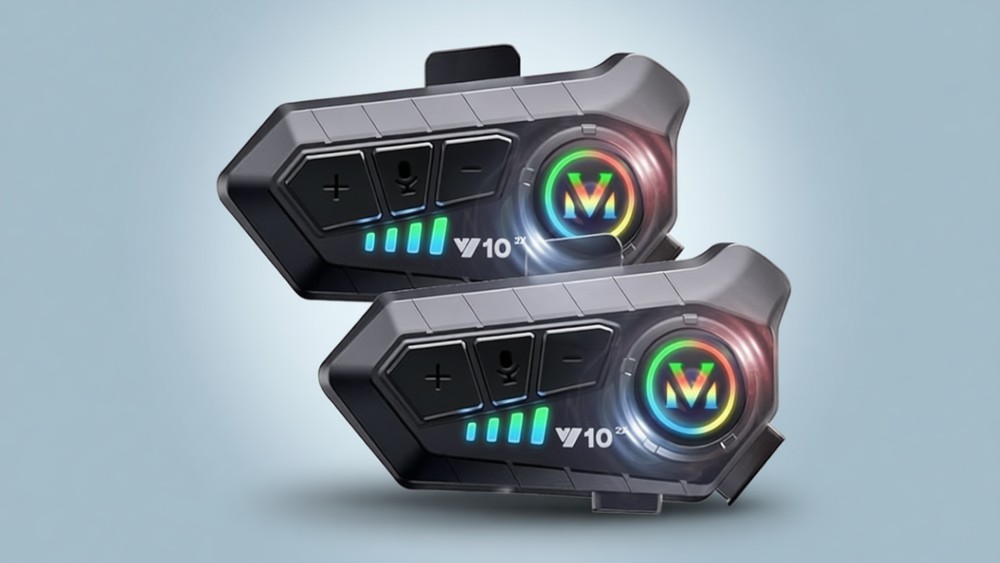
Two helmets, one budget, and no appetite for a name-brand setup: that is the situation the CNBRO 2-pack walks into. A rider and a regular partner want bike-to-bike talk, navigation prompts and the odd phone call, and they want all three for less than one helmet's worth of a premium brand. The budget shelf is full of boxes that promise exactly that.
This one makes the choice harder than usual, because the listing argues with its own spec sheet.
The bullets describe a helmet intercom. The details table underneath describes Bluetooth earbuds, down to an earbud driver type and an earbud weight. Between the two sits a public record of seven ratings with a single written account.
This article walks through what that record can and cannot tell you, what the spec table's earbud rows mean for a helmet install, what 300 metres means in Bluetooth terms, and what the battery claims survive their own arithmetic.
The short version before the detail. The CNBRO Y10-2X two-pack sells two helmet headsets at 26.99 per helmet, which sits close to the middle of our intercom comparison table rather than on the bargain shelf.
It carries an IPX6 rating that only a handful of the 192 units we track can match, Bluetooth 5.3 in the spec table, and a record too thin to confirm the range, the battery hours or anything else the bullets promise. The sections below put numbers on each of those.
A 3.9 carried by seven ratings and one text
Start with what the rating actually rests on. The listing prints 3.9 out of 5 stars from 7 global ratings, and the histogram reads 63 percent five-star, 19 percent three-star and 18 percent one-star as printed. Those percentages do not reconcile cleanly against seven ratings, so we quote them as printed.
What is certain is the shape: both the four-star and two-star bands are empty, and at least one rating sits in each of the five, three and one-star bands.
Only one of the seven ratings carries written words. It is a five-star account from September 2026 with no purchase badge on it, and it describes a rider and a passenger using the pair to talk on a motorcycle, with clear sound and a connection that has held every time. There are no helpful votes on it. Six of the seven ratings say nothing at all.
That is the whole record, and it leaves every practical question open. Nobody has written about whether the 300-metre claim holds past the end of the street, whether the 15-hour intercom figure survives a real ride, whether the units have stayed waterproof through a wet season, or how the mounting hardware copes with a particular helmet.
The one written account stops at setup and sound. A 3.9 on seven ratings is not a verdict on this intercom. It is seven people pressing a button, one of them typing a paragraph.
The spec table describes earbuds, not helmet comms
The most useful thing on this listing is a part of it the bullets never mention. Under the helmet-intercom copy, the details table reads like a Bluetooth earbuds listing that someone pasted a motorcycle theme onto. The Audio Driver Type row says Balanced Armature Driver, which is the tiny driver technology inside in-ear earphones, not the flat dynamic speakers that sit against your ears inside a helmet.
The weight row says 0.64 ounces, which is earbud weight rather than the couple of ounces a helmet intercom and its mount usually carry. Five separate rows describe the form factor as Over Ear. The Built-In Media row says smart earbuds, and the Age Range Description says 6+.
None of those rows proves anything about what arrives in the box, because a recycled template proves nothing.
But it shifts the burden. The bullets never describe the controls, and the spec table answers with a Control Method row that says Touch, on a device a rider has to operate with gloves on at speed. No bullet mentions a button anywhere.
The table carries no warranty row at all, which matters when the price is the main argument for buying.
Before buying, ask the seller two things the listing will not answer: what the controls actually are, and whether the package holds two helmet-mounted intercoms with speakers and microphones, or something shaped closer to the earbuds the spec table keeps describing.

What 300 metres means in Bluetooth terms
The first bullet promises intercom talk between two headsets of the same model up to 300 metres apart. Bluetooth's own figures give that number a context the listing leaves out.
In the low-power mode most headsets run, typical range is about 10 metres, while the published Bluetooth range figures put the standard's best-case implementations anywhere from 40 to 400 metres with clear line of sight between the radios. A 300-metre claim sits inside that best case and far above the mode most devices actually use. It is not impossible on paper.
It is also the kind of figure that assumes no hill, no traffic and no helmet between the two riders. On this listing it has no owner evidence behind it at all, because nobody has written about range.
The same bullet carries the pairing limit, and it is worth reading twice. The two headsets talk to each other when they are the same model.
That rules out bridging to a Sena, a Cardo or any other brand's unit, and it also means a mixed fleet cannot join in. If the second rider in your life already owns a different intercom, this box solves nothing for you. Budget two-packs are built as closed pairs, and this one says so in plain words.
Battery claims only their own arithmetic can test
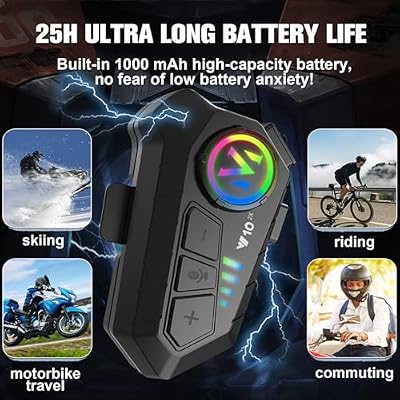
The third bullet packs three numbers around one battery. A 1000mAh pack, charged in about 2.5 hours over USB-C, is asked to deliver 25 hours of talk or 15 hours of intercom. The division is the part worth doing.
25 hours of talk from 1000mAh means an average draw of about 40 milliamps for the whole session, and 15 hours of intercom means about 67 milliamps while the link is live. Those are the draws the claim commits to, and they are optimistic for a radio that is also driving speakers and a microphone, though not beyond physics.
What the claim does not have is a test. No owner has written about how long a charge lasted, and the one written account does not mention battery life at all. Our own comparison data carries battery-hour figures on only four of the 192 intercoms we track, so there is no honest cross-brand comparison to make here either.
Treat 25 and 15 as the manufacturer's ceiling, plan around less, and note that a 2.5-hour charge at least makes topping up between rides cheap in time.
Who this 2-pack makes sense for
Price first, because it is the strongest fact on the listing. At 53.98 for the pair, each helmet costs 26.99, which lands close to the middle of our intercom comparison table rather than at the bottom of it. Cheaper per-helmet units exist in our data, and plenty cost more.
The old framing of this page called it one of the cheapest ways onto two helmets, and our own numbers do not support that any more.
The IPX6 rating is the genuinely uncommon part. Only seven of the 192 intercoms we track carry an IPX6 figure, so if jet-rated weather protection matters to you, this box is in a small club.
Keep the rating honest, though: per the IP code standard, IPX6 certifies resistance to powerful water jets from about three metres away. It is not a submersion rating, and the spec table's unqualified Waterproof row promises more than the IPX6 figure does.
So the decision comes down to this. This 2-pack makes sense for a same-model riding pair on a budget who accept that the entire public record is seven ratings and one unverified paragraph, who are content to treat the range and battery figures as ceilings, and who ask the seller about controls and box contents before paying.
Riders who want owner evidence behind the claims, cross-brand pairing, a warranty row or a spec sheet that describes what actually ships should spend differently, and our comparison table sorts the alternatives by what each costs per helmet.
Common questions about the CNBRO 2-pack
Will it pair with a friend's different intercom?
No. The listing's own bullet limits intercom talk to two headsets of the same model. It will not bridge to another brand, and a mixed group cannot join the conversation.
Can it handle heavy rain?
An IPX6 rating is built for that case as far as the standard goes. It certifies powerful water jets at close range, not submersion, so a soaked ride is within the rating's promise and a dunk in a puddle is not.
What ships in the box?
The listing does not answer cleanly. The Built-In Media row reads smart earbuds, which contradicts the helmet-intercom bullets, and there is no parts list anywhere on the page. Ask the seller before ordering.
Do you have to buy two?
The listing sells the pair. The Number of Packs row says 2, and the price covers both helmets. Bullet one's same-model rule means a single unit has nobody to talk to unless a matching one is already in the group.