This is a bare-bones solution to convert your older bike into a fully-fledged ebike without breaking your bank account. The build process is super easy. You’ll get some decent power and control, but you’ll be responsible for finding a suitable 48-volt battery.
It’s perfect for DIY enthusiasts looking for something easy-to-build. However, you are rolling the dice with your expectations regarding performance since there aren’t many reviews yet.
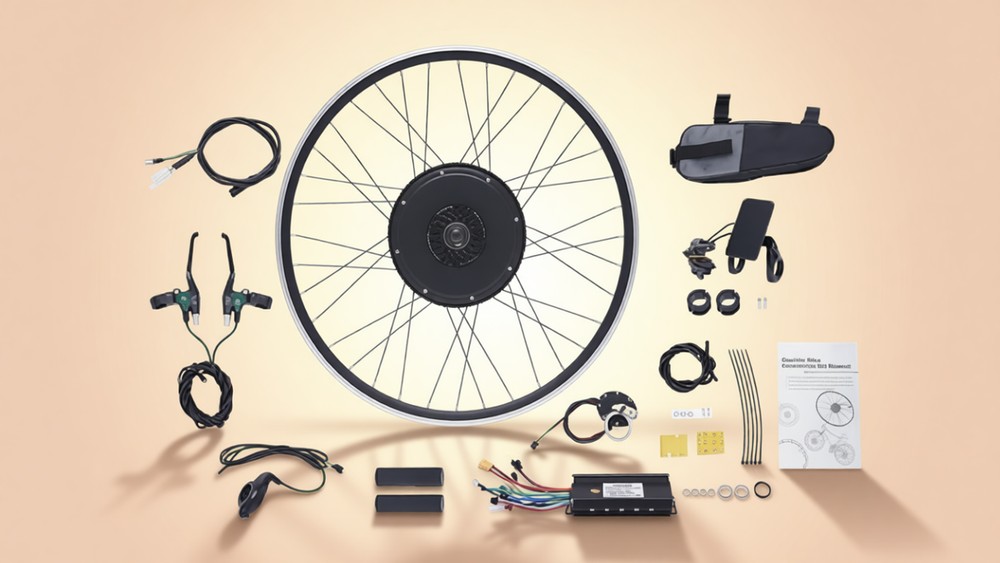
Spec sheet and what's inside the box
According to the seller, you'll receive a 1000W rear-hub motor. That kind of power can generate a ton of torque which translates to serious hill climbing ability and plenty of reserve for maintaining speed under load.
However, a 1000W motor needs a large capacity battery in order to work effectively. So if you choose to pair this motor with a small-capacity lithium-ion battery pack, the motor won't perform very well.
Your battery will run out quickly and possibly shut off the motor completely. You'll need a 48-volt battery capable of supplying sufficient current to keep the motor spinning effectively.
The kit supports three wheel sizes: 28-inch, 29-inch and 700-c. That range covers all types of hard-tail and hybrid frames that were built within the past decade.
The LCD display shows two values: your speed and the remaining charge. While not overly complicated, it serves its purpose as part of a low-cost build.
When you spin your pedals the pedal assist sensor (PAS) detects movement and causes the motor to help. When you squeeze the brakes the motor stops immediately preventing the motor from opposing your braking actions.
The aluminum construction of the hub minimizes the extra weight compared to steel alternatives. On the downside, the addition of a large DC motor adds considerable mass to the rear end of the bike.
The five-speed adjustable gearing lets you cap how much power the motor produces. Lowering the gear setting can conserve battery life and extend the lifespan of the motor during prolonged climbs.
Since the battery isn't included, you'll need to determine how much additional money you're going to spend for a complete power source. A 48-volt system is typical for this level of power usage.
In essence you're purchasing the mechanical/electronic guts of an ebike. Your bike's frame will remain unchanged, but now your rear wheel has become a power plant.
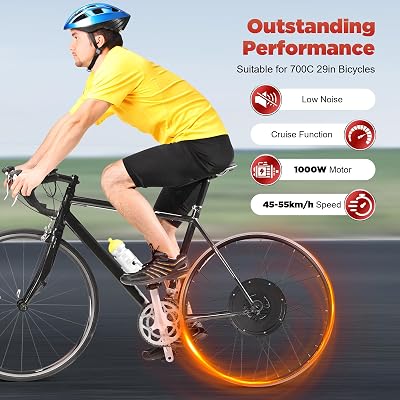
Build experience
Removing your original wheel is the core task required to transform your bike into an ebike using this DIY kit. You'll need to disassemble your original wheel, then transfer each component to the new hub motor.
Keep in mind that your new rear wheel weighs significantly more than your previous wheel due to the heavy DC motor embedded in it. This added mass unbalances your bike and impacts how well you'll be able to steer it.
You will need to carefully position the motor shaft into the dropouts. As the axle is quite fat, the fit is snug. Be sure that your cassette is perfectly aligned. Spokes on your wheel are thicker than on a regular wheel.
These stronger spokes are necessary to withstand the intense forces generated by the motor.
Another issue is the torque arm. A 1000W motor creates enormous stress on your frame. If you don't use a torque arm, over time, your dropouts could break.
Purchase a torque arm as a precautionary measure. The Amazon listing lists the axle size and dropout width, so check those measurements before the wheel arrives.
Also, please pay close attention to your derailleur setup. The larger diameter of the motor hub will likely necessitate adjusting your derailleur hanger. Additionally, you'll probably need to modify the limit screws on your derailleur in order to enable proper shifting through all gears. Cables for powering your motor and accessories require similar attention to detail. You must zip tie any exposed cables to your frame so they don't snag on anything attached to the spokes.
If your cables are too tight they'll put too much tension on your connectors and eventually cause damage to them. Conversely, if they’re too loose they’ll rub on nearby objects resulting in premature wear.
While it is possible to make mistakes while installing this kit, especially if you haven’t done extensive DIY projects previously, ultimately this project requires patience and attention to detail.
Motor performance and the Hall Fallback feature
This dual-mode controller runs either on Hall sensor signals or in sensorless mode. Virtually all controllers use Hall sensors for the quietest, most efficient acceleration.
If a Hall sensor fails, sensorless mode kicks in automatically and the motor keeps running, just with slightly rougher low-speed behavior.
That represents a solid safety net for a kit at this price point and protects riders from being left stranded in event of a failed sensor.
The 1000W rating describes short-duration peak output. Continuous output will typically run lower.
You'll certainly feel the powerful thrust of energy delivered from twisting the throttle. For most users riding on flat ground, that thrust will be sufficient.
The cadence-based PAS sensor enables smooth assistance as though your legs had been extended by a motor.
To achieve an optimized riding experience with regard to sensitivity of PAS operation you can modify the sensitivity settings via adjustments made on your controller.
If you don't modify sensitivity settings appropriately, i.e., find a balance, the power supplied by the motor may appear erratic rather than smoothly linear.
What other buyers are saying about this product
Since the listing is new, treat the specs as the whole story and check the current kit listing on Amazon for any updates to what ships in the box.
There are zero buyer reviews listed for this product. Therefore there is no buying history for this specific model.
Therefore, instead of relying on fellow customers' experiences, which would give you confidence that the components are reliable, you can only trust that the specification claims are accurate.
Your safest course of action is to confirm that you have adequate return windows prior to making your purchase.
Should the motor arrive broken or the individual components prove flimsy. you'll need to ship everything back.
And purchasing items with no reviewer experience is always a gamble. Check whether the spec sheet matches what was described in the listing when checking out products with little or no buyer reviews.
Who should purchase this kit
You should consider buying this kit if you just want a simple upgrade for your existing bicycle and don’t care about having top-of-the-line features.
It’s great for those interested in DIY projects wanting to save cash.
If you've already got a 48 v battery system set up, this kit presents an inexpensive option for adding power to your bike.
It’s ideal for riders who prioritize functionality over fancy features and like simplicity.
You shouldn’t buy this kit if you’re looking for top-notch performance with consistent reliability.
If concerns surrounding lack of reviews discourage you, look around for other options from more reputable brands.
This kit isn't designed for cyclists seeking quiet motors or commercial-level builds.
Don’t try this DIY project unless you are confident in replacing your rear wheel and wiring a motor.
You can check the current listing on Amazon.
Full spec rows live in the conversion kit comparison table, and more guides are in the blog.
Frequently Asked Questions
Does the Mahugde kit include a battery?
No. You supply your own 48V battery. Budget for it separately, and make sure your pack can deliver the current a 1000W motor pulls under load.
What wheels does it fit?
The kit targets 28 inch, 29 inch, and 700C rims, which covers most hybrid and hardtail frames. Measure your dropout spacing before ordering.
Do I need a torque arm?
The listing does not include one, and a 1000W rear hub puts real force into the dropouts. Most DIY builders add a torque arm on aluminum frames. It is cheap insurance.
What happens if a Hall sensor fails?
The controller runs dual mode. If a Hall sensor fails, it falls back to sensorless operation, so the motor keeps working with slightly rougher low-speed behavior instead of dying on the trail.
Is pedal assist included?
Yes. A cadence-based PAS sensor ships with the kit, along with an LCD display showing speed and assist level. The brake levers cut motor power when pulled.