Getting LiFePO4 chemistry in a small form factor used to be a costly endeavor. The physical size of the cells per watt-hour was greater than that of lithium-ion, and therefore, compact LiFePO4 packs were either too expensive or had a reduced capacity. The HAYAEnergy 48V 12Ah LiFePO4 battery is an example of how to get the benefits of LiFePO4 chemistry in a compact external mount format that offers a 576Wh capacity. Additionally, the battery includes a 40A BMS, XT60 discharge connector, and 3A charger.
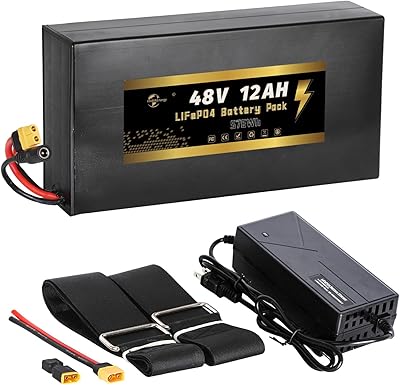
HAYAEnergy makes a 25Ah LiFePO4 pack that has been positively reviewed within the DIY community. This 12Ah version of the battery utilizes the same chemistry to create a smaller, more affordable battery. There are four reviews for this listing with an average of 5 stars. Although this is a very small data set, it is a positive indication of an early stage listing.
LiFePO4 Chemistry at 12Ah
There are two main reasons to utilize LiFePO4 chemistry when considering lithium-ion chemistry: longevity and thermal stability. The LiFePO4 cell is capable of lasting over 2000 plus cycles while the lithium-ion cell can last approximately 700 to 1000 cycles depending on the type of lithium-ion cell utilized in the battery pack. Based on the assumption that the pack will be charged once each day, 2000 cycles equates to over five and one-half years of daily charging before the pack begins to degrade significantly. This increases the overall usable life of the pack when utilized for daily commutes and can provide extended periods of time that the pack remains functional prior to needing replacement.
The thermal stability of the LiFePO4 cells far exceeds that of lithium-ion cells as well. Lithium-ion cells have a greater propensity for thermal runaway when subjected to high ambient temperature, damaged cells, and overcharging conditions. This can cause severe damage to the entire pack and the surrounding components. LiFePO4 cells do not exhibit this level of thermal runaway and are far more stable at elevated temperatures, making them ideal for applications where high ambient temperatures exist or when the pack may be subjected to damaged cells.
Voltage behavior
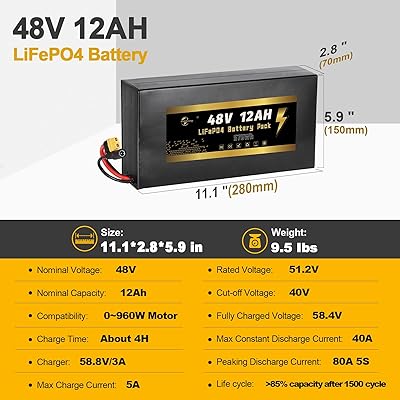
LiFePO4 cells are configured in a 16S arrangement (standard configuration for all 48V LiFePO4 packs), which means they charge to 58.4V nominal and discharge to 51.2V nominal. This is slightly different from lithium-ion packs configured as 13S at 48V, which charge to 54.6V. Although the majority of 48V controllers are capable of handling LiFePO4 packs since the operating ranges are identical, it is imperative to verify that your controller will not trip due to the slightly different charge voltage.
The discharge characteristics of LiFePO4 are remarkably flat, and as such, the voltage of the cells remain relatively constant throughout the majority of the discharge cycle, and then drop rapidly as the battery approaches depletion. Conversely, the discharge characteristics of lithium-ion cells gradually drop as the battery depletes. This results in a consistent level of motor performance until the battery is nearly completely depleted. The drop-off of power during the latter stages of discharge is minimal, resulting in less of a perceived loss of performance.
Core Specs
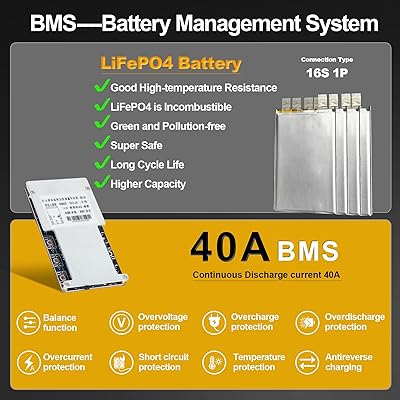
Based on a 576Wh capacity, most riders will realize a range of 18 to 28 miles. The 40A BMS that is included is sufficient to support motors up to 1920W at 48V. The manufacturer lists the motor compatibility as 960W at 48V, leaving ample room in the BMS to absorb the occasional spike in current associated with motor start-up and acceleration.
Connector and charger
XT60 connectors are the best available connector solution at this level of power delivery. They are capable of delivering current cleanly and are generally compatible with most hub motor controllers, mid-drives, and other types of ebike systems. The 3A charger that is included will top off the 12Ah pack in approximately 4 hours, which is significantly faster than the 2A chargers that often come included with packs of comparable capacity.
Due to the external box format of the battery, mounting is accomplished using a rack, bag, or custom bracket rather than sliding into a frame slot. This mounting method is generally preferable for DIY builds and conversions.
Why a 40A BMS on a 12Ah Pack?
A 40A BMS on a 12Ah pack seems excessive, but it is a prudent design decision. The BMS current rating represents the peak current the battery pack can supply without being terminated. Motor startup and climbing hills require a high peak current, and a BMS that is sized close to the nominal current will terminate frequently under peak loading conditions. A 40A BMS on a 12Ah pack allows for the battery to operate under peak loading conditions and avoid termination due to the high peak current, thereby improving the user experience and reducing the stress placed on the BMS.
What Amazon Reviewers Say
Although this is a very small sampling of reviewers, the fact that there are four reviewers with an average of 5 stars is a good indicator of product quality. The reviewers are generally pleased with the operation of the battery and its build quality. One reviewer chose this battery pack over a lithium-ion pack based solely on the increased cycle life of the LiFePO4 chemistry and reported satisfactory operation on his conversion setup.
It is essential to note that the lack of negative reviews does not necessarily indicate that there are no problems with the product. As additional reviewers begin to comment on the product, a more comprehensive review of the product will become available.
Check current pricing and the latest reviews on Amazon since this listing is still accumulating feedback.
Who Should Buy This
This battery pack will appeal to builders who wish to utilize LiFePO4 chemistry in a compact, low-capacity format. If you are building a lightweight conversion or need a secondary battery for a longer primary battery pack, or if you desire increased cycle life and thermal stability over maximum capacity, this battery pack fits your needs at a reasonable cost relative to LiFePO4.
Additionally, if you require increased range, and are willing to settle for standard lithium-ion chemistry, the [battery comparison table(/ebike-batteries/) has several 20Ah and larger options available at possibly a lower cost per watt-hour than this LiFePO4 battery pack. The premium paid for LiFePO4 decreases as the capacity of the pack increases.
Browse 48V LiFePO4 ebike batteries on Amazon to compare options across various capacity ranges, and see the ebike battery reviews section for more LiFePO4 and lithium-ion comparisons.
Frequently Asked Questions
What makes LiFePO4 different from standard lithium-ion? Standard lithium-ion cells utilize a nickel manganese cobalt (NMC) combination in the cathode, while LiFePO4 cells utilize iron and phosphate in the cathode. LiFePO4 exhibits superior thermal stability, longer cycle life (greater than 2000 cycles) and a flatter discharge characteristic than standard lithium-ion cells. While LiFePO4 chemistry provides these benefits, it has lower energy density per unit mass and volume than lithium-ion chemistry. Additionally, LiFePO4 chemistry operates at a slightly different voltage than lithium-ion chemistry and requires a LiFePO4 specific charger.
Will a standard 48V lithium-ion charger work with this battery? No, a standard lithium-ion charger will not properly charge a LiFePO4 battery. Standard lithium-ion packs are charged to 54.6V, while LiFePO4 packs are charged to 58.4V. Charging a LiFePO4 battery with a lithium-ion charger will result in undercharging. The 3A charger provided with the LiFePO4 battery is specifically designed for charging LiFePO4 chemistry to the proper voltage. Any third-party charger that is to be used must be specifically rated for LiFePO4 chemistry at 48V.
What is the real range difference between 576Wh and a 960Wh pack? Based on the capacity of both batteries, the actual range difference between the 576Wh battery and the 960Wh battery is approximately 60%. Therefore, if a 960Wh battery provides 35 miles of range, a 576Wh battery provides approximately 20 to 22 miles of range under the same conditions. Both batteries have the same range per watt-hour, and the range simply scales with the capacity of the battery.
Why does the BMS rating (40A) seem high for a 12Ah pack? Utilizing a BMS with a higher current rating provides headroom for peak current spikes and prevents the BMS from terminating the pack prematurely. During motor startup and hard acceleration, motors draw 2 to 4 times their nominal current. A 40A BMS on a 12Ah battery pack can easily handle these peak currents without terminating, whereas a 15A BMS would likely terminate frequently. This is an intentional design choice that enhances the reliability of the battery pack, and is not an over-design of the battery pack.
How long does the 3A charger take to fully charge the pack? Charging a 12Ah LiFePO4 battery pack from empty using a 3A charger will take approximately 4 hours. This is faster than the 2A chargers that are commonly included with comparable capacity battery packs. If the battery is 50% discharged, charging will take approximately 2 hours.
Is external mounting necessary, or can this fit in a frame slot? This is an external box format, not a downtube or shark/hailong form factor. It does not fit into integrated frame slots. External mounting via rack, bag, or custom bracket is required. For builds where frame-integrated mounting is a priority, use the [battery comparison table(/ebike-batteries/) to filter by form factor.