Screen-free dash cams sound like a cost cut until you have driven with one. The galphi 4K Dash Cam skips the display entirely, records 2160p through a 160 degree lens, moves footage off the camera over 5GHz WiFi, and ships with a card already in the slot. It is small enough to hide behind a mirror. The one thing missing from the box is the hardwire kit for parking mode.
No Screen Is a Feature
A dash cam with a screen gives you a small glowing rectangle in your peripheral vision every time you drive at night. It also gives you something to look at instead of the road, and that is the actual argument for leaving it out. A camera you never think about is a camera doing its job.
Setup and playback happen through the phone app instead, which is where you would review footage anyway. Nobody has ever seriously reviewed an incident on a two inch dash cam screen. The screen-free design also makes the unit smaller, which means it tucks behind the rear-view mirror where it neither blocks your view nor advertises itself to anyone walking past the car.
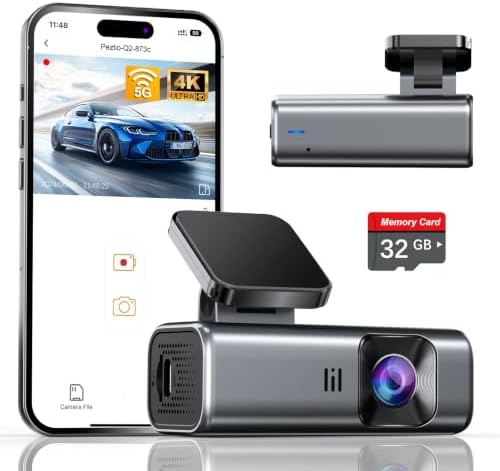
The tradeoff is that you cannot confirm framing without your phone. Aiming a dash cam is a one-time job, so pull up the app, adjust the angle until the horizon sits roughly a third of the way down the frame, and forget about it. Our comparison table covers the other camera gear we have written about.
4K, the F/1.6 Lens, and Night Footage
Resolution is the headline, and 2160p matters for one specific reason: reading license plates. At 1080p a plate two cars ahead at highway speed is a smear. At 4K there is enough detail to resolve it in decent light, and that is the difference between footage that supports an insurance claim and footage that just proves something happened.
Night is where dash cams separate themselves, and it is also where the resolution number stops helping. What matters after dark is aperture and processing, and galphi has specified an F/1.6 lens with wide dynamic range. A wider aperture gathers more light, and WDR balances the exposure between a dark road and oncoming headlights that would otherwise blow out the whole frame.
The consequence when a camera lacks both is predictable and infuriating. You get footage where the incident is a white blob surrounded by black, the plate is unreadable, and the file is useless for exactly the situation you bought the camera for. I can't verify this camera's night output personally, so I'll say only that the specification is the right one for the job.
The 160 degree lens covers adjacent lanes as well as the road ahead, which is what you want for lane-change incidents. Very wide lenses do stretch objects at the frame edges, so a car merging into you will look further away than it is in the footage.
5GHz WiFi and the Card Situation
Most dash cams use 2.4GHz WiFi, and pulling a 4K clip off one is an exercise in watching a progress bar. galphi quotes up to 8MB/s over 5GHz against roughly 2MB/s over 2.4GHz. On a 4K file that is the difference between a thirty second transfer and a two minute one, standing at the side of a road after an incident.
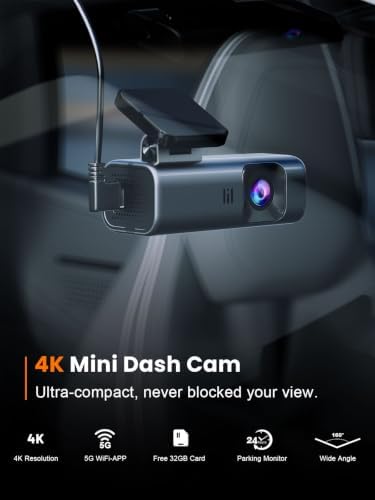
A 32GB card comes pre-installed, and galphi is refreshingly direct about the change from the previous 64GB card, citing memory chip costs rather than pretending nothing happened. That candor is rare in this category. 32GB of 4K footage is not a lot of driving time, so budget for a Class 10 U3 V30 card of 128GB or larger if you drive long distances. High-endurance cards specifically designed for continuous recording last far longer under loop writes.
Loop recording overwrites the oldest unprotected files automatically, and the G-sensor locks a clip when it detects an impact so the important footage survives the overwrite cycle. That combination is what makes a dash cam useful without any user intervention. Set it and forget it. You can check current price on Amazon.
Parking Mode Needs a Part You Don't Have
The 24-hour parking mode records in low-power time-lapse at a reduced frame rate while the car is parked, which catches the hit-and-run in a parking lot that nobody witnesses. It requires a Type C hardwire kit, and that kit is not included.
Hardwiring means running a cable to your fuse box and tapping a constant-power circuit, usually with an inline low-voltage cutoff so the camera does not flatten your battery overnight. That is a straightforward job for anyone comfortable with automotive fuses and a job worth paying a shop for if you are not. Skipping it means the camera only runs when the engine does, which covers most use cases but not the one where somebody clips your bumper in a car park.
Anyone buying this specifically for parking surveillance should order the hardwire kit at the same time. Our hands-on reviews cover other camera setups if parking protection is your priority.
Frequently Asked Questions
Does it come with a memory card?
Yes, a 32GB card is pre-installed. galphi previously shipped 64GB and reduced it due to memory chip costs, which they state openly in the listing. For 4K recording, upgrading to a 128GB or larger high-endurance card is worth doing.
Why is there no screen?
Deliberate design. A screen adds distraction and bulk, and playback happens through the phone app over WiFi instead. The smaller body also hides better behind the rear-view mirror, which keeps it out of your sightline and out of view from outside the car.
How good is the night footage?
The F/1.6 aperture and wide dynamic range are the right specifications for low light, since they gather more light and balance exposure against oncoming headlights. I can't judge the real output personally. What I can say is that a camera without those two features tends to produce useless night footage regardless of its resolution.
Do I need the hardwire kit?
Only if you want 24-hour parking mode. Without it, the camera runs on the cigarette lighter socket and records only when the car is on. Parking mode requires a Type C hardwire kit that is not included in the box.
Will 4K really read license plates?
In good light at moderate distance, usually yes, and that is the main practical reason to choose 4K over 1080p. Speed, angle, and glare all work against you, and a wet plate at night is difficult for any camera at any resolution.
What does the G-sensor do?
It detects sudden impacts or hard braking and locks the current clip so loop recording cannot overwrite it. That means the footage from an incident survives even if you don't touch the camera for days afterward. Sensitivity is usually adjustable in the app if false triggers become annoying.
Sensible engineering in a small package, with the resolution that makes plates readable, the aperture that makes night footage usable, and fast WiFi that makes retrieving a clip painless. The included card is small, the parking mode needs a hardwire kit you buy separately, and the no-screen design means you need your phone to aim it. For a set-and-forget front camera, it covers the essentials properly.