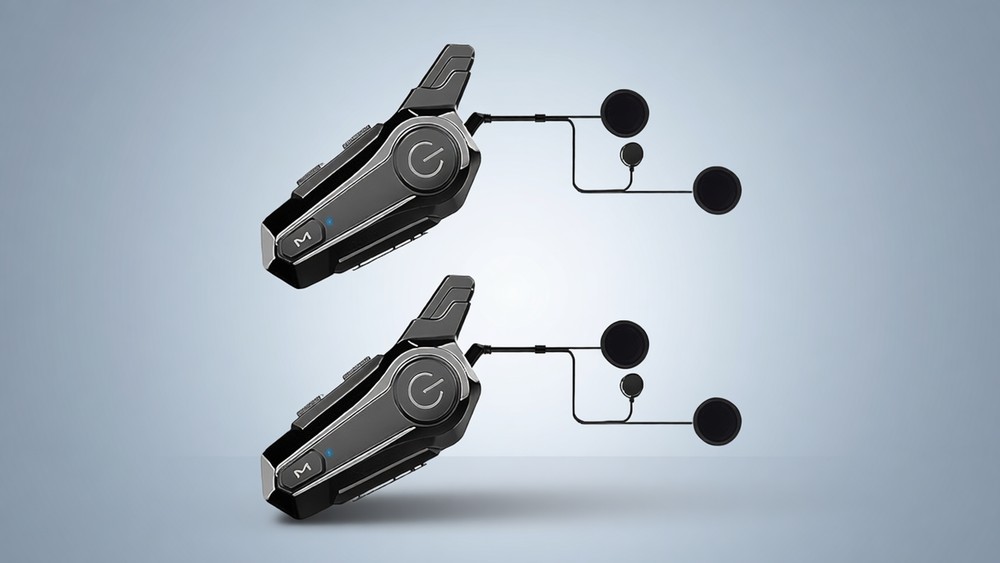
The budget shelf of any intercom market is stacked with two-packs that promise rider-to-rider talk for less than one helmet of a name brand, and the hard part is telling which of them carry a real record. The cepkquis E1 motorcycle intercom has one, 128 ratings and fourteen written texts, every one of them carrying Amazon's purchase badge, and the record tells a more honest story than the listing does.
That story splits cleanly. On the passenger seat behind you, the E1's praise pattern holds up, easy installs and riders happy to hear their other half. Between two bikes at distance, the record collapses the claim the listing leads with, and the collapse is documented by the kit's own buyers.
This article walks the range claim against what owners actually measured, follows the volume ceiling that runs through six texts, explains the mode-switch design two owners describe independently, decodes the waterproofing argument the listing has with itself, and finishes with what the two-pack price really buys per helmet.
The short version before the detail. The E1 buys you a two-helmet kit at a 26-dollar helmet price that sits close to the middle of our intercom comparison table, installs in minutes, and works as a rider-passenger kit by every account that tried it. It costs you the range the bullet prints, usable volume at highway speed by most accounts, and the ability to talk over music without both riders fiddling with buttons. The sections below put numbers on each of those.
The range claim meets its record
The listing cannot keep its own distance straight. Bullet one promises two riders talking across 400 meters. The spec table's Talking Range Maximum row says 800 meters. Both numbers describe the same two units, and the larger one appears only in the row most buyers never expand.
The record's numbers are smaller than either. The friendliest owner who measured anything reports the units link at least 75 feet, which is about 23 meters. The harshest reports a range like 10 feet or cutouts so heavy the link barely matters. Fourteen texts, and not one owner report comes within a factor of ten of the printed claim.
Some of that gap is category behavior rather than this kit's defect. Bluetooth 5.0, the version this class of hardware advertises, tops out around 40 to 400 meters as a radio standard, and intercom makers quote the top of that band. Real rider-to-rider range lands far below it once helmets, bodies, bends in the road, and engine noise get between the antennas, which is why every brand's box number deserves the same discount. The difference here is that the E1's discount is documented by its own buyers, and 23 meters at best is a different product than 400 meters at best.
Plan around the observed numbers. If your rides need bike-to-bike talk at a quarter mile, this is not the kit, and no amount of careful mounting changes the record.
The comm experience: quiet at speed, and a switch nobody warns you about
Volume is the through-line of this record. Six texts across 2024 and 2025 land on the same complaint from different angles. A 2025 owner calls the speakers too quiet if the bike is noisy or wind comes through the helmet. A 2024 owner says no matter how high the volume goes, they struggle to hear and understand once moving, and that the kit works well enough sitting still.
A one-star reports extremely low volume with a lot of static, and says they had to yell into the mic for a passenger to hear. Another calls the volume terrible and says you can't hear the other rider while moving. One says nothing comes through the way it should, and one leaves a warning that you cannot hear anything over two strokes.
Against that stands the record's most helpful text, from 2023 with four votes. That owner took a phone call at about 65 mph and the other person couldn't tell, installed both units on LS2 full-face helmets in about 15 minutes, and notes the thin bass is something even 400-dollar comm sets get criticized for. A passenger-kit owner adds that mic quality is great when the E1 is mounted properly. The honest read is that the E1 can sound fine in the right helmet at moderate speed, and gets thin as noise climbs.
The deeper complaint is architectural, and two owners describe it independently. Music and intercom are exclusive modes. To talk, both helmets have to switch into comms mode, so a rider has to interrupt their passenger, get them to press buttons on their own unit, and only then start the conversation. One owner contrasts this with a cheaper previous brand that let them push a button and speak over the passenger's music. Another adds that the two units cannot stream Bluetooth music between each other at all. If shared music or one-touch talk matters to how you ride, read the March 2025 text before you order.
Pairing splits down the middle. To a phone, easy, two owners say so. Unit to unit, the record argues with itself, with one owner laying out the working sequence, link the first unit to the intercom, then the second, then run the search, while others fought the connection and one says the units wouldn't pair to each other at all.

The claims nobody in the record has tested
The waterproofing claim is the listing arguing with itself in public. The title says IPX6. Bullet four says IP65. Those are different certifications, and the two-digit IP code decodes them cleanly, the first digit rates dust protection from 0 to 6 and the second rates water protection, so IPX6 rates water jets while leaving dust unrated, and IP65 claims full dust tightness with weaker jets. Which one the E1 actually holds, the record can't say, because no owner mentions rain at all. The friendliest text in the record says outright they haven't ridden in any rain yet. Treat the rating as unproven either way and check the seal on your own schedule.
Battery life has the same shape. Bullet three promises 10 hours of streaming or talking. The spec table's Battery Average Life row says 18 hours. No owner in the record reports real hours per charge, so the one number you'd want verified is the one nobody tested. The FM radio the same bullet promises never appears in any text either.
The spec table also carries rows that don't survive contact with the hardware. Number of Channels reads 10 on a two-rider intercom. Impedance reads 0.01 ohm. Included Components reads Cable only, on a listing whose title sells a 2 Pack. When a spec table holds this much filler, the rows that matter, the 400 meters and the 10 hours, deserve the skepticism the filler earns.
The safety net behind all of this is a 1-year warranty row, which is short for the category but real, and backed by a storefront contact route rather than a phone number.
What the two-pack does well
The value case starts with the per-helmet math. The 53-dollar two-pack works out to a 26-dollar helmet, and on our intercom comparison table that price-per-rider sits close to the middle of the 192 units we track. The specs box renders the exact live position, so check it there rather than taking a rank from this article.
What the record praises is consistent. Install comes up easy in three texts, including the 15-minute two-helmet account. Passenger use is the praise pattern, a 2025 owner calls it a great kit for use with a passenger and rates it 10 out of 10 for a budget option, and a January 2025 owner rides with their wife with no issues. The rating base itself, 3.8 from 128, splits 48 percent five-star against 14 percent one-star, with a real middle band of 3-star texts that read as disappointed rather than angry.
Two physical notes from the record. One owner finds the E1 a little bulky on the side of the helmet, a non-issue to them. Another, in 2026, says the units don't stay on the helmet for long, which is a mount complaint worth checking on arrival.

Buy it for the rider behind you
Every signal in this record points the same way. The praise pattern is rider-and-passenger, close together, moderate speed, easy install. The complaint pattern is bike-to-bike, distance, and at-speed volume. The 400-meter claim that headlines the listing has no owner support anywhere in fourteen texts, while 23 meters has one and 10 feet has another.
So the decision this kit forces is an honest one. If your passenger sits behind you and your rides run at city speeds, the E1 is a cheap way to put a working intercom on two helmets, backed by a fully purchase-badged record and a 1-year warranty. If the plan is two bikes touring apart, the record says you'd be buying 23 meters of proven range, and the money belongs in a kit built for bike-to-bike distance instead. The same brand makes one, the cepkquis 2-rider 600M, though its own 600-meter claim deserves the same skepticism this record just taught you to apply.
Frequently asked questions
How far apart can two riders actually be?
The record's best number is at least 75 feet, about 23 meters, from a friendly four-star text, and its worst is about 10 feet from a one-star. The bullet claims 400 meters and the spec table says 800. Nothing in fourteen owner texts approaches either number, so plan for close-range riding.
Can you listen to music and talk at the same time?
No. Two owners independently describe exclusive modes, the music playing and the intercom link never run together, and both helmets have to switch to comms before a conversation starts. One rider therefore has to interrupt the other and get them to press buttons. The units also cannot stream music between each other.
Is it really waterproof?
The title says IPX6 and the bullet says IP65, two different ratings, and no owner in the record has ridden this kit in rain, so the record can't settle the argument. Both ratings describe water jets rather than submersion, and dust protection differs between them. Plan to test the seal yourself inside the 1-year warranty window.
How long does the battery last?
The listing says 10 hours in the bullet and 18 hours in the spec table, and no owner reports real hours per charge. The honest answer is that the number is unverified, and the 10-hour bullet is the more conservative of the two claims.