The unique dual-voltage angle that allows BtrPower 48V/52V 30Ah LiFePO4 battery to differ from a typical 52V or 48V pack is the ability to provide one battery for both voltage systems in a single purchase. The benefit of a dual-voltage capability is that you will have one battery that covers the voltage systems of your bike. Whether you are currently running a 48V build but are planning a 52V upgrade or whether you have two bikes with different voltage systems, this is a beneficial option. The 1440 Wh of LiFePO4 capacity and 2000+ cycle rating make this a great battery to consider when looking for a long-term value added to your build.
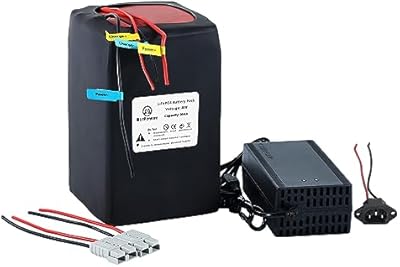
BtrPower has been known to develop a strong reputation among DIY ebike builders based upon the fact that they provide specifications that translate well into reality. The 48V/52V version of this battery continues to build upon that reputation by providing a capability that is rarely seen with competing products.
Specifications and the Dual-Voltage Capability
The basic specifications for the battery are: 30 Ah capacity, 1440 Watt-hours. The operating voltage range covers both 48V and 52V systems. The 50A continuous BMS rating will allow you to run motor sizes of up to 2400 Watts at 48V and up to 2600 Watts at 52V, which should be sufficient for all but the most extreme builds. The 100A peak rating will allow you to exceed the continuous rating of the BMS to accommodate hard acceleration spikes.
Physical Specifications
The physical dimensions of the battery are 9.5 x 6.5 x 4.9 inches, which is the same dimensions as the single-voltage version. The dimensions of the battery are reasonably sized for an external mount application and will provide ample space for mounting the battery outside of the downtube. The included Anderson style connectors are the de facto standard in the DIY EV community. They are capable of handling large amounts of current, the connectors easily come apart and go back together (which makes them ideal for prototyping), and there are many adapters available that will allow you to connect the Anderson style connectors to your existing wiring.
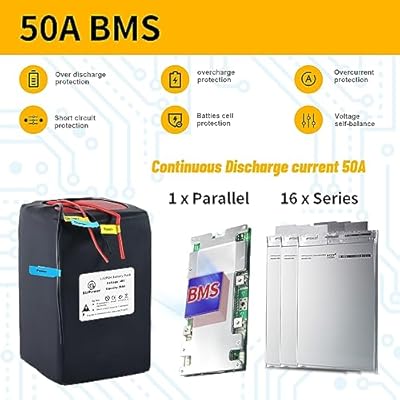
As a result of the LiFePO4 chemistry, the battery will have a 2000+ cycle life span compared to 700-1000 for standard lithium-ion. The battery will also exhibit thermal stability substantially greater than lithium-ion in warmer temperatures and the battery will maintain a flat discharge curve throughout most of the battery's range of operation. As a result of these characteristics, using this battery for a build that will be subjected to daily high mileage will provide significant economic advantages over a four to five year period.
Practical Applications for the Dual-Voltage Capability
This is the primary reason why someone would select this product over the single voltage version. At 48V the battery will charge to 58.4 volts and will operate down to a low voltage cutoff typical for 48V LiFePO4. At 52V the battery will charge to 58.8 volts and will operate throughout the entire 52V voltage range. The BMS will automatically switch to or recognize the system voltage.
In practical terms this means that if you need a battery that can be used with multiple builds or you want to ensure that you will be able to convert your bike from a 48V to a 52V system in the future then this is a viable option. However, this is not a common feature at this price point.
Prior to purchasing this product, the buyer should check that their controller explicitly supports LiFePO4 voltage ranges at the voltage they intend to operate the system. Most 48V and 52V controllers do support LiFePO4 voltage ranges and therefore will not create an issue. However, a few older or budget controllers have very narrow cutoffs that require matching the discharge curve of the LiFePO4 chemistry.
Form Factor and Compatibility
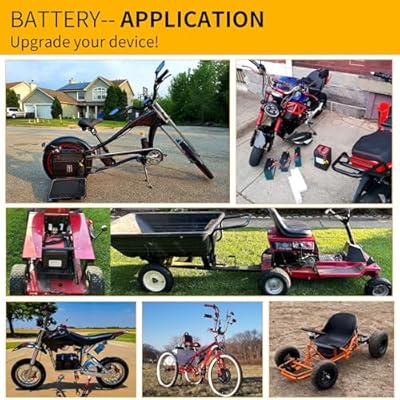
This is an external box format battery pack, not a downtube, shark, hailong, or frame integrated battery pack design. The battery is designed to be mounted externally, whether via racking straps, bag mounted, or integrated into a custom enclosure. This battery will work well for high mileage commute builds, cargo bikes, e-trikes, DIY conversions, and any build where mounting the battery externally is practical.
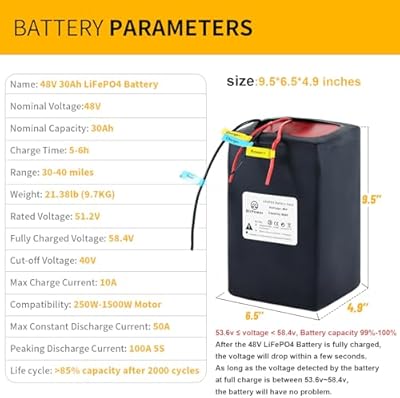
The 50A continuous rating of the BMS will provide adequate current for builds ranging from 250 watts to 1500 watts plus hub motors. The 100A peak rating will provide additional headroom for transient current spikes such as those experienced during start-up and hard acceleration. Note that on sustained hard climbs the draw to the mid-drive motor will be high and the buyer should confirm that the peak draw is below the 50A continuous limit to prevent excessive heat buildup in the BMS.
Real World Range
The 1440Wh of this battery places it in the upper end of the commonly available battery packs. Real world range will depend on the weight of the rider, the terrain, the speed of the bike, and the assist level selected by the rider. Riders that are light and riding on flat ground with moderate assist levels may experience the upper end of the range. However, riders that carry a heavy load, ride on hills, and frequently use the throttle will likely experience the lower end of the range.
One of the benefits of LiFePO4 chemistry is a flat discharge curve. In contrast, lithium-ion exhibits a noticeable loss of power in the last 20% of the discharge cycle. Therefore, the rider will not be managing power fade on long rides.
Amazon Reviewer Feedback
Currently, there are only five reviewers that have provided feedback on this product. However, the reviewers have provided a clean signal regarding the performance of the battery. The reviewers have confirmed that the battery will function as expected at both 48V and 52V, that the build quality of the battery is excellent, and that the Anderson connectors are easy to install in a custom setup. None of the reviewers have reported any failures or compatibility issues with the battery.
Although this reviewer base is relatively small, BtrPower has a positive and consistent review history across their product lines, consistent with the feedback received from these initial reviewers. Check current pricing and reviews on Amazon since availability for LiFePO4 packs at this capacity can vary.
Who Should Buy This
Builders that are seeking long term reliability, a dual-voltage capability, and a battery that will withstand heavy daily use should seriously consider this product. The 2000+ cycle life span of the LiFePO4 chemistry and the thermal stability of LiFePO4 justify the cost differential over lithium-ion at comparable capacities when the build will be subject to heavy usage for several years.
However, this is not the correct solution for riders that seek a standard frame integrated battery. Riders must use an external mounting method for this battery. Use the [battery comparison table(/ebike-batteries/) to filter by voltage and form factor and compare other LiFePO4 and lithium-ion battery options.
See our ebike battery reviews for more LiFePO4 and lithium-ion options across voltages and capacities. For a complete list of packs in this range, browse 48V 52V LiFePO4 ebike batteries on Amazon.
Frequently Asked Questions
Does this actually work at both 48V and 52V? Yes. At 48V the BMS will charge the battery to 58.4 volts and at 52V the BMS will charge the battery to 58.8 volts. Your controller must be capable of supporting LiFePO4 discharge curves at either of the two voltages that you intend to operate the system, which is true for most 48V and 52V controllers.
Will this work with my Bafang BBSHD? Yes, the 50A continuous rating of the BMS will easily accommodate normal operating draws for most Bafang BBSHD builds. On prolonged hard climbs the draw to the mid-drive motor may become high and the 100A peak rating will provide plenty of headroom for transient current spikes. However, the builder should confirm that the peak draw will remain below the 50A continuous limit to prevent excessive heat buildup in the BMS.
What type of Anderson connector adapter do I need? This depends on the wiring scheme that you are currently using. There are many Anderson to XT60 and Anderson to XT90 adapters available and they are relatively inexpensive. If you are using a proprietary connector on your controller, you may need to fabricate a custom pigtail. Anderson connectors are relatively simple to crimp and are a common starting point for most DIY wiring projects.
How does the charge time of this product compare to lithium-ion? Regardless of chemistry, a 5 amp charger will take approximately six to seven hours to recharge a 30 Amp hour battery from empty. Although a LiFePO4 rated charger will provide faster charging times, it must be specifically rated for LiFePO4 at the proper full charge voltage (58.4V for 48V or 58.8V for 52V).
Is LiFePO4 safer than lithium-ion? Yes, LiFePO4 is substantially safer than lithium-ion. LiFePO4 is significantly more thermally stable than lithium-ion and is much less prone to thermal runaway. The safety margin associated with the thermal stability of LiFePO4 is substantial and represents a meaningful advantage over lithium-ion, especially if you plan to operate the battery aggressively or store the battery in less than optimal conditions.
What is the best way to store this battery long-term? You should store the LiFePO4 battery at a state of charge between 40 and 60 percent in a cool, dry location. Additionally, you should avoid storing the battery at a full charge or at a fully discharged state for extended periods of time, as both of these conditions will accelerate the calendar aging of the battery. Overall, LiFePO4 chemistry exhibits better storage characteristics than lithium-ion, however, it is still recommended to store the battery partially charged.