When you require a great deal of capacity and wish to have a long lasting battery, then LiFePO4 chemistry can certainly make the numbers add up differently. With the BtrPower 48V 30Ah LiFePO4 battery providing a total of 1440 watt-hours in a pretty compact package, and the cells behind these numbers are rated for 2000+ charge cycles versus the 700-1000 charge cycles you might expect from standard lithium-ion, you can do a good deal of long haul cost-per-watt-hour math over the entire lifetime of the battery to realize the chemistry advantages provided by BtrPower.
BtrPower is known for producing products that meet their specifications in the ebike DIY community. This is at the upper end of the capacity spectrum for BtrPower, and thus defines the target audience for this product.
Specifications and What the Chemistry Means
In short: 48V nominal, 30Ah capacity, 1440 Wh. The cells are arranged in a 16-cell in-series (16S) configuration, which is standard for 48V LiFePO4 packs. The nominal voltage of each cell is 3.2V, therefore 16 x 3.2V = 51.2V nominal with a full charge voltage of approximately 58.4V. This is important to know if you are using a controller with tight voltage tolerances, because this represents slightly different voltage behaviors than those observed with lithium-ion packs that have 13S configurations.
Size and Physical Specifications
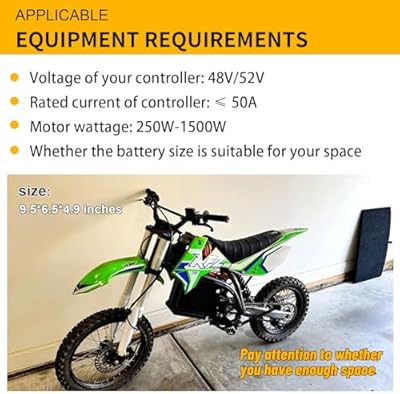
The dimensions of the battery are 9.5 x 6.5 x 4.9 inches, which is quite compact for a 1440Wh pack. The volume of LiFePO4 cells is generally less dense in terms of energy per unit volume compared to lithium-ion, but the pack volume is still suitable for many external mounting applications. The BMS is rated for continuous operation at 50A, which will cover motors up to about 2400W at 48V, far exceeding the peak output of most hub motor installations.
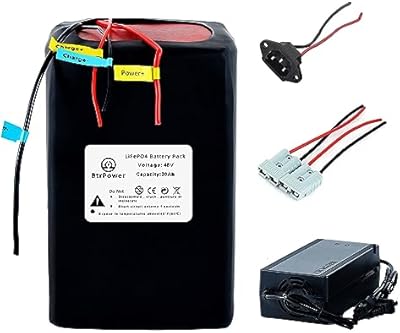
Anderson-style connectors are included with the battery. Anderson connectors represent the industry-standard connectors in the DIY EV space. They provide clean, high-current connections, are easy to connect and disconnect, and there are a wide variety of adapters and extension cables available for them. Including Anderson connectors with the battery at this price point is a significant advantage over sourcing and splicing your own.
LiFePO4 vs Standard Lithium-Ion
There are three main areas where the practical implications of choosing LiFePO4 instead of lithium-ion differ. First, longevity: LiFePO4 can last 2000+ cycles, while standard lithium-ion typically lasts 700-1000 cycles. This equates to LiFePO4 potentially lasting 5-6 years with daily usage before capacity begins to degrade significantly. Second, thermal stability: LiFePO4 is significantly less prone to thermal runaway than lithium-ion, particularly when operating the battery aggressively in warmer temperatures or storing it in non-optimal conditions. Third, voltage flatness: LiFePO4 provides a very flat discharge curve throughout most of the battery's range, providing consistent motor performance until the battery approaches empty, whereas the discharge curve of lithium-ion will gradually flatten as the battery drains.
Energy Density Tradeoffs
One drawback of LiFePO4 is lower energy density. More cell volume is required to store the same watt-hours in LiFePO4 compared to lithium-ion. Additionally, the full-charge voltage of 58.4V is slightly different from that of a lithium-ion 52V pack (which is 58.8V). Therefore, some lithium-ion-based controllers that were optimized for 52V lithium-ion may need to be adjusted for LiFePO4.
Form Factor and Compatibility
The battery is an external box-style pack, and is not in the form factor of a downtube or shark/hailong style pack. As such, it is intended to be mounted externally, either to a rack, bag-mounted, or integrated into a custom enclosure. Who it is best suited for: DIY conversions, cargo ebike builds, e-trikes, scooters, and any project in which mounting the battery externally is feasible.
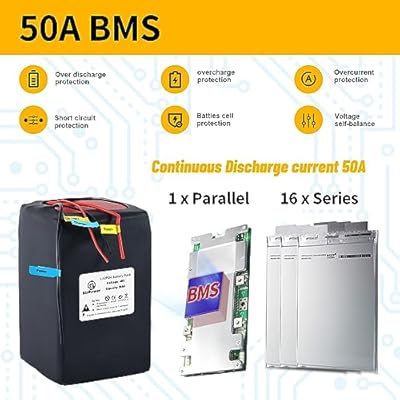
Motor compatibility at 50A continuous covers all builds from 250W to high-power hub motors. However, for mid-drives with a high peak current draw, check your motor's peak specs against the BMS limits. The stated motor range is up to 1500W, which the 50A BMS can handle at 48V.
Real-World Range
You can expect 30-60 miles of range based on the 1440Wh of the battery. The actual range will depend on factors including weight, terrain, assist level, and speed, but the above represents a reasonable estimate for most riders. Lighter riders on flat terrain with moderate assist can achieve towards the upper end of this range. Heavier riders with frequent hill climbs and consistent throttle input will likely fall towards the lower end.
Additionally, the larger capacity of this battery means you are much less likely to be operating below 50% on typical rides. Keeping LiFePO4 cells in the upper half of their range reduces wear over time.
Amazon Reviews
There are currently 12 reviews on Amazon with an average rating of 4.9 stars. The reviewers universally report that the battery arrived well-packaged and performed as advertised. Many reviewers comment positively on the ease of connection with the Anderson connectors (the standard connectors for DIY EV applications). Several reviewers commented on the perceived quality and durability of the battery's build quality.
Of the few lower-rated reviews, most relate to inquiries regarding specifics related to the setup process, and none reflect a failure of the product.
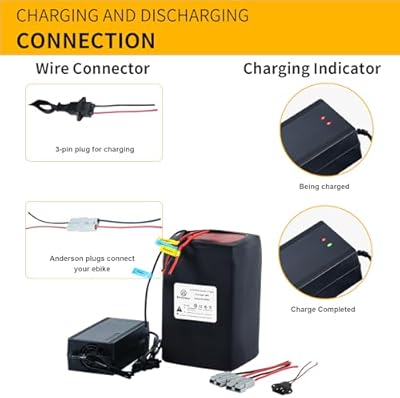
One reviewer noted that the charge time for a 30Ah battery using the included 5A charger was somewhat longer than expected (approximately 6-7 hours). While this is true, it is worth noting that a LiFePO4 charger rated for higher amps and compatible with the 58.4V full charge voltage of the battery would significantly reduce the charge time.
Check current pricing and reviews on Amazon since availability and prices can fluctuate, particularly for LiFePO4 packs of this capacity.
Who Should Buy This
If you are a builder seeking reliable, long-term service from your battery, and you are able to mount the battery externally, the BtrPower 48V 30Ah LiFePO4 is a good option. If you are building a high-mileage daily commuter bike, a cargo ebike conversion, or another type of project that will be subjected to heavy and repeated usage, the 2000+ cycle lifespan of LiFePO4 will greatly affect the financial implications of the product versus less expensive lithium-ion options that need to be replaced after 2-3 years.
It is not a good fit for riders requiring a traditional frame-integrated battery replacement. External mounting of the battery is required for this product. Use the [battery comparison table(/ebike-batteries/) to filter by voltage and form factor and find options that match your specific setup.
See our ebike battery reviews for more LiFePO4 and lithium-ion options across different capacities. To compare LiFePO4 packs in this capacity range, browse 48V LiFePO4 ebike batteries on Amazon to see what else is available.
Frequently Asked Questions
What is the real-world lifespan difference between LiFePO4 and lithium-ion? LiFePO4 is rated at 2000+ cycles, versus 700-1000 cycles for standard lithium-ion. Assuming 1 charge per day, this equates to 5-6 years of daily usage before capacity begins to decrease. The chemistry of LiFePO4 is also more resistant to thermal degradation than lithium-ion, which maintains capacity in extreme temperatures longer than lithium-ion.
Will this work with my 48V controller? Yes. There is one caveat: LiFePO4 at 16S configuration charges to 58.4V and has a nominal voltage of 51.2V, which is slightly different than the nominal voltage of 54.6V for lithium-ion 13S 48V packs. Most controllers that are labeled 48V will support LiFePO4, because the nominal voltage and operational voltage ranges of LiFePO4 and lithium-ion are largely overlapping. However, if your controller has a strict low-voltage cut-off, verify that the controller supports the discharge characteristics of LiFePO4.
Will this work with a Bafang BBS motor? Yes. Bafang BBS02 and BBSHD motors will operate well within the 50A BMS limits at 48V under typical conditions. Peak current draws on hard acceleration on a BBSHD can spike higher, but the 50A continuous rating and BMS peak tolerance will suffice for most mid-drive load cases.
What does the Anderson connector interface with? Anderson connectors are ubiquitous in DIY EV and solar applications. They mate to a wide variety of controllers. If your existing system utilizes a different connector type (such as XT60), you will need an Anderson-to-XT60 adapter cable (available and inexpensive).
How long will it take to charge the battery? Using a standard 5A charger, charging a 30Ah battery will take approximately 6-7 hours. However, if you utilize a higher amp LiFePO4-compatible charger rated at 58.4V (full charge voltage) instead of 54.6V (used for lithium-ion 48V packs), the charging time will be reduced.
Is the pack weather-resistant? The pack is sealed in a case. Although light rain and humidity should not create issues, it is not designed for submersion. For wet condition applications or for mounting the battery to racks, consider adding a waterproof enclosure or a battery bag to protect the pack.