There are two 30Ah LiFePO4 packs from BtrPower listed, and if you're checking out the BtrPower 48V 30Ah LiFePO4 battery with the 5A charger, you'll be getting the version with the faster charger than the basic model. On a 30Ah pack, where charge times matter, moving from a 2A to a 5A charger reduces charging time from approximately 15 hours to a more reasonable 6-7 hours. For daily riders or those using this as a primary commuter pack, that's a significant difference.
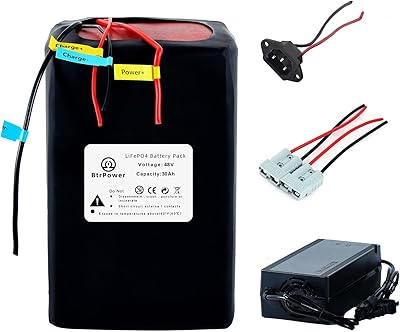
The rest of the specs look exactly as you'd expect from a solid-quality LiFePO4 pack at this capacity. The chemistry is really the big selling point here, not the charger.
Specs at a Glance
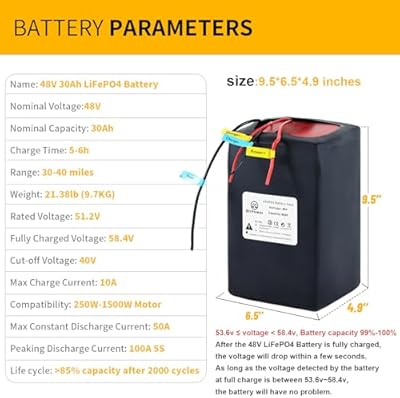
Using the numbers 48V x 30Ah = 1440 watt-hours (that's a whole lot of juice in a package measuring 9.5 by 6.5 by 4.9 inches and weighing in excess of 21 pounds). To give you a reference point, most 48V lithium-ion packs at 20Ah measure around 15 pounds, so you see the weight difference is very real when considering the added volume and mass of LiFePO4 for storing equal amounts of energy.
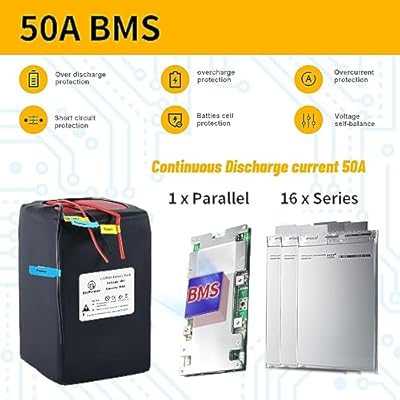
The BMS will allow for a continuous draw of up to 50 amps. This allows for virtually any motor you'd run on a 48V system, from a 250W commuter motor to a 2400W motor (at 48V) as well. For those that run a Bafang BBS02 or BBSHD, or even more powerful cargo builds, the BMS will be more than enough.
The connectors provided are Anderson style connectors. These are the industry-standard connectors for DIY EV and solar work. Anderson connectors are robust, capable of handling high current flow and are generally easy to adapt to whatever type of connector your controller uses.
Physical specs
As for physical specs, this 1440Wh pack is 9.5 by 6.5 by 4.9 inches, which is relatively compact for its capacity. The weight of this pack is greater than most lithium-ion packs at similar capacities, approximately 21+ pounds. Like most LiFePO4 packs at this capacity, the general rule of thumb is to mount this outside the frame with a rack, bag, or custom bracket.
LiFePO4 versus standard lithium-ion
In terms of LiFePO4, the practical advantages boil down to longevity and safety. The rated cycle life of this pack is estimated to exceed 2000 cycles. Budget lithium-ion packs with standard cells will usually have a rated cycle life of 500-700 cycles, while quality lithium-ion cells will typically not exceed 1000 cycles. Given the average daily charge is one, 2000 cycles is the equivalent of approximately 5 and a half years of daily use prior to experiencing noticeable capacity loss. This will likely alter the cost equation of this battery throughout its life.
From a safety standpoint, LiFePO4 chemistry is far more temperature-stable than most forms of lithium-ion chemistry. In addition, the chance of thermal runaway occurring due to damage, overcharge or high ambient temperatures is greatly reduced. For those that plan to install this pack externally, especially in warmer climates, or those installing on cargo bikes that may spend considerable time in a garage, this increased temperature tolerance will prove beneficial.
The voltage behavior of LiFePO4 is slightly different than that of lithium-ion chemistry. A 16S LiFePO4 pack has a nominal voltage of 51.2V and will charge to 58.4V, whereas a 13S lithium-ion pack will charge to 54.6V at 48V. Since most 48V controllers operate over a range that overlaps with both voltages, most should function properly with LiFePO4 packs. That said, verify with your controller manufacturer if you have a controller with a strict high-voltage limit.
Form Factor and Mounting
This is an external box-style pack and is not a frame-mount style configuration such as downtube or shark/hailong. As such, it is intended to be installed via straps, bolts or bag-mounted externally, perfect for cargo bikes, e-trikes, scooter conversions and custom builds where the frame does not require integration with the battery. If you need to replace a battery that is already integrated into your frame with a specific mounting configuration, then this is not the correct solution for you.
Given the compact nature of this pack (9.5 inches long), it can easily be accommodated in a large triangle bag or strapped to a rear rack on many cargo-style builds.
Range Expectations
Using 1440Wh of usable energy and assuming a 48V system, you can estimate your maximum range based on the factors of your rider weight, terrain, assist levels, and your desired speed. Assuming a moderate amount of assistance, a lighter rider will be able to reach the higher end of the estimate (35-65 miles) on flat ground or using primarily PAS level 2. More aggressive riding or hills will naturally consume a larger percentage of the available capacity and decrease your effective range. The baseline capacity here is plenty larger than the majority of 48V lithium-ion packs in the market today at 20Ah.
Additionally, the larger capacity of this pack means you will rarely drain the pack below 50% of capacity during normal rides, which is ideal for maintaining optimal cell health. Cycling LiFePO4 cells above 50% increases their true lifespan (beyond the rated cycle life).
What Amazon Reviewers Say
Currently, the pack has received seven reviews averaging 4.4 stars, which is a small sample size, but the overall consensus among reviewers was positive. Reviewers consistently mention the build quality and how the pack performs as advertised. Many reviewers specifically compliment the Anderson connectors, citing ease of connection and versatility (as Anderson adapters are inexpensive and widely available if you prefer a different connector type). Only two reviewers mentioned installation-related issues (one related to fitment and another related to electrical connectivity), and neither reviewer suggested the product was defective or misrepresented in specifications.
Since this is an external box-style pack, there will always be some degree of custom installation and adaptation required to install it into your specific application. For those planning to do so, be aware that some additional effort may be required.
Check current pricing on Amazon since large-format LiFePO4 packs at this capacity can fluctuate in availability.
Who Should Buy This
Builders requiring a combination of high cycle life and flexibility with regard to external mounting configurations are the best candidates for this pack. Daily commuters who complete 20+ miles each day, cargo ebike conversion projects, e-trike projects, and anyone creating a custom ebike from scratch are likely to appreciate the 2000+ cycle rating and the included 5A charger, making it an excellent option for daily use applications where a lower-cost lithium-ion pack would deteriorate in 2-3 years.
If you need a frame-integrated replacement battery with a specific form factor like shark/hailong or silver fish, this won't fit. Browse the [battery comparison table(/ebike-batteries/) and filter by form factor to find options that match your bike's mounting system.
For more battery options at different capacities and chemistries, browse our ebike battery reviews. You can also search for 48V LiFePO4 ebike batteries on Amazon to compare pricing across the category.
Frequently Asked Questions
Will this battery connect to standard 48V ebike controllers? Yes, with a caveat regarding voltage. A 16S LiFePO4 pack like this will charge to 58.4V and has a 51.2V nominal, somewhat different from a lithium-ion 48V pack. Most 48V controllers will operate with no issues, as the operating ranges for the two chemistries overlap. Consult your controller manufacturer documentation if you have a custom build with restrictive high-voltage limits.
Why does it weigh more than lithium-ion packs of the same capacity? LiFePO4 cells are less energy-dense by volume and weight, so more material is required to store the same amount of watt-hours as NMC lithium-ion cells. While the penalty is a greater weight, the trade-off is a longer cycle life and a greater resistance to thermal degradation. Builders completing high-mileage routes accept the weight penalty to achieve extended cycle life.
What does Anderson connector compatibility mean for my setup? Anderson connectors are commonly used in DIY EV builds. If your controller uses a different connector type (such as XT60 or XT90), Anderson-to-connector adapters are inexpensive and widely available. If you are unsure what connector type your setup utilizes, simply inspect the discharge wire going to your controller.
Can I use the 5A charger with a standard 120V US outlet? Yes. The charger functions with standard US household current. Using the 5A charger to recharge this 30Ah pack from zero will take approximately 6-7 hours. That represents a substantial reduction in recharge time from the 2A chargers typically included with budget packs, which would take 15 or more hours to fully recharge the same capacity.
Is this battery suitable for use in wet conditions on a bike? While the sealed enclosure will protect against most light rain and splash, it is not intended to withstand extended immersion or heavy rainfall exposure. Use a battery bag or mount this pack in a location where it cannot be directly exposed to rain for optimal protection.
What motor power range is supported? The 50A BMS will support motors up to approximately 2400W continuous at 48V. The stated motor range from the listing goes up to 1500W, which is well within what the BMS can handle. Hub motors, mid-drives (including Bafang BBS series), and most conversion kits are well within the supported motor power range.